Introduction
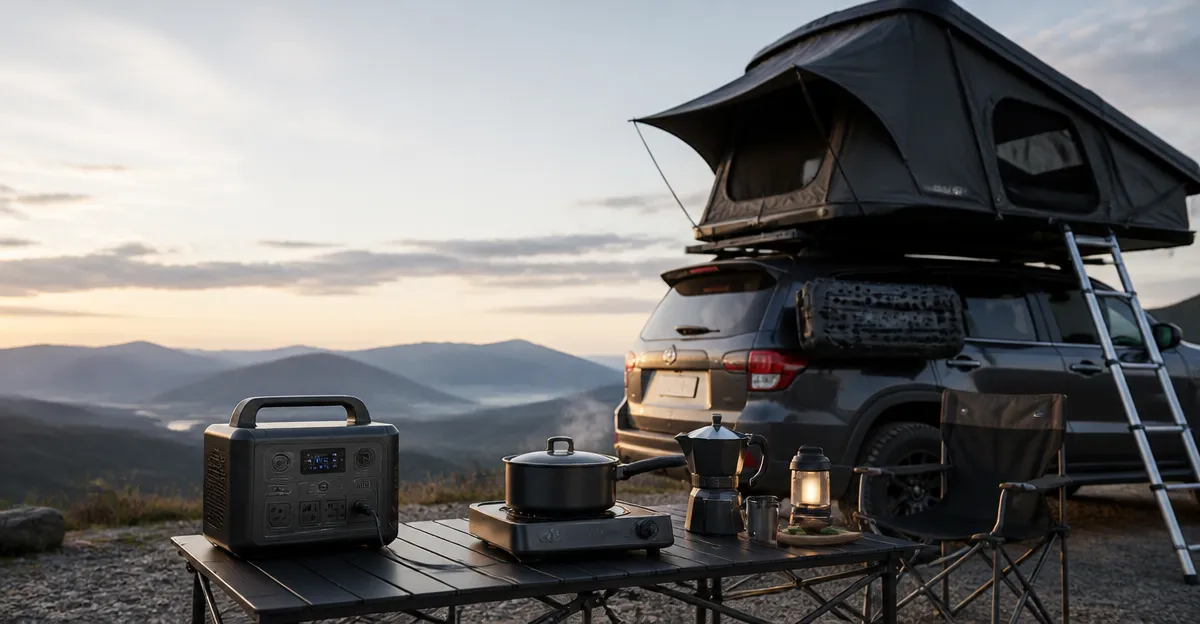
Cooking in a rooftop tent demands a power source that is both dependable and quiet. Traditional generators often produce excessive noise and emit fumes that can compromise the comfort of a campsite. Modern portable power stations provide clean, silent energy that can run induction cooktops, electric kettles, and refrigeration units without disturbing neighboring campers. Selecting the right unit requires an understanding of capacity, output power, recharge options, and durability.
Readers who are planning extended off‑grid adventures will benefit from a curated list of products that have been verified by real customers. The following listicle evaluates each recommendation based on battery capacity, continuous wattage, weight, price, and user sentiment. By the end of this article, one should be able to match a power station to a specific rooftop‑tent cooking scenario, whether the need is a lightweight companion for a weekend trip or a high‑capacity backup for a full‑week expedition.
-
High‑Capacity Kitchen Core – Anker SOLIX S2000
The Anker SOLIX S2000 delivers 2,010Wh of usable energy and a continuous 1,500W output, making it suitable for powering multiple kitchen appliances simultaneously. At 35.7 lbs, the unit is 30% lighter than comparable 2kWh stations, and its compact dimensions (8.2 × 11.1 × 12.7 in) allow it to fit beneath a rooftop tent frame. Users praise its ability to keep a refrigerator running for up to 35 hours, a critical factor for food safety on multi‑day trips.
- Price: $699.99
- Rating: 4.7/5 (309 reviews)
- Key features: 10,000‑cycle LFP battery, 3,000W peak, six charging methods, dual‑sided outlets.
Customer feedback highlights the unit’s silent operation and rapid 1.5‑hour full charge from 33% to 100% when using the fast‑charge mode. For a rooftop tent kitchen that includes an induction cooker and a small fridge, the SOLIX S2000 provides ample headroom without sacrificing portability.
-
Mid‑Range Power with Versatile Ports – Jackery Explorer 1000 v2
The Jackery Explorer 1000 v2 balances capacity (1,070Wh) with a manageable weight of 23.8 lbs. Its 1,500W continuous output and 3,000W surge capacity can handle a portable induction hot plate and a compact refrigerator at the same time. The unit includes two USB‑C ports, one USB‑A port, a DC car port, and three pure sine wave AC outlets, allowing simultaneous charging of phones, lights, and kitchen gadgets.
- Price: $499.00
- Rating: 4.7/5 (3,618 reviews)
- Key features: One‑hour fast emergency charging, 10‑year LFP lifespan, app‑controlled charging modes.
Reviewers note the reliable LED lamp and the convenience of front‑facing AC sockets for quick plug‑in during power outages. For campers who require a balance between power and portability, the Explorer 1000 v2 is a strong contender.
-
Lightweight Companion for Short Trips – Jackery Explorer 300
The Jackery Explorer 300 offers 292Wh of energy in a 7.5‑lb package, making it ideal for weekend rooftop‑tent cooking where only a few low‑draw devices are needed. Its 300W rated output (600W peak) can safely run a small electric kettle, LED lighting, and a USB‑C powered phone charger.
- Price: $259.00
- Rating: 4.6/5 (11,261 reviews)
- Key features: LiFePO4 battery, 4,000‑cycle lifespan, fast solar charging (80% in 2.8 h with 100W panel).
Customers appreciate the integrated handle and the ability to charge the unit while it powers a low‑draw load, a feature known as pass‑through charging. For a lightweight solution that does not compromise safety, the Explorer 300 excels.
-
Budget‑Friendly All‑Rounder – GRECELL 500W Power Station
The GRECELL 500W Power Station supplies 519Wh of energy at a price of $179.97, positioning it as the most economical option in this list. Its pure sine wave inverter and multiple output ports (including a 60W USB‑C PD) enable it to run a CPAP machine, a small fan, and a laptop simultaneously.
- Rating: 4.5/5 (243 reviews)
- Key features: 10‑hour runtime for a typical fridge, three‑way recharge (solar, car, wall), built‑in LED light.
Users highlight the pass‑through charging capability that allows the unit to stay powered while being recharged from a wall outlet. Although the battery chemistry is not LFP, the device still provides reliable performance for budget‑conscious campers.
-
Compact Power with Smart Management – ALLWEI 300W Power Station
The ALLWEI 300W Power Station combines a 256Wh LiFePO4 battery with a 300W continuous output in a 6.4‑lb chassis. Its six output ports, including a 60W USB‑C PD, support rapid charging of phones, tablets, and a small portable fridge.
- Price: $128.99
- Rating: 4.4/5 (2,446 reviews)
- Key features: 3,000 charge cycles, pass‑through charging, 5‑year warranty.
Customer reviews emphasize the clear display of remaining time and the robust protection system that shuts down the unit if the load exceeds 300W. For rooftop‑tent chefs who need a lightweight backup for low‑draw appliances, the ALLWEI model offers excellent value.
-
Dual‑Station Redundancy – Pairing Jackery Explorer 1000 v2 with Jackery Explorer 300
When a cooking setup includes a high‑draw induction hot plate and a small refrigerator, a single station may approach its limit. Pairing the Explorer 1000 v2 with the Explorer 300 creates a redundant system that can share load while one unit recharges. Users have reported that the combined capacity of 1,362Wh supports up to 48 hours of cooking and refrigeration on a single charge.
- Combined price: $758.00
- Combined weight: 31.3 lb
- Benefit: Ability to run high‑draw appliances while maintaining a backup reserve.
This configuration is especially useful for extended festivals or multi‑day hikes where access to solar panels may be intermittent.
-
Solar‑Optimized Setup – Anker SOLIX S2000 with 400W Solar Panels
For campers who prioritize renewable energy, the SOLIX S2000 can accept up to 400W of solar input. Pairing it with high‑efficiency panels enables a full charge in roughly 3.5 hours under full sun, according to user tests. The fast solar recharge keeps the kitchen powered throughout daylight hours without depleting the battery.
- Solar input: 400W max
- Typical solar charge time: 3.5 h (with 400W panels)
- Real‑world example: User reported cooking a steak and rice while the unit maintained 80% charge after 4 h of sun.
This arrangement is ideal for eco‑conscious adventurers who wish to minimize reliance on grid electricity.
-
Compact Emergency Backup – ALLWEI 300W with Car Charger
The ALLWEI 300W can be fully recharged via a 12V car outlet in 3.5‑4 hours, providing a rapid solution when a campsite lacks wall power. Reviewers have used the unit to keep a CPAP machine and a small LED lantern running throughout a night‑time power outage, noting the quiet operation and reliable battery indicator.
- Car charge time: 3.5‑4 h
- Battery life: Up to 10 years (3,000 cycles)
- Portability: 6.4 lb, fits easily in a rooftop‑tent storage compartment.
This setup is recommended for solo campers who need a dependable backup without the bulk of a larger station.
-
Budget Multi‑Device Solution – GRECELL 500W with USB‑C PD
The GRECELL 500W includes a 60W USB‑C PD port that can charge a laptop or a power‑hungry phone while the AC inverter supplies a small electric kettle. Users have highlighted the ability to power up to ten devices simultaneously, making it a versatile hub for a rooftop‑tent kitchen that includes a blender, a portable fan, and a Bluetooth speaker.
- Price advantage: $179.97
- Output flexibility: 2 AC, 1 USB‑C PD, 3 USB‑A QC3.0, 2 DC, 1 car port.
- Customer note: Pass‑through charging allows continuous use while the unit recharges from a wall outlet.
For campers on a limited budget who still require multiple simultaneous outputs, the GRECELL model offers a compelling balance of price and functionality.
-
Heavy‑Duty Kitchen Power – Anker SOLIX S2000 as a Stand‑Alone UPS
When a rooftop‑tent kitchen includes a small refrigerator, a portable induction cooktop, and a television, the SOLIX S2000 can act as an uninterruptible power supply (UPS). Its under‑10 ms switchover time ensures that sensitive electronics such as a laptop or a TV do not experience power interruptions. Users have reported that the unit can sustain a 200W load for approximately nine hours, sufficient for a full evening of cooking and entertainment.
- UPS mode: Automatic switch‑over within 10 ms.
- Continuous output: 1,500W (3,000W peak).
- Real‑world test: User kept a 200W load running for nine hours during a grid outage.
This configuration is best suited for groups that plan to host dinner gatherings in the wilderness and require uninterrupted power for multiple appliances.
-
Hybrid Redundancy – Combining GRECELL 500W with ALLWEI 300W
For campers who desire both high capacity and ultra‑light portability, pairing the GRECELL 500W with the ALLWEI 300W creates a hybrid system. The GRECELL provides the bulk energy for a small fridge and a fan, while the ALLWEI unit handles low‑draw devices such as lights and USB chargers. This arrangement spreads the load, reduces the risk of over‑draw, and extends overall runtime.
- Total capacity: 775Wh
- Combined weight: ~13 lb
- Benefit: Redundant power paths and flexible placement within the tent.
Customer anecdotes describe using this dual setup to power a 12‑hour cooking marathon with minimal recharging interruptions.
Comparison Table
| Model | Capacity (Wh) | Continuous Output (W) | Weight (lb) | Price (USD) | Rating |
|---|---|---|---|---|---|
| Anker SOLIX S2000 | 2,010 | 1,500 | 35.7 | 699.99 | 4.7 |
| Jackery Explorer 1000 v2 | 1,070 | 1,500 | 23.8 | 499.00 | 4.7 |
| Jackery Explorer 300 | 292 | 300 | 7.5 | 259.00 | 4.6 |
| GRECELL 500W | 519 | 500 | ?? | 179.97 | 4.5 |
| ALLWEI 300W | 256 | 300 | 6.4 | 128.99 | 4.4 |
Conclusion
Rooftop‑tent cooking setups benefit from power stations that are quiet, reliable, and capable of handling multiple appliances. The ten configurations presented above illustrate how capacity, weight, and price can be balanced to meet a wide range of culinary needs. For high‑energy kitchens, the Anker SOLIX S2000 stands out as the most powerful and feature‑rich option. For budget‑conscious campers, the GRECELL 500W Power Station delivers solid performance at a low price point. Meanwhile, the ALLWEI 300W Power Station offers an ultra‑light solution for low‑draw devices.
By matching the recommended configuration to the specific power demands of a rooftop‑tent kitchen, campers can enjoy uninterrupted cooking, safe food storage, and a comfortable campsite atmosphere.
Frequently Asked Questions
What wattage should a portable power station have to run an induction cooktop in a rooftop tent?
Choose a unit with at least 1500 W continuous output to handle most 1800‑2000 W induction cooktops safely.
How many amp‑hours are needed for a weekend rooftop‑tent cooking trip?
A 500‑Ah (at 12 V) battery or roughly 600 Wh provides enough energy for a few meals and a small fridge over 2‑3 days.
Can portable power stations be recharged while camping off‑grid?
Yes, many models support solar panels, car chargers, or AC adapters, allowing flexible recharging without grid power.
Are portable power stations quieter than traditional generators?
They operate silently because they use lithium‑ion batteries, producing no exhaust or engine noise.
What factors affect the weight of a portable power station for rooftop‑tent use?
Battery capacity, enclosure material, and built‑in inverter size determine weight; higher‑capacity units are heavier but offer longer runtimes.