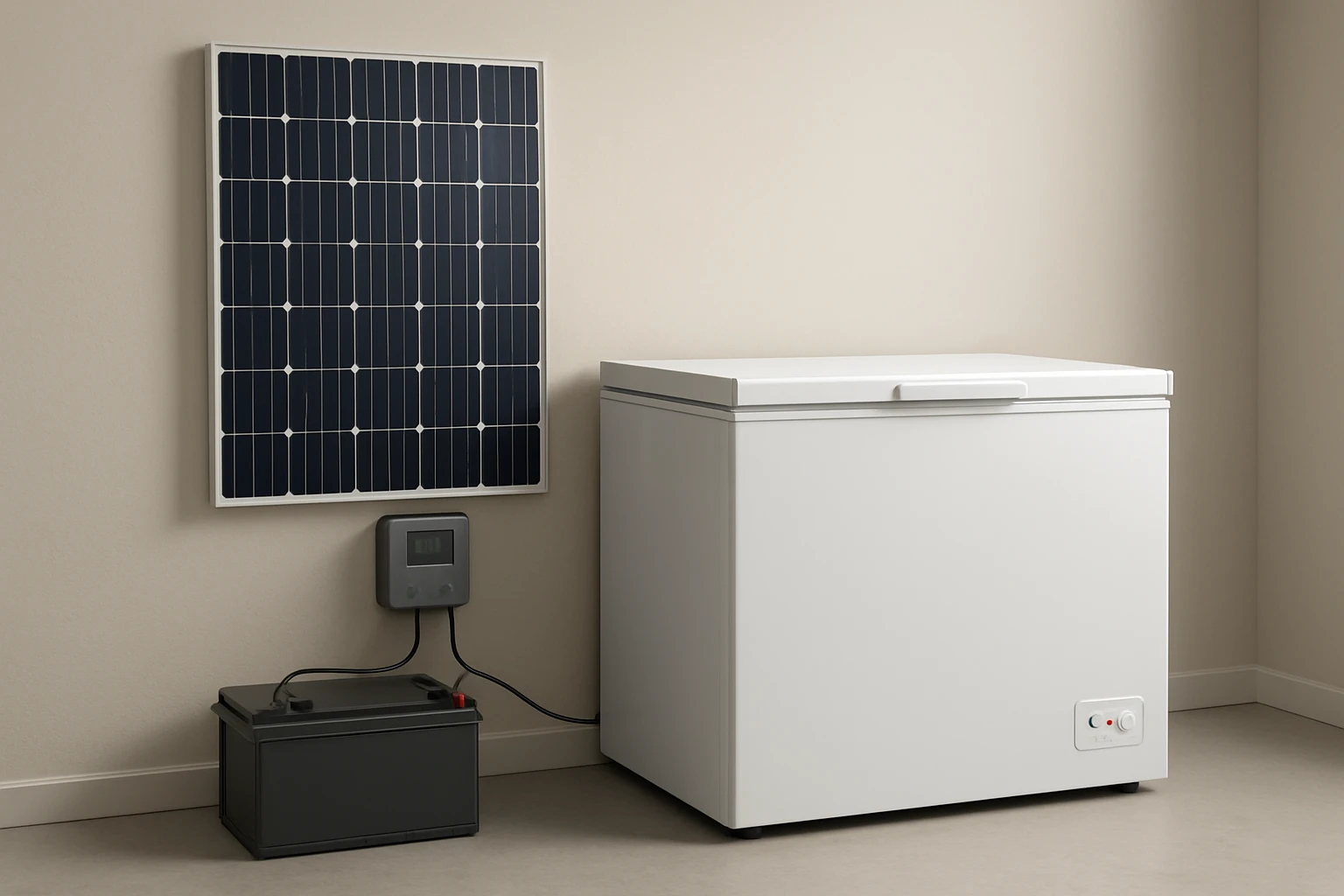
How to Power a Chest Freezer Off-Grid with Solar: Sizing Panels, Batteries, and Cost‑Saving Tips
Introduction
Operating a chest freezer in a remote cabin, RV, or off‑grid workshop requires a dependable energy source that can handle continuous loads. This guide explains how to calculate the energy demand of a typical freezer, select appropriately sized solar panels, choose batteries that provide sufficient reserve, and integrate an inverter for AC appliances. Readers will also discover practical cost‑saving strategies and product recommendations that simplify installation and improve reliability. By the end of the article, one will be equipped to design a solar system that keeps food frozen without relying on the utility grid.
Background and Context
Chest freezers are popular for off‑grid use because they retain cold for many hours even when power is interrupted. However, they draw a significant amount of power, especially during the compressor start‑up cycle, which can exceed the average running current. Understanding the distinction between continuous draw and surge demand is essential for selecting a charge controller and inverter that will not overload the system. Additionally, solar generation varies with geographic location, seasonal sun angle, and weather, so designers must incorporate a safety margin to ensure reliable operation throughout the year.
Estimating Freezer Energy Consumption
The first step is to determine the daily kilowatt‑hour (kWh) requirement of the freezer. A typical 14‑cubic‑foot chest freezer consumes about 1.5 kWh per day when operating at a 12‑V system, though this value can range from 1.2 kWh to 2.0 kWh depending on insulation and ambient temperature. To calculate, multiply the rated wattage (often 50‑70 W) by the number of operating hours per day, then add a 20 % buffer for start‑up surges. For example, a 60 W freezer running 24 hours uses 1.44 kWh; adding 20 % yields approximately 1.73 kWh per day.
Solar Panel Sizing
Solar panels must generate enough energy to meet the daily freezer load while accounting for system losses, which typically amount to 15‑20 % due to wiring resistance, charge‑controller inefficiency, and temperature derating. Assuming a 20 % loss, the required array output becomes 1.73 kWh ÷ 0.80 ≈ 2.16 kWh per day. In locations that receive an average of 5 peak sun hours per day, the necessary panel wattage is 2.16 kWh ÷ 5 h ≈ 432 W. Therefore, a 400 W array provides a solid baseline, and adding a modest margin (e.g., a 500 W system) ensures reliable performance during cloudy periods.
Choosing the Right Charge Controller
For a 400 W array, a PWM controller rated for at least 30 A is sufficient, but an MPPT controller offers higher efficiency, especially when panel voltage exceeds battery voltage. The Renogy 400W Premium Solar Kit includes a 40 A MPPT charge controller, which tracks the maximum power point with 99 % efficiency and reduces energy loss compared with traditional PWM units. This controller also provides temperature‑compensated charging, protecting AGM, Gel, Flooded, and Lithium batteries from over‑charging during hot weather.
Battery Bank Sizing
Battery capacity must cover the freezer’s energy demand for at least one full day of autonomy, plus an additional reserve for cloudy days. Using the 1.73 kWh daily requirement and a 12 V battery bank, the amp‑hour (Ah) needed is 1.73 kWh ÷ 12 V ≈ 144 Ah. To preserve battery life, it is advisable to limit depth‑of‑discharge (DoD) to 50 % for lead‑acid chemistries, which doubles the required capacity to roughly 288 Ah. A common configuration is two 12 V, 150 Ah AGM batteries wired in parallel, providing 300 Ah and satisfying the 50 % DoD guideline.
Inverter Selection for AC Loads
While a chest freezer can operate directly on DC, many users prefer to run it from a standard AC outlet for convenience and compatibility with existing appliances. The inverter must handle the continuous power draw (approximately 60 W) and the surge demand, which can reach 200‑300 W during compressor start‑up. The Renogy 1000W Pure Sine Wave Inverter supplies 1000 W continuous power and 2000 W peak surge, far exceeding the freezer’s requirements and allowing additional AC devices such as lights or a small heater. Its pure sine wave output protects sensitive electronics, and the built‑in USB port simplifies charging of mobile devices.
Integrating the System: A Practical Example
Consider an RV owner who wishes to power a 14‑cubic‑foot freezer while traveling off‑grid. The owner selects the Renogy 100W Solar Panel Starter Kit as a starter, then expands to the 400 W Premium Kit for full‑time use. The 100 W kit provides a quick entry point, delivering an average of 500 Wh per day under optimal conditions, which can sustain a small freezer for short trips. For longer expeditions, the 400 W kit supplies roughly 2 kWh daily, comfortably covering the freezer’s demand plus auxiliary loads such as lighting and a small refrigerator.
Comparison and Selection Guide
| Feature | Renogy 100W Starter Kit | Renogy 400W Premium Kit | Renogy 1000W Inverter |
|---|---|---|---|
| Panel Power | 100 W monocrystalline | 4 × 100 W monocrystalline (400 W total) | N/A (DC‑AC conversion) |
| Charge Controller | 30 A PWM | 40 A MPPT (99 % tracking efficiency) | N/A |
| Peak Surge Capacity | Not applicable | Not applicable | 2000 W |
| Continuous Power Output | Not applicable | Not applicable | 1000 W |
| Price (USD) | $119.99 | $520.99 | $175.99 |
| Rating | 4.6/5 (6,130 reviews) | 4.5/5 (1,920 reviews) | 4.3/5 (4,472 reviews) |
| Ideal Use Case | Entry‑level, small‑load RV or camper | Full‑time off‑grid power for freezer, lighting, and tools | Running AC appliances, including freezers, from a 12 V battery bank |
The table above highlights the strengths of each product. For users who need only modest power, the 100 W starter kit offers a low‑cost entry point with a reliable PWM controller. Those requiring higher daily generation should invest in the 400 W premium kit, which pairs a high‑efficiency MPPT controller with robust mounting hardware. Finally, the 1000 W pure sine wave inverter is essential when the freezer or other appliances require AC power, ensuring clean electricity that protects sensitive electronics.
Best Practices & Cost‑Saving Tips
- Size the solar array with at least a 20 % oversize factor to accommodate seasonal variations and shading.
- Use high‑quality, appropriately gauged cables (e.g., 10 AWG for 30 A PWM, 4 AWG for 40 A MPPT) to minimize voltage drop.
- Install panels at a tilt angle equal to the latitude of the location for optimal year‑round production.
- Employ a battery management system (BMS) for lithium batteries to extend cycle life and improve safety.
- Take advantage of Renogy’s Bluetooth monitoring modules to track real‑time voltage, current, and state‑of‑charge, reducing the risk of over‑discharge.
- Combine the inverter with an automatic transfer switch (ATS) if the freezer will be used alongside grid power, ensuring seamless transition during outages.
Implementing these practices not only improves system reliability but also reduces long‑term operating costs by preventing premature component failure. Additionally, purchasing the kits directly from Amazon often provides free shipping and access to customer reviews that can guide installation nuances.
Frequently Asked Questions
- How many solar panels are needed for a 14‑cubic‑foot freezer? A 400 W array (four 100 W panels) typically supplies enough energy for a freezer that consumes about 1.5‑2 kWh per day, plus a margin for other loads.
- Can a PWM controller handle the start‑up surge of a freezer? Yes, provided the controller’s amperage rating exceeds the peak current; a 30 A PWM controller is adequate for a single 100 W panel, while a 40 A MPPT controller offers additional headroom for larger arrays.
- What battery type is best for off‑grid freezers? AGM or Lithium Iron Phosphate (LiFePO4) batteries provide high cycle life and low self‑discharge; AGM is cost‑effective, while LiFePO4 offers deeper DoD without sacrificing lifespan.
- Do I need an inverter if my freezer runs on 12 V DC? Not necessarily; many chest freezers are available in 12 V DC models. However, an inverter enables the use of standard AC freezers and other appliances, offering greater flexibility.
- How often should I check the system’s performance? Weekly monitoring of voltage, current, and state‑of‑charge is advisable, especially during seasonal transitions. The Renogy Bluetooth module simplifies this task by providing mobile alerts.
- Is it safe to install panels on a moving vehicle? Panels designed for RVs include vibration‑resistant brackets and weather‑proof connectors (IP65/67). Properly secured Z‑brackets, as supplied with the kits, ensure durability while traveling.
- What is the expected lifespan of the solar panels? Renogy offers a 25‑year power output warranty, indicating that panels will retain at least 80 % of their rated capacity after that period.
Conclusion
Powering a chest freezer off‑grid with solar energy is a feasible and cost‑effective solution when the system is correctly sized and components are chosen wisely. By calculating the freezer’s daily consumption, selecting a suitably oversized solar array, pairing it with a high‑efficiency MPPT charge controller, and using a pure sine wave inverter, users can achieve reliable refrigeration without grid dependence. The Renogy product line—100 W Starter Kit, 400 W Premium Kit, and 1000 W Pure Sine Wave Inverter—provides a cohesive ecosystem that simplifies design, installation, and monitoring. With the best‑practice tips and FAQs presented herein, readers are prepared to implement a robust off‑grid freezer solution that safeguards food, reduces energy costs, and enhances overall independence.
Products Featured in This Guide
Renogy 100W Solar Panel Starter Kit
Price: $119.99 | Rating: 4.6/5 (6,130 reviews)
Featured because it offers an affordable entry point for users who need a compact, easy‑to‑install solar solution that can power a small freezer or serve as a starter for future expansion.
Renogy 400W Premium Solar Kit
Price: $520.99 | Rating: 4.5/5 (1,920 reviews)
Featured because its 400 W array and 40 A MPPT charge controller provide the power and efficiency needed for continuous freezer operation and additional off‑grid loads.
Renogy 1000W Pure Sine Wave Inverter
Price: $175.99 | Rating: 4.3/5 (4,472 reviews)
Featured because it delivers clean AC power with sufficient surge capacity for freezer compressors, ensuring reliable operation of standard household appliances off‑grid.