Introduction
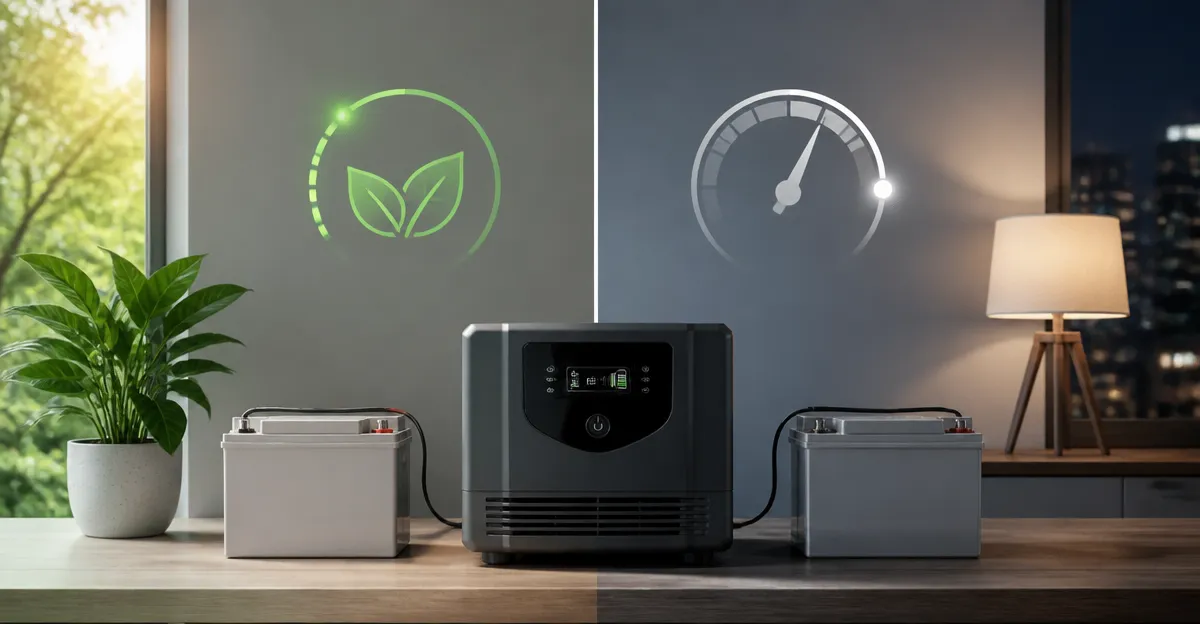
Inverter technology has become essential for travelers, remote workers, and emergency preparedness. This guide explains the difference between Eco Mode and Normal Mode, and how each setting influences runtime. Readers will learn the underlying principles, see real‑world product examples, and acquire actionable strategies to maximize backup time. By the end of the article, one will be equipped to select the most appropriate inverter for any application.
Background and Context
Inverters convert low‑voltage DC power from a vehicle battery or solar panel into usable 110‑120V AC power. The conversion process inevitably generates heat and draws current, which reduces the available energy stored in the battery. Eco Mode reduces the inverter's output power or adjusts the internal switching frequency to lower consumption, thereby extending the time a battery can sustain a load. Normal Mode prioritizes full power delivery and rapid response, which is useful for high‑demand devices but shortens runtime. Understanding these trade‑offs is critical for anyone relying on portable power.
Understanding Eco Mode and Normal Mode
Eco Mode typically limits continuous output to a fraction of the inverter's rated capacity, often between 30% and 60%. By operating below peak capacity, the inverter generates less heat and draws less current, which conserves battery life. Normal Mode removes these limits, allowing the inverter to provide its full rated wattage, such as 300 W or 400 W, at the expense of higher energy consumption. The choice between modes depends on the load profile: low‑power devices like phones and LED lights benefit from Eco Mode, while laptops or power tools may require Normal Mode.
Many modern inverters incorporate automatic switching, detecting when the load falls below a threshold and entering Eco Mode without user intervention. However, manual control remains valuable when the user knows the upcoming power demand. Selecting the appropriate mode can increase backup time by 20% to 50%, depending on the inverter efficiency and battery capacity.
How Eco Mode Impacts Inverter Runtime
Runtime is a function of battery capacity (amp‑hours), inverter efficiency, and the power draw of connected devices. Eco Mode improves efficiency by reducing internal losses, which translates directly into longer operation. For example, a 12 V 100 Ah battery paired with a 300 W inverter operating in Normal Mode may sustain a 150 W load for approximately 2.5 hours. The same setup in Eco Mode, with a 40% reduction in draw, could extend runtime to over 3.5 hours.
Temperature also plays a role. Inverters that run cooler in Eco Mode experience less thermal throttling, maintaining stable voltage output for longer periods. This stability is especially important for sensitive electronics such as medical devices or laptops, where voltage fluctuations can cause data loss or hardware damage.
Choosing the Right Inverter for Backup Power
When selecting an inverter, consider the maximum continuous wattage required, the availability of Eco Mode, and the quality of protection circuitry. The following products illustrate a range of capabilities that align with different use cases.
- BESTEK 300W Car Power Inverter offers 300 W continuous power, dual USB fast‑charging ports, and a durable aerospace aluminum housing. Its 5‑year warranty and built‑in 40 A fuse provide confidence for extended road trips.
- PiSFAU 200W Car Power Inverter combines two AC outlets with four USB ports, including a USB‑C fast‑charging option. Its quiet, high‑efficiency design makes it suitable for camping where noise reduction is valued.
- BELTTT 2000W Pure Sine Inverter delivers 2000 W continuous power and a pure sine wave output, essential for sensitive electronics such as home theater systems. The intelligent LCD display and remote controller add convenience for off‑grid installations.
- Pro Chaser 400W Car Power Inverter provides a 65 W USB‑C PD port alongside dual AC outlets, delivering fast charging for modern smartphones while maintaining a compact form factor.
- LANDERPOW 3000W Pure Sine Inverter is designed for heavy‑duty applications, offering three AC outlets, a 30 W USB‑C PD port, and a hard‑wire terminal for high‑current tools. Its robust copper cables and remote monitoring system ensure reliable performance in RVs and trucks.
Comparison and Selection Guide
| Feature | BESTEK 300W | PiSFAU 200W | BELTTT 2000W | Pro Chaser 400W | LANDERPOW 3000W |
|---|---|---|---|---|---|
| Continuous Power | 300 W | 200 W | 2000 W | 400 W | 3000 W |
| Surge Capacity | 700 W | 200 W (no surge spec) | 4000 W | 800 W | 6000 W |
| USB Ports | 2 × 4.8 A | 4 (incl. USB‑C) | 5 V 2.1 A | USB‑A 18 W, USB‑C 65 W | USB‑C 30 W, USB‑A 3.1 A |
| Pure Sine Wave | No | No | Yes | No | Yes |
| Price (USD) | 26.99 | 22.95 | 179.99 | 29.98 | 219.99 |
| Average Rating | 4.5 | 4.4 | 4.5 | 4.5 | 4.4 |
For users who need modest power for laptops and phones, the BESTEK 300W Car Power Inverter offers an excellent balance of price and features. Those requiring a quieter, more efficient unit for camping may prefer the PiSFAU 200W Car Power Inverter. For off‑grid homeowners or professionals who must run sensitive equipment, the BELTTT 2000W Pure Sine Inverter and LANDERPOW 3000W Pure Sine Inverter provide the necessary waveform quality and surge capacity. The Pro Chaser 400W Car Power Inverter stands out for users who value fast USB‑C charging alongside moderate AC power.
Best Practices & Tips to Maximize Backup Time
- Enable Eco Mode whenever the load is below 50% of the inverter’s rated capacity. This simple adjustment can extend runtime by up to 40%.
- Use high‑capacity, low‑internal‑resistance batteries such as lithium‑iron‑phosphate (LiFePO4) cells. They discharge more evenly and sustain higher currents without excessive voltage sag.
- Keep the inverter well‑ventilated. Even in Eco Mode, prolonged operation generates heat; adequate airflow prevents thermal throttling.
- Prioritize essential loads. Disconnect non‑critical devices such as decorative lighting to conserve power for communication equipment and medical devices.
- Employ a smart power strip with individual outlet monitoring. This allows the user to shut off idle devices without unplugging them manually.
- Regularly inspect and tighten all battery connections. Loose terminals increase resistance, reducing overall efficiency and potentially causing overheating.
- Consider using a remote monitoring system, such as the one included with the LANDERPOW 3000W Pure Sine Inverter, to track voltage and load in real time and prevent deep discharge.
Frequently Asked Questions
1. Does Eco Mode affect the quality of the AC waveform?
Eco Mode typically reduces the inverter’s switching frequency, which can slightly increase total harmonic distortion. For most low‑sensitivity devices, this change is negligible. However, pure sine wave inverters such as the BELTTT and LANDERPOW models maintain waveform quality even in Eco Mode, making them suitable for audio‑visual equipment.
2. Can I switch between Eco and Normal Mode while the inverter is running?
Most modern inverters allow on‑the‑fly mode changes via a button or mobile app. The transition is seamless, but it is advisable to reduce the load before switching to Normal Mode to avoid sudden voltage dips.
3. How much battery capacity is needed for a 24‑hour backup?
Assuming an average load of 150 W and an inverter efficiency of 90%, the required energy is 150 W × 24 h ÷ 0.9 ≈ 4,000 Wh. At 12 V, this translates to roughly 333 Ah of battery capacity. Using Eco Mode can lower the required capacity by up to 30%.
4. Are pure sine wave inverters always better than modified sine wave units?
Pure sine wave inverters produce a waveform identical to utility power, which protects sensitive electronics and reduces audible humming in audio equipment. Modified sine wave units are less expensive but may cause overheating or reduced performance in certain devices. For critical backup scenarios, a pure sine wave inverter is recommended.
5. Does the size of the inverter affect its efficiency?
Larger inverters often incorporate more robust cooling systems and higher‑quality components, which can improve efficiency at higher loads. However, when operating well below their rated capacity, smaller units such as the BESTEK 300W or PiSFAU 200W may achieve comparable or better efficiency due to lower internal losses.
Conclusion
Eco Mode and Normal Mode each serve distinct purposes, and understanding their impact on runtime is essential for effective power management. By selecting an inverter that matches the intended load, enabling Eco Mode when appropriate, and following best‑practice maintenance, users can significantly extend backup time. The products highlighted in this guide illustrate a spectrum of solutions, from budget‑friendly car adapters to high‑power pure sine wave units for off‑grid living.
Products Featured in This Guide
BESTEK 300W Car Power Inverter
Price: $26.99 | Rating: 4.5/5 (33,915 reviews)
Featured for its compact aluminum housing, dual USB fast‑charging ports, and 5‑year warranty, making it ideal for road trips and camping.
PiSFAU 200W Car Power Inverter
Price: $22.95 | Rating: 4.4/5 (5,003 reviews)
Featured for its quiet high‑efficiency design, four USB ports including USB‑C, and portable dimensions suitable for camping.
BELTTT 2000W Pure Sine Inverter
Price: $179.99 | Rating: 4.5/5 (618 reviews)
Featured for its high continuous power, pure sine wave output, intelligent LCD display, and remote controller for off‑grid installations.
Pro Chaser 400W Car Power Inverter
Price: $29.98 | Rating: 4.5/5 (352 reviews)
Featured for its 65 W USB‑C PD port, dual AC outlets, and compact design, providing fast charging for modern mobile devices.
LANDERPOW 3000W Pure Sine Inverter
Price: $219.99 | Rating: 4.4/5 (573 reviews)
Featured for its massive 3000 W continuous output, three AC outlets, 30 W USB‑C fast charging, and remote LED monitor for heavy‑duty RV and truck applications.