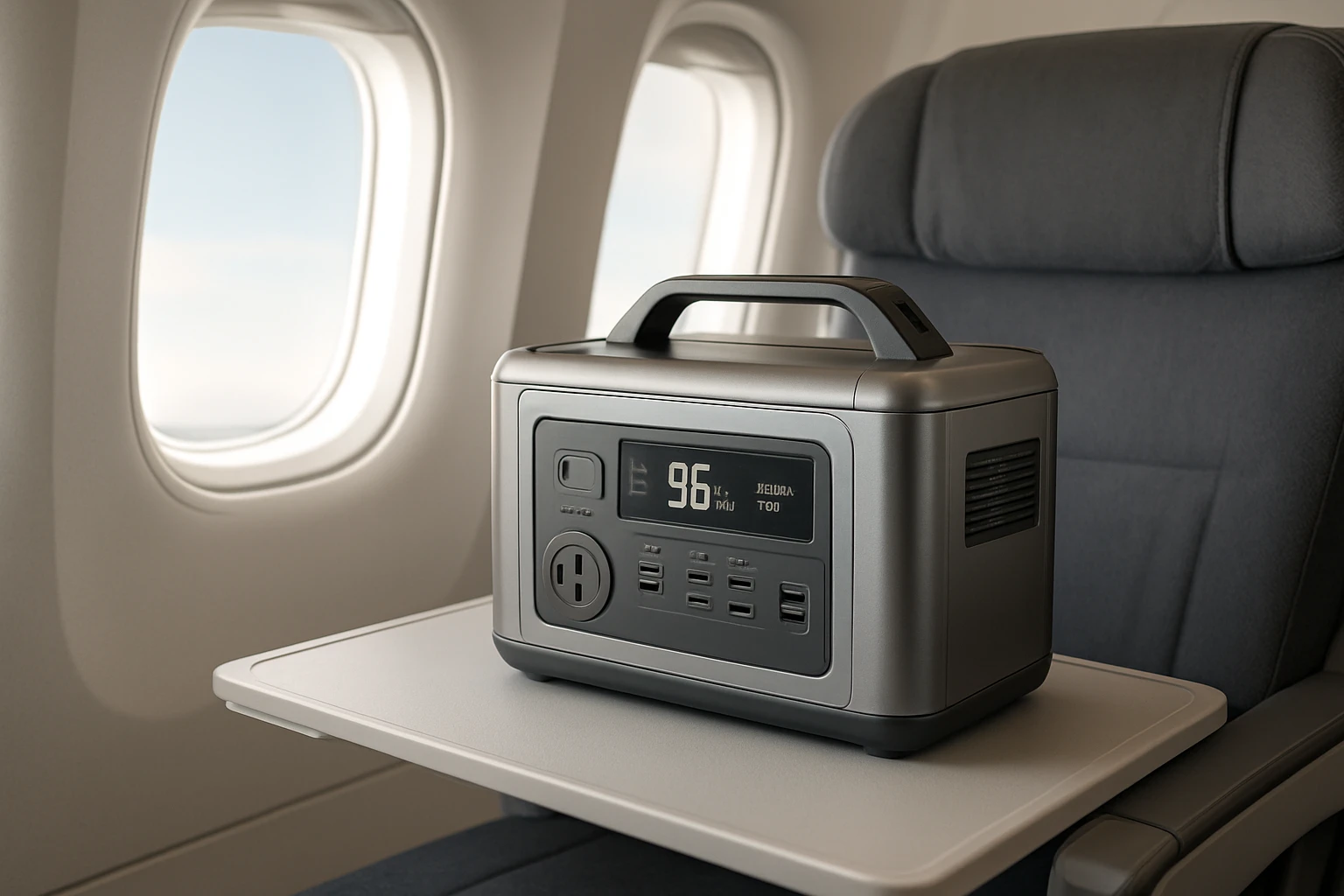
Flying with Portable Power Stations: 2026 FAA Guide to Battery Limits, Carry‑On Rules & TSA Tips
Introduction
The modern traveler frequently relies on portable power stations to keep devices charged during long layovers, remote destinations, or unexpected delays. In 2026 the Federal Aviation Administration (FAA) and Transportation Security Administration (TSA) have clarified battery capacity limits, carry‑on procedures, and safety protocols for lithium‑ion power packs. This guide explains the regulatory framework, outlines the steps required to travel with a power station, and recommends two proven models—the Jackery Explorer 300 and the HOWEASY 120W Portable Power Station—that meet FAA specifications while delivering reliable performance.
Readers will learn how to interpret watt‑hour (Wh) limits, how to pack and declare a power station, and which accessories simplify airport security checks. The information is intended for frequent flyers, digital nomads, and emergency‑preparedness enthusiasts who require off‑grid power without violating airline policies.
Background and Context
Since the introduction of the 2020 FAA Battery Guidance, airlines have required that all spare lithium‑ion batteries be carried in the cabin, never in checked baggage. The rule is expressed in two numeric thresholds: batteries up to 100 Wh may be transported without airline approval, while those between 100 Wh and 160 Wh require written consent from the carrier. Batteries exceeding 160 Wh are prohibited on passenger aircraft.
Portable power stations differ from small power banks because they contain internal battery packs that can range from 50 Wh to 500 Wh. The FAA treats the entire unit as a single battery, so the total Wh rating printed on the device determines its admissibility. In addition, the TSA screens for damaged cells, exposed terminals, or signs of overheating.
Understanding these limits is essential because a traveler who inadvertently brings a 300 Wh generator into checked luggage may face confiscation, flight delays, or fines. The following sections break down the rules, explain how to calculate Wh, and provide practical steps for compliance.
Key Concepts and Airline Policies
Watt‑hour calculation: Wh = (Voltage V × Ampere‑hours Ah). Most manufacturers list the Wh rating directly on the product label; if only Ah is provided, multiply by the nominal voltage (usually 3.7 V for lithium‑ion cells) to obtain Wh.
Carry‑on versus checked baggage: All power stations must be placed in a carry‑on bag, preferably a dedicated insulated sleeve. The device should be turned off, with all ports covered, to prevent accidental discharge.
Airline notification: For units between 100 Wh and 160 Wh, contact the airline at least 24 hours before departure. Provide the model name, Wh rating, and a copy of the product specification sheet. Most carriers will issue a written approval that can be shown at the gate.
Safety features to look for: Built‑in battery management systems (BMS), over‑temperature protection, short‑circuit protection, and pure sine‑wave inverters are hallmarks of flight‑compatible devices. These features reduce the risk of thermal runaway, a primary concern for regulators.
Recommended Products for Air Travel
Two power stations stand out for meeting FAA limits while offering versatile output options for travelers.
Jackery Explorer 300
The Jackery Explorer 300 is a 293 Wh lithium‑ion power station that falls just below the 300 Wh ceiling, making it permissible for carry‑on without airline approval. Its key specifications include:
- 293 Wh capacity, 300 W continuous output, 500 W peak
- Two pure sine‑wave AC outlets, 60 W USB‑C PD port, fast‑charge 3.0 USB‑A, and a 12 V DC car port
- Recharges to 80 % in approximately two hours via wall outlet and PD USB‑C simultaneously
- Weight: 7.1 lb, compact dimensions suitable for a standard carry‑on bag
- 4.6‑star rating from 11,170 reviews, indicating high reliability
Its integrated MPPT controller accelerates solar recharging when paired with the optional Jackery SolarSaga 100 panel (sold separately). The device also supports pass‑through charging, allowing simultaneous solar input and device output—an advantage on long flights with limited ground power.
HOWEASY 120W Portable Power Station
The HOWEASY 120W Portable Power Station offers an 88 Wh battery, comfortably within the 100 Wh unrestricted limit. Its notable features are:
- 88 Wh capacity, 120 W continuous AC output (240 W peak)
- Eight output ports: two AC sockets, USB‑C (18 W), two QC 3.0 USB‑A, standard USB‑A, and two 12 V DC ports
- LED display indicating remaining power and charging status
- Weight: 2.3 lb, dimensions 6.6 × 4 × 3 in, making it ideal for backpack travel
- 4.3‑star rating from 1,382 reviews, reflecting solid user satisfaction
Its three recharging modes—AC adapter, car charger, and solar panel (15–24 V, not included)—provide flexibility for both domestic flights and international itineraries where ground power may be unavailable.
Comparison and Selection Guide
| Feature | Jackery Explorer 300 | HOWEASY 120W Portable Power Station |
|---|---|---|
| Battery Capacity (Wh) | 293 Wh | 88 Wh |
| FAA Category | 100‑160 Wh (requires carrier approval only if >100 Wh) | ≤100 Wh (no approval needed) |
| Continuous AC Output | 300 W (pure sine wave) | 120 W (peak 240 W) |
| Port Variety | 2 AC, 1 USB‑C PD, 1 fast‑charge USB‑A, 1 USB‑A, 1 DC car | 2 AC, 1 USB‑C, 2 QC 3.0 USB‑A, 1 USB‑A, 2 DC |
| Weight | 7.1 lb | 2.3 lb |
| Price (USD) | $189.00 | $59.98 |
| User Rating | 4.6/5 (11,170 reviews) | 4.3/5 (1,382 reviews) |
Choosing between the two depends on travel style. The Jackery Explorer 300 is suited for longer trips, remote workstations, or families that need to power multiple devices simultaneously. The HOWEASY model excels for lightweight backpackers, short‑haul business travelers, or anyone who prefers a device that requires no carrier approval.
Best Practices & Tips for Airport Security
- Verify the Wh rating before packing. Locate the label on the power station or consult the manufacturer’s spec sheet. If the rating is ambiguous, calculate using V × Ah.
- Carry documentation. Print a one‑page spec sheet that includes the model name, Wh rating, and a photo of the label. Present this at security if requested.
- Turn the unit off and protect ports. Use the built‑in power‑off switch and cover all outlets with the supplied caps or tape to prevent accidental activation.
- Store in a dedicated sleeve. A hard‑shell or padded case isolates the battery from other items and reduces the chance of damage during handling.
- Declare the device at the gate. Even if the unit is under 100 Wh, informing the gate agent eliminates confusion and speeds up boarding.
- Plan for recharging. Bring a compact AC adapter (such as the one included with the Jackery Explorer 300) and, if possible, a lightweight solar panel for layovers where power outlets are scarce.
- Know airline‑specific rules. Some carriers, such as Delta and United, have online forms for battery approval; others require a printed letter. Check the airline website 48 hours before departure.
Frequently Asked Questions
- Can I bring a power station larger than 160 Wh in my carry‑on? No. Batteries exceeding 160 Wh are prohibited on passenger aircraft, regardless of airline approval.
- Do I need to remove the battery from the power station? No. The FAA treats the entire device as a single battery pack; removing internal cells is not required and may void the warranty.
- Is solar charging allowed on the tarmac? Yes, provided the solar panel is turned off and stored in the carry‑on bag. The panel itself is not a battery and therefore does not fall under the Wh limits.
- What happens if the power station shows an error code at security? Explain that the device includes a certified BMS and show the printed spec sheet. Security personnel may perform a visual inspection but will not power the unit.
- Can I use the power station during the flight? Most airlines prohibit the use of external power sources that draw from the cabin’s power supply. However, you may use the unit to charge personal devices while it is turned off, provided the aircraft’s Wi‑Fi or seat‑back power is not used.
- Are there differences between US and EU regulations? EU rules also limit spare lithium batteries to 100 Wh without carrier approval, but some European carriers allow up to 160 Wh with documentation. Always verify the destination country’s guidelines.
Conclusion
Traveling with a portable power station in 2026 is straightforward once the FAA’s Wh thresholds and TSA security procedures are understood. By selecting a compliant device—such as the 293 Wh Jackery Explorer 300 for heavier power needs or the 88 Wh HOWEASY 120W Portable Power Station for ultra‑light travel—passengers can maintain connectivity, power essential electronics, and avoid costly airport delays. Remember to turn the unit off, keep it in a dedicated carry‑on sleeve, and carry a printed spec sheet. With these practices, the traveler gains the confidence of uninterrupted power while remaining fully compliant with airline safety standards.
Products Featured in This Guide
Jackery Explorer 300
Price: $189.00 | Rating: 4.6/5 (11,170 reviews)
Featured for its 293 Wh capacity, pure sine‑wave inverter, and rapid dual‑input charging, making it ideal for travelers who need substantial power while remaining within the FAA’s 100‑160 Wh carry‑on category.
HOWEASY 120W Portable Power Station
Price: $59.98 | Rating: 4.3/5 (1,382 reviews)
Featured for its lightweight 88 Wh battery, eight versatile output ports, and sub‑100 Wh rating that requires no airline approval, perfect for backpackers and short‑haul flyers.