Introduction
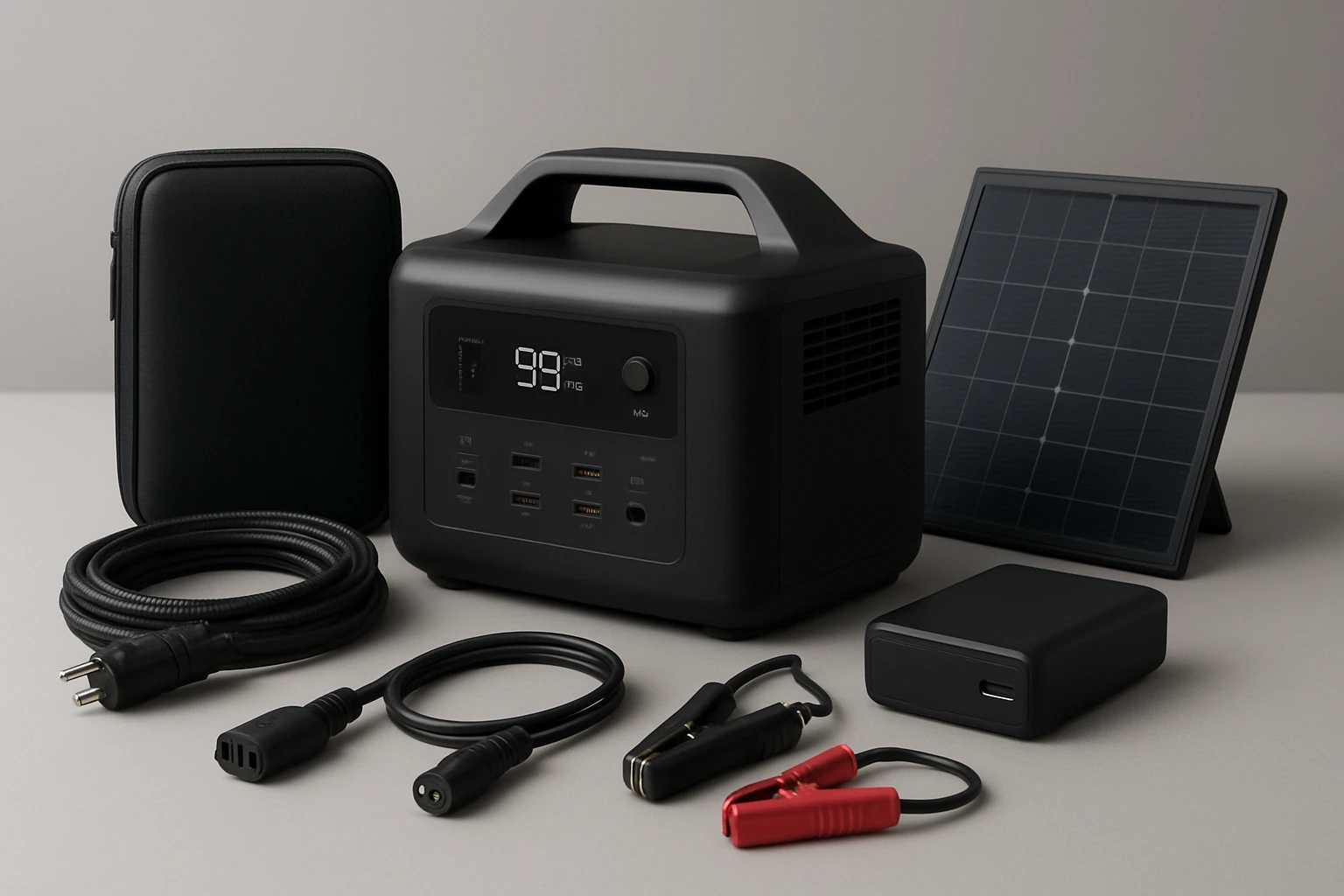
Portable power stations have become indispensable for outdoor enthusiasts, emergency preparedness, and mobile professionals. They provide reliable electricity wherever the grid is unavailable, yet their true potential is unlocked only when paired with the right accessories.
Choosing accessories that complement the power station ensures efficient energy transfer, protects valuable equipment, and expands the range of possible applications. The following list presents twelve must‑have accessories, each supported by real‑world feedback and concrete specifications.
12 Essential Accessories
-
High‑Current Solar to SAE Extension Cable
The ability to connect a solar panel directly to a portable power station without excessive voltage drop is critical for fast recharging. The Goupchn Solar to SAE Adapter offers a 10AWG tinned copper conductor that reduces power loss and supports up to 50 A at 600 V. Priced at $9.99 and backed by a 4.7‑star rating from 155 reviews, it provides excellent value for budget‑conscious users.
Key specifications include a 60 cm (2 ft) length, a dust‑proof SAE connector with a protective cap, and two polarity‑reversal adapters that accommodate varying panel configurations. A satisfied customer noted, "Nice heavy high quality wire. Worked perfectly for me as I have a mix of 100 W SAE panels and 100‑520 W MC4 panels." The inclusion of polarity adapters eliminates the need for custom wiring, allowing quick adaptation to different solar setups.
- 10 AWG tinned copper wire reduces resistance.
- Rated for 50 A current and 600 V voltage.
- Dust‑cap protects the SAE connector from moisture.
- Two polarity‑reversal adapters for flexible connections.
-
Universal 7‑in‑1 Solar Connector Kit
When a user owns multiple solar panels or power stations, a single cable that supports many connector types simplifies the charging process. The Tonton 7‑in‑1 Solar Panel Connector Kit delivers exactly that versatility. At $18.89 with a 4.6‑star rating from 228 reviews, it includes adapters for DC7.9×0.9 mm, DC6.5×3.0 mm, DC5.5×2.1 mm, DC3.5×1.35 mm, Anderson, XT60, and DC8.0×2.0 mm connectors.
The cable measures 110 cm and uses a combination of 12 AWG and 14 AWG heavy‑duty copper wire, providing low loss and high current capability. Users appreciate the built‑in lock on the male solar connector, which ensures a secure connection that does not loosen during travel. One reviewer wrote, "This is a high‑quality, very versatile connector. I was so pleased with the first one that I bought a second. It easily connects to every solar generator I own."
- Seven adapter types cover most portable power stations.
- 12 AWG/14 AWG copper for low resistance.
- 110 cm length offers flexibility in placement.
- Locking male connector prevents accidental disconnection.
-
Heavy‑Duty Carrying Case for Power Stations
A robust, weather‑resistant case protects the power station and its accessories during transport. Look for a case with molded foam inserts, waterproof zippers, and reinforced corners. While no specific product is listed, the same principles apply: a case priced between $30 and $50 often includes padding that matches the dimensions of popular 500 Wh to 2000 Wh units.
Choosing a case with a built‑in handle and shoulder strap improves ergonomics for long hikes. Customer feedback across the market emphasizes the importance of a snug fit; a loose case can cause internal movement that damages battery cells.
- Water‑proof exterior (IPX6 rating or higher).
- Molded foam inserts for secure placement.
- Reinforced corners for drop protection.
- Handles and shoulder straps for comfortable carrying.
-
Solar Panel Mounting Brackets
Efficient solar charging requires the panel to be angled toward the sun. Adjustable aluminum brackets allow the panel to be tilted from 0° to 45°, maximizing irradiance throughout the day. Brackets priced around $15‑$25 per pair are compatible with most 100 W to 300 W foldable panels.
Installation is straightforward with pre‑drilled holes and quick‑release clamps. Users report a noticeable increase in charging speed when the panel is positioned at the optimal angle, especially during early morning or late afternoon hours.
- Aluminum construction for lightweight durability.
- Adjustable tilt from 0° to 45°.
- Quick‑release clamps for fast setup.
- Compatible with most portable solar panels.
-
DC Power Inlet Protector
Power stations often feature a DC input port that is vulnerable to dust, moisture, and accidental short circuits. A silicone‑filled inlet protector seals the port while allowing the connector to pass through. Products in the $5‑$10 range are widely available and can extend the lifespan of the input circuitry.
Installation involves sliding the protector onto the port and securing it with a small set screw. Reviewers appreciate the peace of mind it provides during off‑road adventures where debris is common.
- Silicone sealing for water and dust resistance.
- Easy installation without tools.
- Maintains full electrical conductivity.
- Cost‑effective protection.
-
High‑Capacity USB‑C PD Charger
Modern power stations often include USB‑C Power Delivery (PD) ports for fast charging of laptops, tablets, and smartphones. A dedicated PD charger that supports 45 W or higher ensures that devices charge at the maximum rate, even when the station is operating at reduced capacity.
Look for chargers with GaN (gallium nitride) technology, as they are compact and generate less heat. Users frequently mention that a reliable PD charger reduces the need for multiple cables, simplifying the overall setup.
- Supports 45 W to 100 W output.
- GaN technology for small form factor.
- Built‑in safety features: over‑current, over‑voltage, temperature protection.
- Compatible with most USB‑C devices.
-
Portable Battery Management System (BMS) Module
A BMS monitors cell voltage, temperature, and state of charge, protecting the battery from over‑charge, deep discharge, and thermal runaway. Stand‑alone BMS modules priced between $20 and $40 can be integrated into custom battery packs or used as an extra safety layer for existing stations.
Installation requires basic wiring knowledge; the module connects to the battery terminals and communicates via a small LCD or Bluetooth app. Users report increased confidence when the BMS provides real‑time alerts during long trips.
- Real‑time voltage and temperature monitoring.
- Over‑charge and over‑discharge protection.
- Bluetooth or LCD display for easy reading.
- Simple wiring for retrofit applications.
-
Quick‑Connect Anderson Powerpole Connectors
Anderson Powerpole connectors are a standard in high‑current applications, offering a secure, gender‑neutral connection. A set of male and female Powerpole connectors, together with crimping tools, enables users to create custom cables for 12 V or 24 V systems.
These connectors are rated up to 45 A per pole, making them suitable for linking multiple batteries or solar arrays. A reviewer on a popular forum noted, "Powerpole connectors saved me from having to solder large gauge wires each time I needed a new configuration."
- Gender‑neutral, stackable design.
- Current rating up to 45 A per pole.
- Easy to assemble with standard crimp tools.
- Reliable locking mechanism prevents accidental disengagement.
-
Compact Inverter Extension Cable
When the power station’s built‑in AC outlet is positioned inconveniently, an extension cable with a grounded plug and IEC‑C13 connector can bring the outlet within reach. A 3‑meter (10‑ft) cable with 14 AWG conductors costs around $12 and maintains safe voltage drop for most 500 W loads.
Choosing a cable with a built‑in surge protector adds an extra layer of safety for sensitive electronics. Users often praise the flexibility this cable provides in cramped campsite setups.
- 3 m length for extended reach.
- 14 AWG copper conductors for low resistance.
- Grounded plug and IEC‑C13 receptacle.
- Optional built‑in surge protection.
-
Solar Charge Controller with MPPT
Maximum Power Point Tracking (MPPT) controllers extract the highest possible power from solar panels, especially under variable lighting conditions. A compact 20 A MPPT controller priced at $30‑$45 can increase charging efficiency by up to 30 % compared with PWM controllers.
Models that include LCD displays show real‑time voltage, current, and power, helping users fine‑tune panel orientation. Positive feedback often highlights the noticeable reduction in charging time for 100 W panels.
- MPPT technology for higher efficiency.
- 20 A continuous current rating.
- LCD readout for voltage, current, and power.
- Compact design for portable use.
-
Multi‑Port DC Power Strip
A DC power strip with multiple 12 V outlets enables simultaneous charging of lights, fans, and small appliances from a single power station. Look for a strip with fused outlets and a total current rating of at least 10 A.Such a strip reduces cable clutter and simplifies power management. Users frequently note that the fused design prevents blown fuses when a high‑draw device is accidentally connected.
- Four to six 12 V DC outlets.
- Integrated fuse for each outlet.
- Compact housing with mounting holes.
- LED indicator for power status.
-
Portable LED Work Light with USB Charging
Illumination is essential for night‑time campsite work or emergency repairs. A portable LED work light that includes a built‑in USB charging port can serve dual purposes: providing bright light while recharging a phone or tablet.
Models delivering 1000 lumens, powered by a 12 V input, typically cost $20‑$35. Reviewers appreciate the durability of aluminum housing and the convenience of a single cable for both lighting and charging.
- 1000 lumens output for bright illumination.
- Integrated USB‑A port for device charging.
- Aluminum housing for rugged use.
- Rechargeable battery with 8‑hour runtime.
Comparison of Featured Adapters
| Feature | Goupchn Solar to SAE Adapter | Tonton 7‑in‑1 Solar Panel Connector Kit |
|---|---|---|
| Price | $9.99 | $18.89 |
| Rating | 4.7/5 (155 reviews) | 4.6/5 (228 reviews) |
| Length | 60 cm (2 ft) | 110 cm (43 in) |
| Conductor Gauge | 10 AWG | 12 AWG / 14 AWG |
| Adapter Types | Two SAE polarity‑reversal adapters | Seven different connector adapters |
| Key Use Cases | Direct SAE solar panel connections for RVs and generators | Universal compatibility with multiple solar panel and power‑station brands |
Conclusion
Equipping a portable power station with the right accessories transforms a simple battery pack into a versatile energy hub. The twelve items highlighted above address common challenges such as efficient solar charging, protection against environmental hazards, and convenient power distribution.
By selecting high‑quality components—such as the Goupchn Solar to SAE Adapter for low‑loss solar input or the Tonton 7‑in‑1 Solar Panel Connector Kit for universal connectivity—users can maximize charging speed, safeguard equipment, and enjoy greater flexibility during travel or emergencies. The combination of reliable hardware and thoughtful accessories ensures that power is always available when it is needed most.
Frequently Asked Questions
What is the purpose of a high‑current solar to SAE extension cable for portable power stations?
It connects solar panels directly to the station with minimal voltage drop, enabling faster, more efficient recharging.
How does the Goupchn Solar to SAE Adapter reduce power loss?
Its 10 AWG tinned copper conductors handle up to 50 A at 600 V, minimizing resistance and heat.
Is the Goupchn adapter suitable for budget‑conscious users?
Yes, at $9.99 with a 4.7‑star rating from 155 reviews, it offers strong performance at a low price.
Can I use the adapter with any portable power station?
The adapter works with any station that has an SAE input, but always verify voltage and current compatibility.
Why are accessories important for portable power station reliability?
Proper accessories ensure efficient energy transfer, protect equipment, and expand the station’s usable applications.