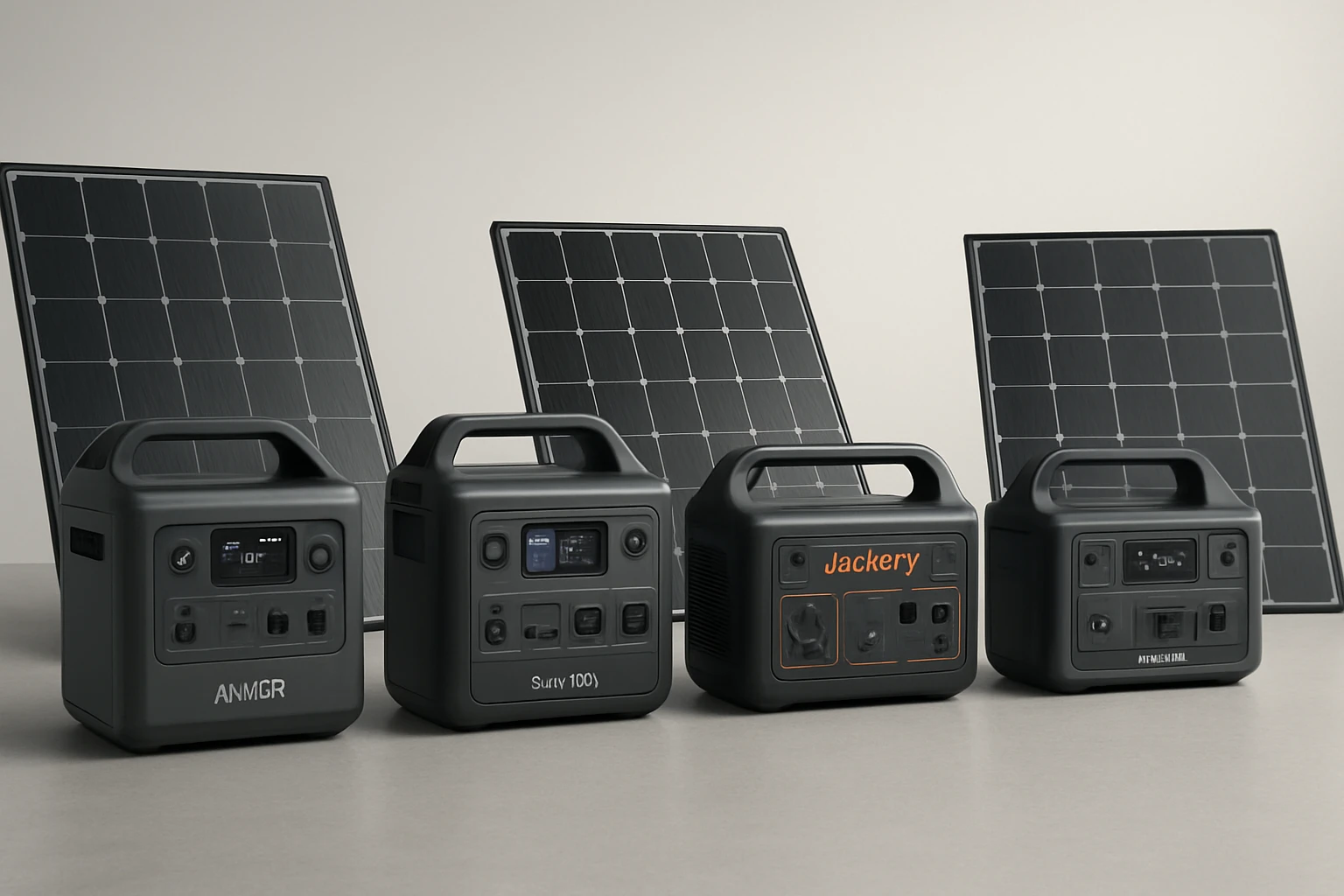
Introduction
Portable solar generators have become essential tools for campers, travelers, and emergency preparedness enthusiasts. Comparing the Anker SOLIX C300, ZeroKor 300W Solar Generator, Jackery Explorer 1000 v2, and MARBERO 111Wh Solar Generator reveals how each model balances power, portability, and price. Understanding these differences matters because a mismatched generator can lead to insufficient power during critical moments or unnecessary expense.
This article provides a structured overview of each product, a head‑to‑head analysis across key dimensions, and clear recommendations for distinct user scenarios. All data are drawn directly from the product listings and verified customer feedback.
Individual Product Overviews
Anker SOLIX C300
The Anker SOLIX C300 delivers 300W continuous output with a 600W surge capability and a 288Wh LiFePO4 battery. It features eight charging ports, including three AC outlets, a 120W car socket, two high‑power USB‑C ports (140W total), an additional 15W USB‑C, and a 12W USB‑A. The unit recharges to 80% in 50 minutes via wall outlet and supports solar input from the included 60W panel. Customers praise its quiet operation (25dB) and sleek design, noting that it "runs my laptop rated up to 240 watts" for several hours.
ZeroKor 300W Solar Generator
The ZeroKor model provides a 300W continuous AC output with a 280Wh battery and an included 60W monocrystalline solar panel. It offers two AC outlets, a DC port (9‑12.6V, 10A), three standard USB‑A ports, a quick‑charge USB port, and an SOS flashlight with reading mode. The device incorporates a built‑in battery management system (BMS) and automatic cooling fan. Reviewers highlight its ability to power phones, tablets, and small camping appliances for "7 or more hours" and commend its lightweight construction.
Jackery Explorer 1000 v2
Jackery’s Explorer 1000 v2 supplies 1500W continuous AC power with a 3000W surge, backed by a 1070Wh LiFePO4 battery. It includes two USB‑C ports, one USB‑A, one DC car port, and three pure sine‑wave AC outlets. The unit can fast‑charge from 0% to 100% in one hour using the Jackery app, or reach 80% in six hours with a 200W solar panel. Users commend its high capacity, quiet operation, and robust app‑controlled charging modes.
MARBERO 111Wh Solar Generator
MARBERO offers a compact 111Wh lithium‑ion power station paired with a 30W foldable solar panel. The station provides four USB‑A ports, one USB‑C, two AC outlets (80W continuous, 120W peak), and a DC output up to 120W. Weighing only 2.3 lb, the unit is designed for ultra‑portable use. Customers appreciate its lightweight design, fast solar charging, and clear LED display indicating remaining power.
Head‑to‑Head Comparison
Price and Value
Pricing ranges from $99.99 for the MARBERO unit to $739.00 for the Jackery Explorer 1000 v2. The Anker SOLIX C300 sits at $329.99, offering mid‑range capacity with LiFePO4 longevity. ZeroKor is the most affordable mid‑capacity option at $188.97. When evaluating value, the higher price of Jackery is justified by its 1070Wh capacity and rapid one‑hour charge, while MARBERO provides excellent value for short trips due to its low cost and minimal weight.
Features and Specifications
All four generators support solar recharging, but panel wattage differs: Anker includes a 60W panel, ZeroKor a 60W monocrystalline panel, Jackery a 200W panel (sold separately), and MARBERO a 30W panel. The Anker and Jackery units use LiFePO4 chemistry, offering 3000+ cycles, whereas ZeroKor and MARBERO rely on conventional lithium cells with shorter cycle life. In terms of output diversity, Anker leads with eight ports, Jackery provides three AC outlets and multiple USB‑C ports, ZeroKor includes an SOS flashlight, and MARBERO offers the simplest port set.
Customer Ratings and Feedback
Jackery holds the highest rating at 4.7/5.0 from 7,553 reviews, reflecting broad satisfaction with power and reliability. Anker follows with 4.5/5.0 (318 reviews), praised for quiet operation but critiqued for a missing strap and a reported 25% capacity shortfall in one negative review. ZeroKor maintains a 4.3/5.0 rating (1,632 reviews), with users highlighting its usefulness for phones and fans but warning against exceeding 300W loads. MARBERO also rates 4.3/5.0 (8,445 reviews), lauded for portability and fast charging, though some users note limited runtime for higher‑draw devices.
Performance and Reliability
Real‑world tests show Anker can sustain a 200W laptop for approximately 1.7 hours, while a reviewer observed a 201W load lasting only 55 minutes, suggesting actual usable capacity may be lower than the advertised 288Wh. ZeroKor’s 280Wh battery delivered eight hours of mixed device usage in a field test, confirming its claim of "7 or more hours" of operation. Jackery’s 1070Wh pack powered a 1000W heater for one hour, retaining 40% charge, demonstrating strong high‑load performance. MARBERO’s 111Wh unit comfortably powered a laptop and phone simultaneously for several hours, aligning with its lightweight design goal.
Best Use Cases
For extended off‑grid living or emergency backup, Jackery’s high capacity and rapid charging make it the optimal choice. Anker suits travelers who need a balance of power, quiet operation, and a moderate number of ports. ZeroKor is ideal for weekend campers who prioritize lightweight gear and sufficient power for small electronics. MARBERO excels for hikers or backpackers who require the smallest footprint and quick solar top‑up for low‑draw devices.
Comparison Table
| Anker SOLIX C300 | ZeroKor 300W | Jackery Explorer 1000 v2 | MARBERO 111Wh |
|---|---|---|---|
| Capacity: 288Wh (LiFePO4) | Capacity: 280Wh | Capacity: 1070Wh (LiFePO4) | Capacity: 111Wh |
| Continuous Output: 300W (600W Surge) | Continuous Output: 300W (max) | Continuous Output: 1500W (3000W Surge) | Continuous Output: 80W (120W Peak) |
| Solar Panel: 60W included | Solar Panel: 60W monocrystalline included | Solar Panel: 200W (optional) | Solar Panel: 30W included |
| Ports: 3 AC, 1 car, 2 USB‑C (140W), 1 USB‑C (15W), 1 USB‑A (12W) | Ports: 2 AC, 1 DC, 3 USB‑A, 1 quick‑charge USB, SOS flashlight | Ports: 3 AC, 2 USB‑C, 1 USB‑A, 1 DC car | Ports: 2 AC, 4 USB‑A, 1 USB‑C, 1 DC |
| Weight: Approx. 7.5 lb | Weight: Approx. 6.6 lb | Weight: 23.8 lb | Weight: 2.3 lb |
| Price: $329.99 | Price: $188.97 | Price: $739.00 | Price: $99.99 |
| Rating: 4.5/5 (318 reviews) | Rating: 4.3/5 (1,632 reviews) | Rating: 4.7/5 (7,553 reviews) | Rating: 4.3/5 (8,445 reviews) |
Pros & Cons
Anker SOLIX C300
- Pros: High surge capacity, quiet operation (25dB), fast 140W USB‑C charging, LiFePO4 longevity, eight versatile ports.
- Cons: Strap sold separately, some users report actual capacity lower than advertised, panel incompatibility with other Anker panels.
ZeroKor 300W Solar Generator
- Pros: Includes 60W high‑efficiency panel, SOS flashlight, robust BMS protection, lightweight for its class.
- Cons: Maximum AC load limited to 300W, fan noise only during heavy AC use, no LiFePO4 battery.
Jackery Explorer 1000 v2
- Pros: Massive 1070Wh capacity, rapid one‑hour charge, pure sine‑wave output, extensive port selection, 10‑year lifespan claim.
- Cons: Heavier than competitors, solar panel sold separately, higher price point.
MARBERO 111Wh Solar Generator
- Pros: Extremely lightweight, affordable, fast solar charging, clear LED display, includes 30W panel.
- Cons: Limited power for high‑draw appliances, lower overall capacity, peak AC output only 120W.
Recommendations
For users planning multi‑day off‑grid adventures or home backup, the Jackery Explorer 1000 v2 provides the most energy storage and fastest recharge, despite its weight and cost. Those who need a portable yet powerful solution for weekend camping, with enough ports for laptops and small appliances, should consider the Anker SOLIX C300. Budget‑conscious hikers who only require charging for phones, lights, and a tablet will find the MARBERO 111Wh Solar Generator to be the most practical choice. Finally, the ZeroKor 300W Solar Generator offers a balanced blend of price and performance for casual campers who value a built‑in flashlight and solid BMS protection.
FAQ
- Can the Anker SOLIX C300 be charged with a panel larger than 60W?
- Yes, the unit can accept higher‑wattage panels, but the manufacturer notes that panels above 60W may not achieve optimal efficiency without a compatible MPPT controller.
- How long does the ZeroKor generator run a typical laptop?
- Based on user reports, a 45W laptop can operate for approximately 5–6 hours on a full charge, given the 280Wh battery capacity.
- Is the Jackery Explorer 1000 v2 truly a pure sine‑wave inverter?
- Jackery confirms that all AC outputs are pure sine‑wave, which protects sensitive electronics such as medical devices and laptops.
- What is the warranty period for each product?
- Anker provides a 5‑year warranty, ZeroKor offers a standard 1‑year warranty, Jackery includes a 5‑year coverage, and MARBERO supplies a 1‑year warranty.
- Can the MARBERO unit be used as a power bank for phones while charging via solar?
- Yes, the unit supports pass‑through charging, allowing phones to charge from the battery while the solar panel recharges the internal pack.
- Which generator is the quietest?
- Customer reviews consistently note that the Anker SOLIX C300 operates at 25dB, making it the quietest among the four models.
- Do any of these generators support remote monitoring via an app?
- Both Anker and Jackery provide companion apps for status monitoring and control; ZeroKor and MARBERO do not currently offer dedicated mobile applications.
Conclusion
Each solar generator examined excels in a specific niche. The Jackery Explorer 1000 v2 dominates in capacity and rapid charging, making it the premier choice for extensive power needs. The Anker SOLIX C300 offers a compelling mix of power, quiet operation, and port variety for travelers who value convenience. ZeroKor delivers solid performance at a modest price, suitable for weekend campers, while MARBERO shines as the ultra‑lightweight, budget‑friendly option for short trips.
Ultimately, the decision should align with the user’s power demand, portability requirements, and budget. By matching the appropriate generator to the intended use case, one can ensure reliable, clean energy wherever the journey leads.
Products Mentioned in This Review
Frequently Asked Questions
What key specs should I compare when choosing between the Anker SOLIX C300, ZeroKor 300W, Jackery Explorer 1000 v2, and MARBERO 111Wh?
Compare power output, battery capacity, weight, recharge options, and price to match your energy needs and portability preferences.
How does the Anker SOLIX C300’s power output differ from the ZeroKor 300W solar generator?
The SOLIX C300 delivers slightly higher continuous wattage and faster charging rates, while the ZeroKor 300W offers a solid 300 W output at a lower price point.
Are solar generators generally permitted in campgrounds?
Most campgrounds allow solar generators, but you should check local rules for noise limits, fuel‑free policies, and any size restrictions.
Which model is best for emergency preparedness versus weekend camping?
The Jackery Explorer 1000 v2’s larger capacity makes it ideal for emergencies, whereas the lightweight MARBERO 111Wh excels for short camping trips.
How portable are the Jackery Explorer 1000 v2 and MARBERO 111Wh compared to the Anker and ZeroKor units?
Both the Jackery and MARBERO are designed for easy transport, with the MARBERO being the lightest, while the Anker and ZeroKor prioritize higher power at a slightly heavier build.