Campground Battery Swap Stations for Campers: The Ultimate How‑To Guide
Introduction
The modern camper expects reliable power wherever the journey leads. This guide explains the concept of battery swap stations, outlines the technical foundations, and demonstrates how campgrounds can implement a system that serves both short‑term visitors and long‑term residents. Readers will learn how to assess power requirements, select appropriate equipment, install safe and efficient stations, and maintain them for years of dependable service.
Throughout the article, specific products are highlighted because they address common challenges such as battery health, system diagnostics, and portable power management. The recommendations are based on real Amazon listings, including price, rating, and format details, ensuring that readers can make informed purchasing decisions.
Background/Context
Campers rely on a variety of power sources, from deep‑cycle lead‑acid batteries to lithium‑ion packs. Each technology offers distinct advantages in terms of energy density, weight, and lifespan. Understanding these differences is essential before a campground invests in a swap station.
Deep‑cycle lead‑acid batteries provide robust performance at a low initial cost, but they require regular maintenance and have a limited number of charge cycles. Lithium‑ion batteries, by contrast, deliver higher energy per kilogram, charge faster, and tolerate deeper discharge, yet they command a higher upfront price.
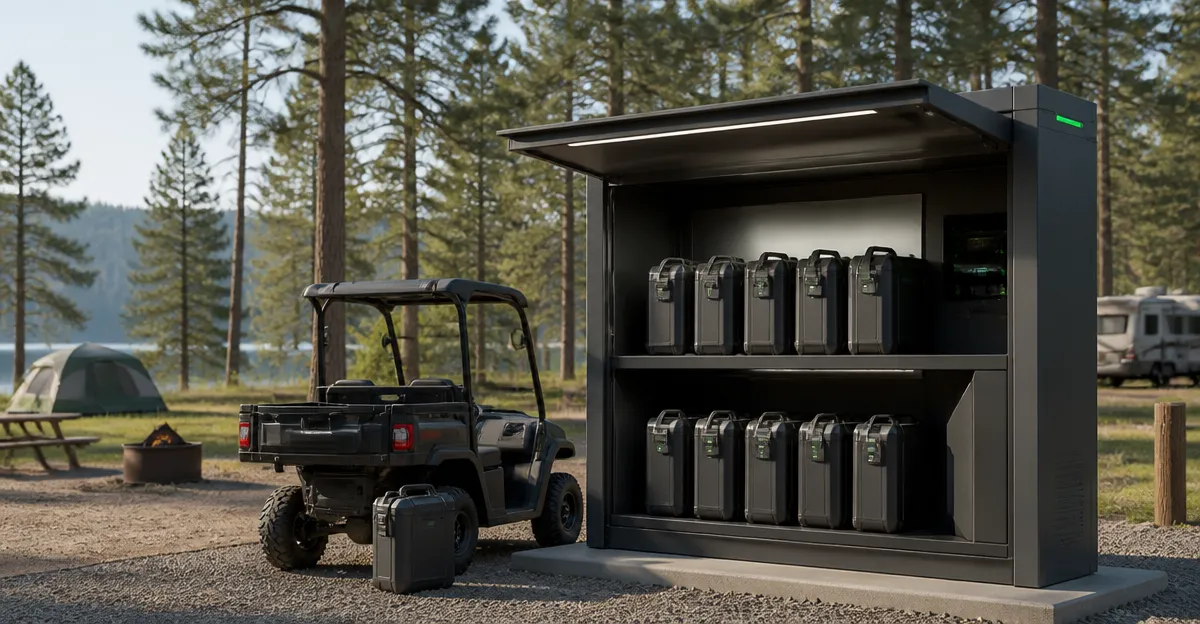
Battery swap stations function as centralized hubs where campers can exchange depleted batteries for fully charged units. The stations typically include charging racks, safety interlocks, and a user interface that records transactions. Proper design minimizes downtime, maximizes safety, and reduces the environmental impact of discarded batteries.
Understanding Battery Swap Stations
There are three primary categories of swap stations: manual, semi‑automated, and fully automated. Each category aligns with a different level of campground traffic and budget.
- Manual stations consist of a charging rack and a simple lockable enclosure. Campers physically replace batteries under supervision. This model is inexpensive and suitable for low‑traffic sites.
- Semi‑automated stations add electronic controls, such as a keypad or RFID reader, to verify user identity and track battery inventory. They often include a basic display that indicates charging status.
- Fully automated stations employ robotic arms that retrieve and store batteries without human intervention. These systems require substantial capital but deliver the highest throughput and labor savings.
When evaluating a system, one must consider power capacity, charging speed, safety certifications, and integration with existing campground utilities. The following product recommendations complement each station type.
Recommended Reading for System Care
Effective battery management begins with knowledge. The RV & Camper Maintenance Guide offers practical advice on caring for every onboard system, including batteries. Its concise format (paperback, $9.99) and perfect rating (5/5 from one reviewer) make it a valuable reference for campground operators who wish to educate their guests.
Choosing the Right Battery System
Selection hinges on three criteria: energy demand, turnaround time, and budget. Campgrounds that host full‑time RV parks often require high‑capacity lithium packs, whereas weekend‑only sites may find lead‑acid solutions sufficient.
The following table compares common battery types against key performance indicators.
| Battery Type | Initial Cost | Cycle Life | Weight (kg per kWh) | Maintenance |
|---|---|---|---|---|
| Lead‑acid (deep‑cycle) | Low | 500‑800 | 30‑35 | Regular electrolyte checks |
| Lithium‑ion (LiFePO4) | High | 2000‑3000 | 10‑12 | Minimal |
| Nickel‑metal hydride | Medium | 800‑1200 | 20‑25 | Occasional balancing |
For campgrounds seeking a comprehensive management solution, the book Campground Management provides a detailed framework for establishing operational procedures, including power infrastructure planning. Although priced at $284.59 and rated 3.4/5 from four reviews, its hardcover format ensures durability for reference in a field office.
Installing and Maintaining a Swap Station
Installation proceeds through a structured sequence that guarantees safety and compliance with electrical codes. The steps below outline a typical workflow for a semi‑automated station.
- Site assessment: Verify that the location offers adequate ventilation, flood protection, and proximity to a three‑phase power source.
- Electrical design: Size the feeder cables to handle the maximum charging current, typically 30 A per rack, and incorporate ground‑fault circuit interrupters (GFCI).
- Physical mounting: Secure the charging rack to a concrete pad using anchor bolts rated for the anticipated load.
- Control integration: Connect the keypad or RFID reader to the station controller, ensuring that the firmware is updated to the latest version.
- Testing and commissioning: Perform a load test with a fully discharged battery, monitor voltage rise, and verify that safety interlocks engage correctly.
Routine maintenance includes visual inspection of cable connections, cleaning of battery terminals, and periodic calibration of the state‑of‑charge algorithm. The RV Lifestyle Manual offers insights into living off‑grid, including strategies for extending battery life. Priced at $2.99, this Kindle edition holds a 3.8/5 rating from 33 reviews and is a practical companion for both operators and travelers.
Comparison/Selection Guide
The table below assists readers in matching product features to their specific campground needs.
| Feature | RV & Camper Maintenance Guide | Campground Management | RV Lifestyle Manual |
|---|---|---|---|
| Format | Paperback | Hardcover | Kindle Edition |
| Price | $9.99 | $284.59 | $2.99 |
| Rating | 5/5 (1 review) | 3.4/5 (4 reviews) | 3.8/5 (33 reviews) |
| Primary Focus | System maintenance for RVs and campers | Establishing and operating a campground | Boondocking lifestyle and power strategies |
| Best For | Technical reference for battery care | Comprehensive campground operations guide | Traveler‑oriented power management tips |
Best Practices & Tips
Implementing a successful battery swap station requires adherence to industry best practices. The following recommendations are distilled from professional standards and the referenced literature.
- Maintain a temperature‑controlled environment; batteries degrade rapidly above 30 °C.
- Label each battery with a unique identifier and record its cycle count to predict end‑of‑life.
- Provide clear signage that explains the swap procedure, safety warnings, and contact information for assistance.
- Offer a basic training session for campground staff, using excerpts from the RV & Camper Maintenance Guide to illustrate proper handling.
- Integrate a solar‑charging array where feasible; this reduces grid load and demonstrates environmental stewardship.
- Schedule quarterly audits of the charging infrastructure, checking for corrosion, loose connections, and firmware updates.
- Consider a warranty or service contract for high‑value lithium packs, as they often include battery management system (BMS) support.
Frequently Asked Questions
1. How many batteries should a small campground stock?
The optimal inventory depends on average stay length and daily turnover. A rule of thumb is to maintain a stock equal to 1.5 times the number of active sites, ensuring that at least one fully charged unit is available for each occupied slot.
2. Can lead‑acid batteries be used in a fully automated station?
Yes, but the system must incorporate a robust ventilation system to mitigate hydrogen gas accumulation. Automated handling mechanisms must also be compatible with the heavier weight of lead‑acid packs.
3. What safety certifications should a swap station possess?
Look for UL listed or IEC 60335 compliance, which confirms that the equipment meets international safety standards for battery charging and enclosure design.
4. How often should batteries be replaced?
Replacement intervals vary by chemistry. Lead‑acid batteries typically require replacement after 500 cycles or three to five years, whereas lithium‑ion packs can last 2,000 cycles or up to ten years with proper care.
5. Is it necessary to provide a charging fee?
Charging fees help offset electricity costs and equipment depreciation. Many campgrounds adopt a tiered pricing model, offering a complimentary first swap and charging for subsequent exchanges.
6. Can a swap station support both 12 V and 24 V systems?
Yes, provided the charging racks include dual‑voltage converters and the control software can differentiate between the two configurations.
7. What role does the RV Lifestyle Manual play in battery management?
The manual supplies practical advice on maximizing battery life while traveling, such as avoiding deep discharge, using solar panels, and monitoring state‑of‑charge with a reliable gauge.
Conclusion
Campground battery swap stations empower travelers to enjoy uninterrupted power on the open road while reducing reliance on noisy generators. By understanding battery technologies, selecting an appropriate station type, and following rigorous installation and maintenance procedures, campground operators can create a resilient power ecosystem. The recommended publications—RV & Camper Maintenance Guide, Campground Management, and The RV Lifestyle Manual—provide the knowledge foundation necessary for successful implementation.
Products Featured in This Guide
RV & Camper Maintenance Guide
Price: $9.99 | Rating: 5/5 (1 review)
Featured because it delivers concise, practical advice on maintaining camper batteries and other onboard systems, which is essential for both operators and guests.
Campground Management
Price: $284.59 | Rating: 3.4/5 (4 reviews)
Featured because it provides a comprehensive framework for establishing and operating a campground, including sections on power infrastructure and guest services.
The RV Lifestyle Manual
Price: $2.99 | Rating: 3.8/5 (33 reviews)
Featured because it offers real‑world tips for boondocking and battery management, complementing the technical guidance presented in this article.