Introduction
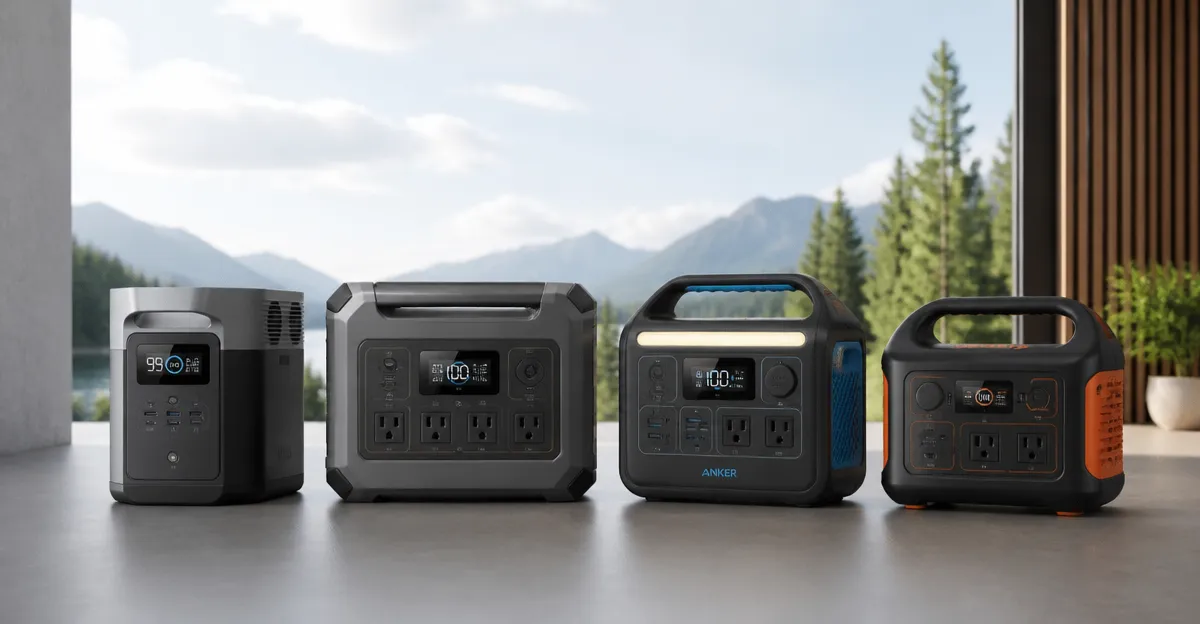
Portable power stations have become essential tools for homeowners, campers, and remote workers who require reliable electricity away from the grid. This article compares five leading Amazon listings: EF ECOFLOW DELTA 2, ABOK Ark3600, Anker SOLIX C300, Jackery Explorer 300, and Anker SOLIX C1000 Gen2. Each model offers a distinct blend of capacity, output power, and charging speed, making the selection process nuanced.
Understanding the differences matters because a mismatch between capacity and intended use can lead to insufficient power during emergencies or unnecessary expense for casual camping trips. The comparison below examines price, specifications, customer feedback, performance reliability, and ideal scenarios, enabling readers to make an informed purchase decision.
Individual Product Overviews
EF ECOFLOW DELTA 2
The DELTA 2 provides a 1024 Wh LiFePO4 battery, 1800 W continuous AC output, and 15 assorted outlets, allowing it to run most household appliances. Its claim of 7 × faster charging delivers 0‑80 % in 50 minutes and a full charge in 80 minutes using AC input, a significant advantage for rapid backup situations. The unit is expandable to 3 kWh, giving users the flexibility to add extra battery modules for extended off‑grid adventures. Priced at $1,019.48, it holds a 4.7‑star rating from 5,167 reviews, and only 13 units remain in stock, indicating high demand.
ABOK Ark3600
The Ark3600 boasts a massive 3840 Wh LiFePO4 battery, expandable up to 11 520 Wh, and a 3600 W rated output with a 4500 W peak, sufficient for nearly any home appliance. Fast charging is achieved in 1.29 hours when AC and solar inputs are combined, while a sole AC charge requires three hours. It offers 15 output ports, including multiple AC, USB‑A, USB‑C, DC, and a cigarette‑lighter socket, providing comprehensive connectivity. At $1,099.00, the product carries a 4.6‑star rating based on 88 reviews and is currently listed as In Stock.
Anker SOLIX C300
The SOLIX C300 delivers 288 Wh of LiFePO4 capacity with a 300 W continuous (600 W surge) AC output, targeting lightweight travelers. It features eight versatile ports, including three AC outlets, two high‑power USB‑C ports (140 W each), a 120 W car socket, and a standard USB‑A port. Fast charging to 80 % is accomplished in 50 minutes via a wall outlet, and a compatible 100 W solar panel can sustain prolonged outdoor use. Priced at $269.99, it enjoys a 4.6‑star rating from 1,803 reviews and is readily available.
Jackery Explorer 300
The Explorer 300 supplies 292 Wh of LiFePO4 energy with a 300 W continuous (600 W surge) AC output, emphasizing ultra‑lightweight portability at only 7.5 lb. It includes two AC outlets, a 100 W USB‑C PD port, two USB‑A ports, and a 120 W car port, allowing simultaneous operation of six devices. Solar recharging to 80 % takes approximately 2.8 hours with a 100 W panel, making it suitable for short‑duration trips. The unit costs $198.99, holds a 4.6‑star rating from 11,095 reviews, and is in stock.
Anker SOLIX C1000 Gen2
The SOLIX C1000 Gen2 combines a 1024 Wh LiFePO4 battery with a 2000 W continuous (3000 W peak) AC output, delivering substantial power for home backup and larger RV setups. Its HyperFlash technology enables a full charge in 49 minutes at 1 600 W, while 600 W of solar input recharges the unit in 1.8 hours. Ten ports—including AC, USB‑C, USB‑A, and DC—support diverse device connections, and a 10 ms UPS switch ensures uninterrupted operation for critical equipment. Retailing for $499.98, it carries a 4.7‑star rating from 1,372 reviews and is currently In Stock.
Head‑to‑Head Comparison
Price and Value
When evaluating cost, the Jackery Explorer 300 emerges as the most affordable option at $198.99, offering a respectable 292 Wh capacity for budget‑conscious users. The Anker SOLIX C300 follows at $269.99, providing a modest increase in capacity and faster USB‑C charging for a slightly higher price. The Anker SOLIX C1000 Gen2 delivers premium performance at $499.98, positioning itself as a mid‑range value proposition given its high output and ultra‑fast recharge. The EF ECOFLOW DELTA 2 and ABOK Ark3600 sit at the premium end, priced at $1,019.48 and $1,099.00 respectively, reflecting their larger capacities and advanced features.
Features and Specifications
Capacity ranges from 288 Wh (SOLIX C300) to 3840 Wh (Ark3600), with the DELTA 2 and C1000 Gen2 each offering 1024 Wh. Output power spans 1800 W (DELTA 2) to 3600 W (Ark3600) and peaks at 3000 W for the C1000 Gen2. Charging speed varies dramatically: the DELTA 2 reaches full charge in 80 minutes, the C1000 Gen2 in 49 minutes, while the Ark3600 requires three hours on AC alone. Solar input limits are 500 W for the DELTA 2, 2000 W for the Ark3600, and 600 W for the C1000 Gen2, influencing off‑grid recharging efficiency.
Customer Ratings and Feedback
All five models maintain strong ratings above 4.6 stars, indicating broad customer satisfaction. The EF ECOFLOW DELTA 2 and Anker SOLIX C1000 Gen2 each hold a 4.7‑star rating, reflecting praise for rapid charging and robust build quality. The Jackery Explorer 300, despite its lower price, matches the 4.6‑star average of the SOLIX C300 and Ark3600, suggesting that users value its lightweight design and reliability. Review counts differ markedly, with the Explorer 300 accumulating over 11,000 reviews, while the Ark3600 has a modest 88, highlighting differing market exposure.
Performance and Reliability
LiFePO4 chemistry underpins every unit, delivering cycle lives between 3000 and 4000+, ensuring long‑term durability. The DELTA 2 advertises over 3000 cycles, the Ark3600 exceeds 4000 cycles, and the Jackery Explorer 300 promises more than 4000 cycles before reaching 70 % capacity. Fast charging technologies such as HyperFlash (C1000 Gen2) and 7 × faster charging (DELTA 2) provide practical advantages during power outages. The Ark3600’s UPS 10 ms switchover further enhances reliability for critical medical equipment.
Best Use Cases
For homeowners seeking a high‑capacity backup system, the ABOK Ark3600 stands out with its 3840 Wh base capacity and 3600 W output, capable of running multiple appliances simultaneously. The EF ECOFLOW DELTA 2 suits users who prioritize rapid recharge and modular expandability for extended camping trips. The Anker SOLIX C300 and Jackery Explorer 300 excel in lightweight, short‑duration adventures where portability outweighs raw power. Finally, the Anker SOLIX C1000 Gen2 offers a balanced solution for remote workers and tiny‑home owners who need substantial power and ultra‑fast recharge without the bulk of the Ark3600.
Comparison Table
| Feature | EF ECOFLOW DELTA 2 | ABOK Ark3600 | Anker SOLIX C300 | Jackery Explorer 300 | Anker SOLIX C1000 Gen2 |
|---|---|---|---|---|---|
| Battery Capacity (Wh) | 1024 | 3840 (expandable to 11520) | 288 | 292 | 1024 |
| Continuous AC Output (W) | 1800 | 3600 | 300 | 300 | 2000 |
| Peak Power (W) | 1800 | 4500 | 600 | 600 | 3000 |
| Number of Outlets | 15 | 15 | 8 | 6 | 10 |
| Fast‑Charge Time (Full) | 80 min (AC) | 3 hr (AC) | 50 min (80 % via USB‑C) | 2.8 hr to 80 % (100 W solar) | 49 min (1 600 W) |
| Solar Input Limit (W) | 500 | 2000 | 100 | 100 | 600 |
| Cycle Life (≈) | 3000+ | 4000+ | 3000 | 4000+ | 4000 |
| Price (USD) | $1,019.48 | $1,099.00 | $269.99 | $198.99 | $499.98 |
| Amazon Rating | 4.7/5 (5,167 reviews) | 4.6/5 (88 reviews) | 4.6/5 (1,803 reviews) | 4.6/5 (11,095 reviews) | 4.7/5 (1,372 reviews) |
Pros & Cons
EF ECOFLOW DELTA 2
- Pros: Rapid 0‑80 % charge in 50 minutes, modular expansion to 3 kWh, 15 versatile outlets, high 1800 W output.
- Cons: Premium price, limited solar input (500 W), only 13 units left indicating potential stock shortage.
ABOK Ark3600
- Pros: Massive 3840 Wh base capacity, expandable to 11 520 Wh, 3600 W continuous output, UPS 10 ms switchover.
- Cons: Heavier and bulkier, slower AC‑only charge (3 hr), higher price point.
Anker SOLIX C300
- Pros: Extremely portable, 140 W USB‑C fast charging, quiet operation (25 dB), competitive price.
- Cons: Lower capacity (288 Wh), limited solar compatibility, fewer AC outlets.
Jackery Explorer 300
- Pros: Lightest unit at 7.5 lb, affordable, robust LiFePO4 cycle life, easy carry handle.
- Cons: Small capacity (292 Wh), modest output, solar recharging slower than higher‑end models.
Anker SOLIX C1000 Gen2
- Pros: Ultra‑fast 49‑minute full charge, high 2000 W output, 10 ms UPS, compact despite 1024 Wh.
- Cons: Mid‑range price, solar input limited to 600 W, may be overkill for casual campers.
Recommendations by Use Case
For homeowners requiring a reliable backup during grid failures, the ABOK Ark3600 offers unmatched capacity and output, ensuring that essential appliances remain operational. Those who value rapid recharge and modular expandability for extended off‑grid trips should consider the EF ECOFLOW DELTA 2, which balances power and flexibility.
Travelers and weekend hikers seeking lightweight power will benefit most from the Jackery Explorer 300 or the Anker SOLIX C300, with the Jackery providing the lowest entry cost. Remote workers or tiny‑home owners who need higher continuous output and ultra‑fast recharge should select the Anker SOLIX C1000 Gen2 for its blend of power density and convenience.
Frequently Asked Questions
- How long does it take to fully charge each power station using a wall outlet? The DELTA 2 reaches 100 % in 80 minutes, the Ark3600 requires three hours, the SOLIX C300 attains 80 % in 50 minutes, the Explorer 300 reaches 80 % in about 2.8 hours with a 100 W solar panel, and the SOLIX C1000 Gen2 completes a full charge in 49 minutes.
- Can these units run a typical home refrigerator? Both the DELTA 2 (1800 W) and the Ark3600 (3600 W) have sufficient continuous output to power most standard refrigerators, while the SOLIX C1000 Gen2 (2000 W) can also handle this load. The lower‑output models (SOLIX C300 and Explorer 300) are better suited for smaller appliances.
- What is the expected lifespan of the batteries? All five stations employ LiFePO4 cells, offering cycle lives between 3000 and 4000+. The DELTA 2 and SOLIX C300 guarantee over 3000 cycles, whereas the Ark3600, Explorer 300, and SOLIX C1000 Gen2 exceed 4000 cycles before capacity drops to 70 %.
- Are the solar panels included? None of the listings include solar panels in the box; each product must be paired with compatible panels sold separately.
- Which model provides the fastest UPS switchover for critical devices? The ABOK Ark3600 advertises a 10 ms UPS backup, while the SOLIX C1000 Gen2 also offers a 10 ms UPS switch, making both suitable for medical equipment such as CPAP machines.
Conclusion
Each of the five power stations examined delivers a distinct value proposition, ranging from ultra‑lightweight, budget‑friendly options to high‑capacity, rapid‑charge solutions for demanding home backup scenarios. The EF ECOFLOW DELTA 2 and ABOK Ark3600 dominate the high‑capacity segment, with the Ark3600 offering the largest energy reserve and the DELTA 2 excelling in charging speed and modularity. For users prioritizing portability and cost, the Jackery Explorer 300 and Anker SOLIX C300 provide reliable performance at modest prices. The Anker SOLIX C1000 Gen2 bridges the gap, delivering high output and ultra‑fast recharge while remaining more compact than the Ark3600.
Overall, the best choice depends on individual power requirements, budget constraints, and intended usage environments. Homeowners seeking comprehensive backup should gravitate toward the Ark3600, while adventure seekers will find the Jackery Explorer 300 or SOLIX C300 more appropriate. Professionals needing rapid recharge and high output will appreciate the capabilities of the SOLIX C1000 Gen2.