Introduction
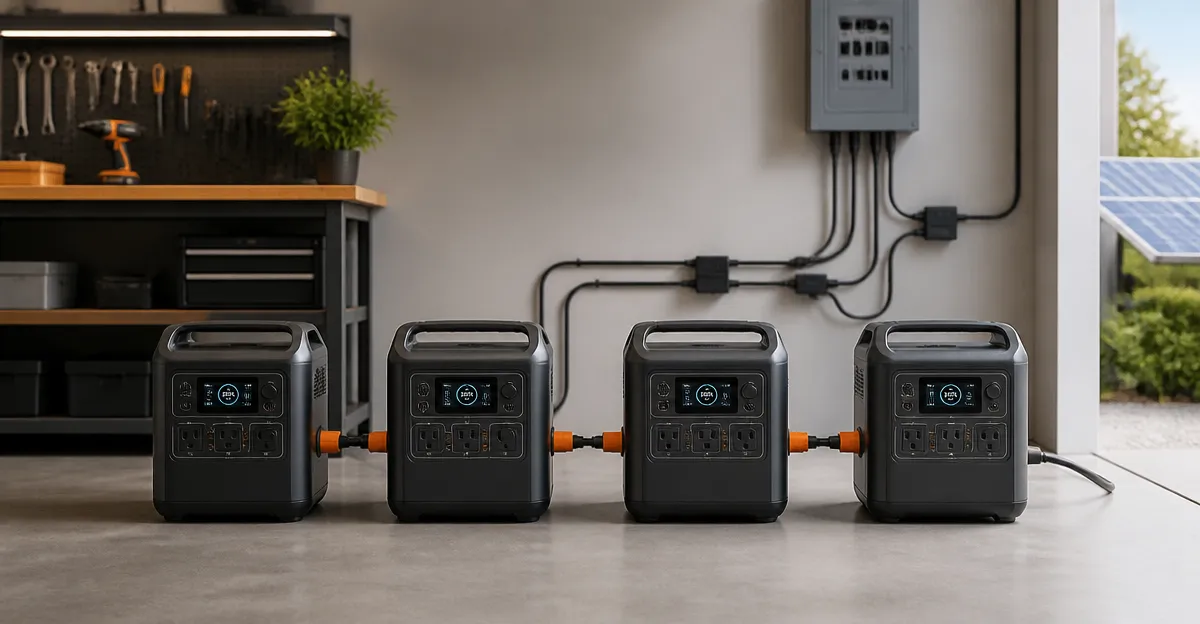
One often discovers that a single portable power station cannot satisfy the energy demand of a fully equipped campsite or an RV during a prolonged outage. This guide explains how to load balance two or more power stations, creating a unified power source that delivers higher wattage while preserving battery health. Readers will learn the principles of parallel connection, the safety precautions required, and the practical steps to achieve efficient power distribution. By following these instructions, one can extend operating time, reduce reliance on fuel generators, and enjoy a quieter, cleaner energy solution.
What You’ll Need
- Two compatible portable power stations (e.g., Anker SOLIX C300 Portable Power Station and ABOK Ark3600 Portable Power Station)
- Heavy‑duty DC power cables rated for the combined current (minimum 10 A per conductor)
- Parallel connection adapter or Y‑splitter specifically designed for the stations’ output ports
- Multimeter or portable power monitor to verify voltage and current
- Protective fuses or circuit breakers appropriate for the total load
- Solar panels (optional) and compatible MC4 connectors if renewable charging is desired
- Tool kit containing wrenches, screwdrivers, and cable crimping tools
Step 1: Verify Compatibility and Safety Ratings
Before attempting any parallel configuration, one must confirm that the power stations share the same battery chemistry, nominal voltage, and connector type. The Anker SOLIX C300 utilizes a LiFePO4 battery with a nominal voltage of 48 V, while the ABOK Ark3600 also employs LiFePO4 cells at 48 V, making them electrically compatible. Both units provide protective circuitry that prevents over‑current, over‑voltage, and short‑circuit conditions, which is essential for safe load sharing. Reviewing the user manuals for each model ensures that the manufacturer does not void the warranty when units are paralleled.
Step 2: Select the Appropriate Parallel Port
Each power station offers dedicated parallel ports designed for stacking or load balancing. The Anker SOLIX C300 features a two‑way fast‑charging USB‑C PD 3.1 port that can serve as an input or output, while the ABOK Ark3600 provides a high‑current AC output and a DC‑5521 port suitable for parallel connections. Choose the DC‑5521 port on the ABOK unit because it matches the voltage range of the Anker station and supports up to 30 A, which accommodates the combined load of typical camping appliances. Using the correct port prevents voltage mismatch and reduces the risk of overheating.
Step 3: Prepare the Parallel Cable Assembly
Construct a cable assembly that joins the two parallel ports with minimal resistance. Cut two lengths of 10‑gauge silicone‑insulated wire, strip 10 mm of insulation from each end, and attach crimp connectors rated for at least 30 A. Connect one end of the first wire to the positive terminal of the Anker station, and the opposite end to the positive terminal of the ABOK station. Repeat the process for the negative terminals using a separate wire. Verify that all connections are tight, that there is no exposed conductor, and that the cable length does not exceed three meters to avoid unnecessary voltage drop.
Step 4: Install Protective Fuses
Insert inline fuses between each power station and the parallel cable to protect against accidental short circuits. A 30 A slow‑blow fuse is suitable for the Anker SOLIX C300, while a 40 A fuse matches the higher current capability of the ABOK Ark3600. Place the fuses as close to the power station output ports as possible, securing them with heat‑shrink tubing. This arrangement ensures that if one station experiences a fault, the fuse will isolate the problem without compromising the entire system.
Step 5: Connect the Load Distribution Bus
After the two stations are linked, attach a distribution bus bar that will feed the campsite or RV appliances. The bus bar should be rated for at least 600 W continuous load, matching the combined surge capacity of the two stations (600 W from Anker and 4500 W peak from ABOK). Connect the positive side of the bus to the fused positive cable and the negative side to the fused negative cable. Use bolt‑down terminals to secure the connections, and double‑check that the bus bar is grounded according to local electrical codes.
Step 6: Verify Voltage and Current Balance
Power on both stations and use a multimeter to measure the voltage at the bus bar. The reading should be within 2 % of the nominal 48 V. Next, measure the current drawn by a representative load, such as a 150 W camping refrigerator. The current should be shared approximately equally between the two stations, indicating proper load balancing. If one station supplies a disproportionate amount of current, adjust the cable resistance or verify that the internal balancing circuitry is active.
Step 7: Integrate Solar Charging (Optional)
To maintain charge during extended off‑grid stays, connect a 100 W solar panel to the Anker SOLIX C300 using the recommended Anker solar panel. The station can accept up to 100 W of solar input, providing rapid replenishment while the ABOK Ark3600 can be simultaneously charged via its 2000 W PV input port. Ensure that the solar panel’s voltage does not exceed the station’s maximum input rating, and use MC4 connectors with a weather‑proof junction box. This configuration enables continuous operation without depleting the battery reserves.
Step 8: Monitor System Performance
Both power stations include built-in displays that show battery percentage, input power, and output load. The ABOK Ark3600 also offers a Bluetooth app that allows remote monitoring of voltage, temperature, and remaining runtime. Regularly check these metrics to confirm that neither battery is approaching its low‑voltage cutoff, which could shorten cycle life. Adjust the load or add additional solar input if the state of charge drops below 20 % during prolonged use.
Tips & Pro Tips
- Always operate the stations in a well‑ventilated area; although the Anker SOLIX C300 emits only 25 dB, heat buildup can affect efficiency.
- Use a surge protector between the distribution bus and sensitive electronics to guard against transient spikes.
- When traveling, secure the parallel cable with zip ties to prevent accidental tripping or abrasion.
- Consider adding a small uninterruptible power supply (UPS) module downstream of the bus bar for devices that require clean sine‑wave power.
- Schedule regular maintenance checks of cable connections, especially after exposure to moisture or dust.
Troubleshooting
Problem: One station shuts down while the other continues to supply power.
Solution: Verify that the protective fuse has not blown; replace it with an identical rating. Check the parallel cable for any signs of corrosion or loose terminals.
Problem: Voltage at the bus bar fluctuates beyond 5 %.
Solution: Measure the resistance of each cable segment; high resistance can cause voltage sag. Replace any undersized wires with the recommended 10‑gauge silicone wire.
Problem: Solar panels do not charge the Anker station.
Solution: Ensure the solar panel is oriented toward direct sunlight and that the MPPT controller on the Anker unit is active. Confirm that the panel voltage matches the input range of 12‑30 V.
Conclusion
By following the steps outlined in this guide, one can safely load balance multiple portable power stations, creating a robust and flexible energy system for camping, RV travel, and off‑grid emergencies. The combined capacity of the Anker SOLIX C300 and the ABOK Ark3600 delivers both high surge power and long‑duration runtime, while proper cabling, fusing, and monitoring protect the investment and extend battery life. Readers are encouraged to apply these practices, adapt them to their specific power needs, and enjoy reliable, quiet electricity wherever the adventure leads.
Products Mentioned in This Guide
Anker SOLIX C300 Portable Power Station
Price: Not listed
Rating: Not listed
Key features include 288 Wh LiFePO4 battery, 300 W continuous output, 140 W two‑way USB‑C fast charging, and a quiet 25 dB operation level.
ABOK Ark3600 Portable Power Station
Price: $1,169.00
Rating: 4.6/5.0 (86 reviews)
Key features include 3840 Wh LiFePO4 battery expandable to 11520 Wh, 3600 W continuous output, 15 versatile output ports, and a built‑in Bluetooth monitoring app.
Frequently Asked Questions
How can I safely connect two portable power stations in parallel?
Use a purpose‑built parallel adapter or Y‑splitter and heavy‑duty DC cables, ensuring both stations have the same voltage rating and are turned on before connecting.
What type of cables are required for load balancing multiple power stations?
Heavy‑duty DC power cables rated for at least 10 A per conductor and sized for the combined current of the stations.
Do the portable power stations need to be the same brand or model?
They don’t have to be identical, but they must have compatible voltage outputs and support parallel operation.
Will load balancing extend the runtime of my portable power stations?
Yes, distributing the load across multiple units allows each battery to discharge more slowly, increasing overall operating time.
Are there any safety precautions I should follow when load balancing?
Always check cable ratings, use a proper adapter, avoid exceeding the combined wattage limit, and monitor temperature and battery health during use.