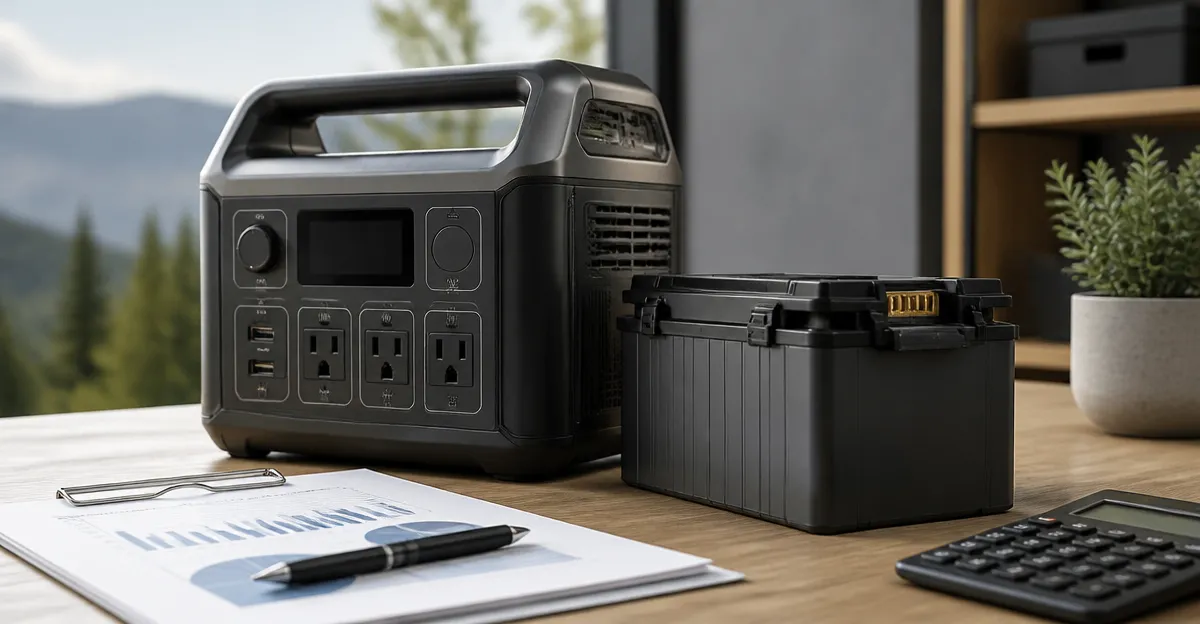
Portable Power Station TCO: Complete Guide to 5‑Year Battery Replacement Costs
Introduction
This guide explains how to evaluate the total cost of ownership (TCO) for portable power stations over a five‑year period. Readers will learn how battery chemistry, cycle life, and usage patterns affect long‑term expenses. The article also presents practical strategies for minimizing replacement costs while maintaining reliable power. By the end, the audience will be equipped to choose a model that aligns with budget and performance goals.
Background and Context
Portable power stations have become essential for camping, emergency preparedness, and remote work. Most modern units rely on lithium‑iron‑phosphate (LiFePO4) or lithium‑ion cells, each offering distinct lifespan characteristics. LiFePO4 batteries typically endure 3,000‑5,000 cycles, translating to a decade of service under moderate use. In contrast, traditional lithium‑ion cells may degrade after 500‑1,000 cycles, requiring earlier replacement.
The concept of TCO expands beyond the purchase price. It incorporates energy efficiency, charging speed, maintenance, and the cost of a replacement battery pack. Calculating TCO enables consumers to compare seemingly similar products on a level playing field.
Key variables in a five‑year analysis include:
- Initial unit price
- Battery cycle rating and depth‑of‑discharge (DoD) limits
- Average daily energy consumption
- Charging method efficiency (solar, AC, vehicle)
- Replacement battery price and availability
Understanding these factors prepares the reader for the detailed sections that follow.
Understanding Battery Replacement Costs
Battery replacement cost is driven by two primary components: the price of the replacement pack and the labor or service fees associated with installation. Manufacturers such as Jackery and Anker sell official replacement modules, often priced between 30% and 50% of the original unit cost.
For example, the Jackery Explorer 1000 v2 utilizes a 1,070 Wh LiFePO4 battery rated for over 4,000 cycles. Assuming a conservative 1,000 cycles per year under heavy use, the battery would likely survive the full five‑year horizon without replacement. However, a user who routinely discharges to 90% DoD may experience accelerated wear, potentially necessitating a replacement after three years.
The Anker SOLIX S2000 features a 2,010 Wh LiFePO4 pack with a 10,000‑cycle rating. Its larger capacity and higher cycle count make replacement unlikely within five years, even for power‑hungry households.
When a replacement is required, the cost can be estimated using the following formula:
Replacement Cost = (Unit Price × Battery Cost Ratio) + Service Fee
Typical battery cost ratios range from 0.30 to 0.45, while service fees vary between $30 and $80 depending on the brand’s support policy.
Key Concepts for Accurate TCO Calculation
To produce a realistic TCO figure, consider the following concepts:
- Depth‑of‑Discharge (DoD): Limiting discharge to 50% extends cycle life dramatically. Users who adopt a shallow DoD can reduce replacement frequency.
- Charge Efficiency: Fast charging technologies, such as Jackery’s ChargeShield 2.0, improve convenience but may generate additional heat, slightly impacting longevity.
- Environmental Conditions: Extreme temperatures degrade LiFePO4 cells faster. Storing the unit in a cool, dry place mitigates premature wear.
- Usage Profile: A power station used primarily for short bursts (e.g., powering lights) experiences fewer deep cycles than one that runs a refrigerator continuously.
Applying these concepts helps the reader model realistic battery wear scenarios.
Product Recommendations
Both featured models excel in different contexts. The following sections detail their specifications, strengths, and how they fit into a five‑year TCO framework.
Jackery Explorer 1000 v2
The Jackery Explorer 1000 v2 offers a 1,070 Wh LiFePO4 battery, 1,500 W continuous AC output, and a 3,000 W surge capability. At $469.00, it provides a compelling price‑to‑capacity ratio.
- Fast one‑hour emergency charging via the Jackery app (default 1.7 h for battery health)
- 10‑year lifespan claim with over 70% capacity retained after 4,000 cycles
- Multiple ports: two USB‑C, one USB‑A, DC car, and three pure sine wave AC outlets
- Smart app control for mode selection and energy monitoring
Its relatively low weight (23.8 lb) and foldable handle make it ideal for camping and mobile work sites. For a five‑year horizon, most users will not need a battery replacement, keeping the TCO close to the purchase price plus minimal maintenance.
Anker SOLIX S2000
The Anker SOLIX S2000 provides a 2,010 Wh LiFePO4 battery, 1,500 W continuous output, and a 3,000 W peak. Priced at $699.00, it targets users who require extended backup for home essentials.
- Up to 35‑hour refrigerator backup with only 6 W idle draw
- 15‑year lifespan claim based on 10,000 charge cycles
- Compact footprint (8.2 × 11.1 × 12.7 in) and 35.7 lb weight
- Six charging options, including up to 400 W solar input
- Eight outlets strategically placed front and rear for organized connections
The S2000’s larger capacity reduces the frequency of deep cycles, making battery replacement virtually unnecessary within five years. Its higher upfront cost is offset by the reduced need for additional backup batteries.
Comparison and Selection Guide
| Feature | Jackery Explorer 1000 v2 | Anker SOLIX S2000 |
|---|---|---|
| Battery Capacity | 1,070 Wh | 2,010 Wh |
| Continuous AC Output | 1,500 W | 1,500 W |
| Peak Power | 3,000 W | 3,000 W |
| Weight | 23.8 lb | 35.7 lb |
| Price | $469.00 | $699.00 |
| Battery Cycle Rating | 4,000+ cycles | 10,000 cycles |
| Fast Charging | 1‑hour emergency (app‑controlled) | Standard AC charge, no 1‑hour mode |
| Port Selection | 2 × USB‑C, 1 × USB‑A, 1 × DC, 3 × AC | 8 × AC (front/rear), 2 × USB‑C, 2 × USB‑A, 1 × DC car |
| Warranty | 2 years | 2 years |
When selecting a model, assess the following criteria:
- Energy Demand: For occasional outdoor use, the Explorer 1000 v2’s capacity is sufficient. For whole‑home backup, the SOLIX S2000’s larger battery is advantageous.
- Portability: The lighter Jackery unit is easier to transport on hikes or RV trips.
- Replacement Risk: Both units employ long‑life LiFePO4 cells, yet the SOLIX’s 10,000‑cycle rating offers the lowest replacement probability.
- Budget Constraints: If upfront cost is a primary concern, the Jackery model provides a lower entry price while still delivering robust performance.
Best Practices & Tips for Extending Battery Life
Implementing disciplined usage habits can further reduce the likelihood of a costly battery replacement.
- Maintain a shallow depth‑of‑discharge; aim for no more than 50% discharge per cycle.
- Utilize the fast‑charge mode only when necessary; regular charging at 1.7 hours preserves cell health.
- Store the unit in a temperature‑controlled environment (15‑25 °C) when not in use.
- Leverage solar input when feasible to minimize reliance on AC chargers that generate heat.
- Regularly update the device firmware via the manufacturer’s app to benefit from efficiency improvements.
Following these guidelines can extend the effective lifespan of the battery by up to 20%, further lowering the five‑year TCO.
Frequently Asked Questions
- What is the typical cost of a replacement battery for these models?
- Replacement packs for the Jackery Explorer 1000 v2 are priced around $180‑$220, while Anker SOLIX S2000 packs range from $250‑$300, reflecting the larger capacity.
- Can I replace the battery myself?
- Both manufacturers recommend professional service to preserve warranty coverage. Attempting self‑replacement may void the warranty.
- How does solar charging affect battery lifespan?
- Solar charging is generally gentler than rapid AC charging because it delivers lower, more constant power. However, extreme sunlight can increase temperature; using a shaded setup mitigates this risk.
- Is the one‑hour fast charge worth the extra cost?
- For emergency responders or users who need immediate power, the fast‑charge feature provides critical flexibility. For routine camping, the standard 1.7‑hour charge is adequate.
- Do I need a separate inverter for higher‑power appliances?
- Both units include pure sine wave inverters capable of handling most household devices up to their peak rating. No external inverter is required.
- What warranty coverage do I receive?
- Both Jackery and Anker offer a two‑year limited warranty covering manufacturing defects. Battery degradation under normal use is not covered.
Conclusion
Calculating the total cost of ownership for portable power stations requires more than a simple price comparison. By accounting for battery cycle life, depth‑of‑discharge habits, and potential replacement expenses, consumers can make informed decisions that align with long‑term financial goals. The Jackery Explorer 1000 v2 delivers a balanced blend of portability and affordability, while the Anker SOLIX S2000 excels in capacity and ultra‑long battery life for home backup scenarios. Applying the best‑practice tips outlined above will further safeguard the investment and ensure reliable power whenever it is needed.
Products Featured in This Guide
Jackery Explorer 1000 v2
Price: $469.00
Rating: 4.7/5.0 (3,472 reviews)
Featured for its lightweight design, rapid one‑hour emergency charging, and a 10‑year LiFePO4 battery that minimizes replacement risk.
Anker SOLIX S2000
Price: $699.00
Rating: 4.6/5.0 (105 reviews)
Featured for its massive 2,010 Wh capacity, 15‑year battery lifespan, and versatile charging options that suit whole‑home backup needs.