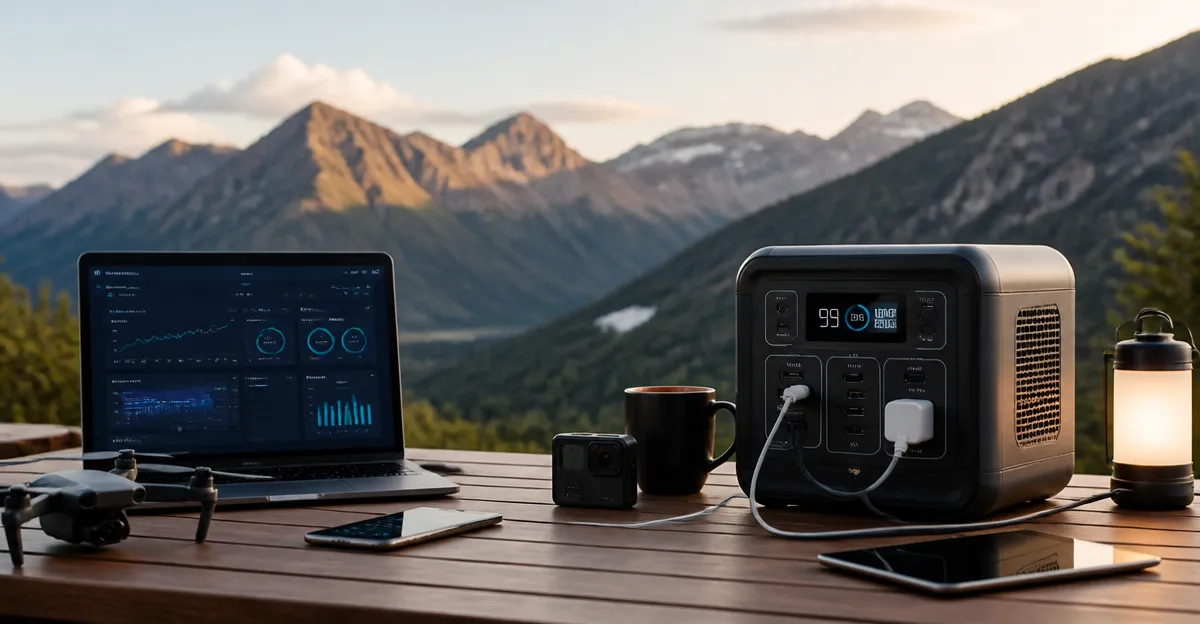
IoT Load Scheduling for Portable Power Stations: The Ultimate Guide to Smart Energy Management
Introduction
Portable power stations have become essential components of modern Internet of Things (IoT) deployments, especially in remote or off‑grid environments. This guide explains how to schedule IoT loads efficiently, reduce waste, and extend runtime using intelligent control techniques. Readers will learn foundational concepts, practical scheduling strategies, and how specific products can simplify implementation. By the end of the article, the audience will be equipped to design resilient, energy‑aware IoT systems.
Background and Context
IoT devices typically operate on low‑power microcontrollers, yet the cumulative demand of sensors, communication modules, and actuators can strain limited battery resources. Traditional fixed‑capacity batteries lack the flexibility to handle variable loads, leading to frequent recharges or unexpected shutdowns. Portable power stations, equipped with larger lithium‑based cells and multiple output ports, provide a scalable buffer that can be managed programmatically. Understanding the electrical characteristics of these stations—such as continuous wattage, peak surge, and battery chemistry—is crucial for effective load scheduling.
Most modern stations use lithium‑iron‑phosphate (LiFePO4) or lithium‑ion cells, offering high cycle counts and stable voltage under load. LiFePO4 chemistry, for example, can endure more than 4,000 charge cycles before dropping to 70 % capacity, which translates to a decade of reliable service. Additionally, many units feature pure sine‑wave inverters, ensuring compatibility with sensitive IoT equipment that requires clean power. These technical attributes enable developers to implement sophisticated scheduling algorithms without risking device damage.
Key Concepts in IoT Load Scheduling
Effective scheduling begins with categorizing loads into three groups: critical, periodic, and opportunistic. Critical loads—such as safety sensors or communication gateways—must remain powered at all times, while periodic loads—like data uploads—can be timed to off‑peak periods. Opportunistic loads, for example environmental cameras, may be deferred until sufficient battery reserve is available. By assigning priority levels, the system can make real‑time decisions based on battery state of charge (SoC) and forecasted generation from solar panels.
Another essential concept is the use of predictive analytics. By analyzing historical consumption patterns and solar input, the scheduler can anticipate future SoC trends and pre‑emptively shift loads. Machine‑learning models, even lightweight ones running on edge devices, can improve prediction accuracy over time. When combined with a portable power station that supports pass‑through charging, the system can maintain critical loads while simultaneously recharging from solar or AC sources.
Finally, communication protocols matter. Many IoT platforms support MQTT or CoAP, which allow low‑overhead status reporting. The power station should expose its telemetry—voltage, current, remaining capacity—through a simple API or Bluetooth interface, enabling the central controller to adjust schedules dynamically.
Smart Scheduling Strategies
One practical strategy is time‑based throttling. The controller can define a daily schedule that aligns high‑energy tasks, such as firmware updates, with periods of peak solar generation. For example, a station receiving 100 W of solar input can allocate up to 80 % of that power to charging while the remaining 20 % supports active loads. This approach maximizes renewable utilization and minimizes reliance on grid power.
Another technique is load shedding based on SoC thresholds. When the battery falls below a configurable limit—commonly 30 %—the system can temporarily disable opportunistic loads, preserving power for critical functions. Once the battery recharges above a higher threshold—say 70 %—the disabled loads resume. This hysteresis prevents rapid on/off cycling that could shorten battery life.
Hybrid charging, where the station draws simultaneously from solar and AC sources, further enhances flexibility. Devices that support dual‑input charging can receive a combined input of up to 400 W, reducing total recharge time. The scheduler should prioritize solar input first, falling back to AC only when solar is insufficient, thereby reducing electricity costs.
Integrating Portable Power Stations
When selecting a portable power station for IoT load scheduling, consider the following criteria: continuous output power, peak surge capability, number and type of output ports, battery chemistry, and available APIs for telemetry. The following products illustrate how these criteria map to real‑world solutions.
The Jackery Explorer 300 offers a 292 Wh LiFePO4 battery, 300 W continuous output, and a 600 W peak surge. Its lightweight design (7.5 lb) and multiple ports—including a 100 W USB‑C PD port—make it ideal for edge gateways and sensor hubs. With a 4.6‑star rating from over 11,000 reviewers, the unit provides reliable power for up to 14 hours of LED lighting, a common IoT use case.
The Anker SOLIX S2000 delivers 2,010 Wh of capacity, 1,500 W continuous output, and a 3,000 W peak. Its 10,000‑cycle LiFePO4 cells guarantee a 15‑year lifespan, making it suitable for larger IoT installations such as remote weather stations or small data‑center back‑ups. The unit’s eight outlets, dual‑sided design, and fast 400 W solar input enable rapid recharging and flexible load distribution.
The Jackery Explorer 1000 v2 provides 1,070 Wh of energy, a 1,500 W AC inverter, and a 3,000 W surge. Its integrated app supports one‑hour emergency charging, real‑time power monitoring, and configurable charging modes. With a 4.7‑star rating from 3,588 reviewers, this model balances high capacity with a portable form factor (23.8 lb), suitable for mobile IoT labs or field‑service vehicles.
The BLUETTI AC180 packs 1,152 Wh, 1,800 W continuous output, and a boost mode up to 2,700 W. It can be fully charged in one hour via a 1,440 W AC input, which is valuable for rapid turnaround between field deployments. Its 5‑year warranty and 4.6‑star rating reflect strong consumer confidence. The unit’s eight outlets and app‑controlled power boost make it a versatile hub for mixed‑load IoT sites.
The ALLWEI 300W Portable Power Station offers a compact 256 Wh LiFePO4 battery, 300 W continuous output, and six output ports, including a 60 W USB‑C PD port. Weighing only 6.4 lb, it is ideal for lightweight sensor arrays or personal emergency kits. Its 4.4‑star rating and 5‑year warranty underscore reliability for low‑to‑moderate power demands.
Comparison and Selection Guide
| Product | Capacity (Wh) | Continuous Output (W) | Peak Surge (W) | Weight (lb) | Ideal Use‑Case |
|---|---|---|---|---|---|
| Jackery Explorer 300 | 292 | 300 | 600 | 7.5 | Edge gateways, portable sensor rigs |
| Anker SOLIX S2000 | 2,010 | 1,500 | 3,000 | 35.7 | Remote stations, small off‑grid data centers |
| Jackery Explorer 1000 v2 | 1,070 | 1,500 | 3,000 | 23.8 | Mobile labs, vehicle‑mounted IoT hubs |
| BLUETTI AC180 | 1,152 | 1,800 | 2,700 | 30 | Rapid‑turnaround field deployments |
| ALLWEI 300W | 256 | 300 | 600 | 6.4 | Lightweight sensor packs, personal backup |
Choosing the right station depends on three variables: total energy demand, peak power requirement, and mobility constraints. For deployments where the aggregate load never exceeds 300 W, the ALLWEI or Jackery Explorer 300 provide the most portable solution. When continuous loads approach 1 kW, the Jackery Explorer 1000 v2 or BLUETTI AC180 become more appropriate. For enterprise‑scale remote sites demanding multi‑kilowatt output, the Anker SOLIX S2000 offers the necessary headroom and long‑term cycle durability.
Best Practices & Tips for Smart Energy Management
- Always monitor battery SoC in real time and integrate alerts for thresholds below 20 %.
- Leverage the pass‑through charging feature of stations such as the Jackery Explorer 300 to keep critical loads powered while the unit recharges.
- Pair solar panels sized to deliver at least 20 % of the station’s continuous output, ensuring a net positive energy balance.
- Schedule firmware updates and high‑bandwidth transmissions during periods of peak solar generation.
- Utilize the station’s built‑in MPPT controller—available on most modern units—to maximize solar conversion efficiency.
- Implement redundancy by deploying two smaller stations in parallel rather than a single large unit for critical infrastructure.
- Regularly calibrate battery gauges by performing a full discharge‑to‑zero cycle followed by a full charge, as recommended by manufacturers.
Frequently Asked Questions
- Can I control a portable power station remotely? Many stations, including the Jackery Explorer 1000 v2 and BLUETTI AC180, provide Bluetooth or Wi‑Fi enabled apps that expose voltage, current, and SoC data. These APIs can be integrated with MQTT brokers for automated control.
- What is the difference between continuous output and peak surge? Continuous output is the maximum power the inverter can sustain indefinitely, while peak surge is a short‑duration allowance for devices that draw higher power at startup, such as compressors.
- How often should I perform a full discharge cycle? For LiFePO4 batteries, a full discharge every six months helps balance cells and maintain accurate SoC reporting. For lithium‑ion cells, an annual full discharge is sufficient.
- Is solar charging faster than AC charging? Solar charging speed depends on panel wattage and the station’s MPPT controller. Units like the Anker SOLIX S2000 accept up to 400 W solar input, which can exceed AC charging rates for high‑capacity batteries.
- Can I connect multiple power stations together? Yes, pass‑through charging allows one station to charge another via the DC car port, creating a cascade that extends runtime for critical loads.
- What safety features protect my IoT devices? Look for stations with pure sine‑wave inverters, over‑current protection, short‑circuit detection, and temperature monitoring. All featured products include these safeguards.
- How do I size a solar panel for my station? Divide the station’s continuous output by the average solar irradiance (approximately 1 kW/m²) to estimate required panel wattage. Adding a 20 % margin accounts for cloud cover and angle losses.
Conclusion
Smart IoT load scheduling transforms portable power stations from simple backup batteries into dynamic energy hubs. By categorizing loads, employing predictive analytics, and selecting a station that matches capacity and output needs, developers can achieve longer runtimes, lower operating costs, and higher reliability. The products highlighted in this guide—Jackery Explorer 300, Anker SOLIX S2000, Jackery Explorer 1000 v2, BLUETTI AC180, and ALLWEI 300W—represent a spectrum of capabilities suitable for a wide range of deployments. Applying the best‑practice tips and adhering to the FAQ guidance will ensure that any IoT system remains powered, even in the most challenging off‑grid scenarios.
Products Featured in This Guide
Jackery Explorer 300
Price: $259.00 | Rating: 4.6/5 (11,199 reviews)
Featured for its lightweight (7.5 lb) LiFePO4 battery, 300 W continuous output, and versatile port selection, making it ideal for edge gateways and portable sensor rigs.
Anker SOLIX S2000
Price: $649.99 | Rating: 4.6/5 (225 reviews)
Featured for its massive 2,010 Wh capacity, 1,500 W continuous output, and 15‑year lifespan, suitable for remote stations and small off‑grid data centers.
Jackery Explorer 1000 v2
Price: $499.00 | Rating: 4.7/5 (3,588 reviews)
Featured for its 1,070 Wh capacity, fast 1‑hour emergency charging, and robust app control, perfect for mobile labs and vehicle‑mounted IoT hubs.
BLUETTI AC180
Price: $449.00 | Rating: 4.6/5 (1,859 reviews)
Featured for its 1,152 Wh capacity, 1,800 W output with boost to 2,700 W, and one‑hour full charge capability, ideal for rapid‑turnaround field deployments.
ALLWEI 300W Portable Power Station
Price: $149.00 | Rating: 4.4/5 (2,435 reviews)
Featured for its compact 256 Wh LiFePO4 battery, lightweight design (6.4 lb), and six output ports, making it suitable for lightweight sensor packs and personal backup.