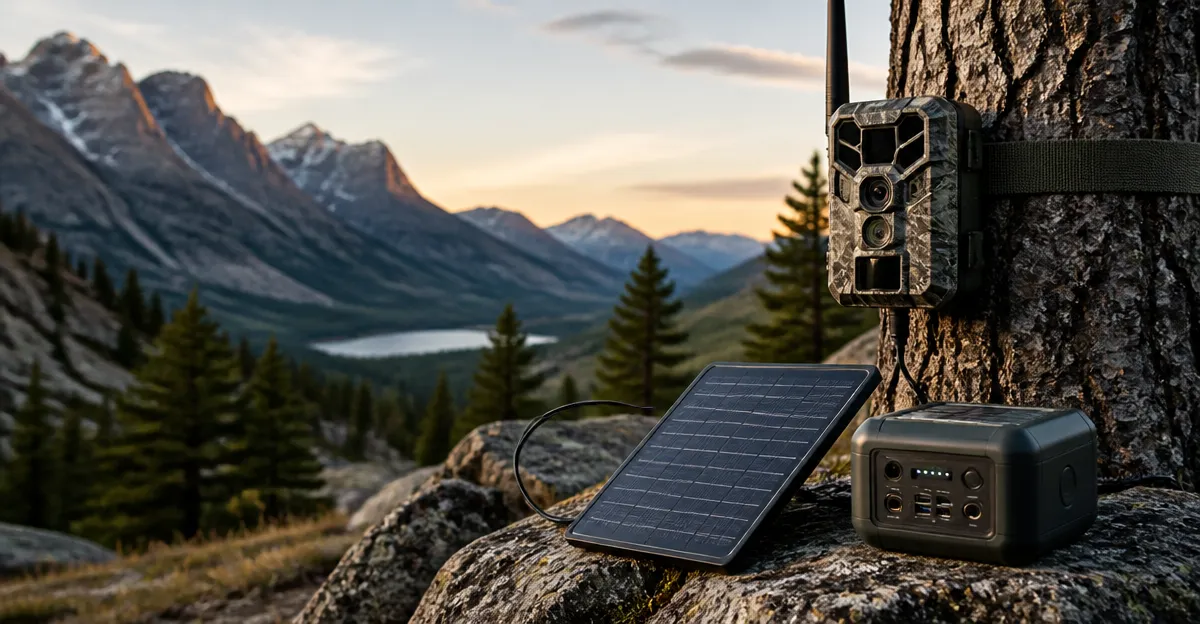
Ultimate Guide: Powering Time‑Lapse Camera Traps with Portable Power Stations
Introduction
Time‑lapse camera traps are essential tools for wildlife researchers, conservationists and outdoor enthusiasts. They capture critical data over days, weeks or months without human presence. This guide explains how to power these devices reliably using portable power stations. Readers will learn foundational concepts, how to match power capacity to camera requirements, and which commercial units provide the best value for specific field scenarios.
Background and Context
Modern camera traps typically consume between 2 W and 10 W depending on sensor size, flash type and recording mode. Continuous operation for a 30‑day deployment therefore requires between 1.4 kWh and 7.2 kWh of stored energy. Traditional solutions such as disposable batteries become costly and environmentally unfriendly at this scale. Portable power stations combine high‑capacity lithium‑based batteries with multiple output ports, allowing a single unit to sustain a camera trap and auxiliary equipment such as lights, communication modules or small weather stations.
Key technical terms are defined below:
- Wh (Watt‑hour): Measure of stored energy. A 1000 Wh battery can deliver 100 W for ten hours.
- Surge Power: Brief peak power that a unit can supply for motor start‑up or flash discharge.
- LiFePO₄ (Lithium Iron Phosphate): Battery chemistry offering longer cycle life and enhanced safety compared with traditional lithium‑ion cells.
- MPPT (Maximum Power Point Tracking): Solar‑charging technology that maximises energy harvest from photovoltaic panels.
Choosing the Right Capacity for Camera Traps
Capacity selection begins with estimating total energy demand. Multiply the camera’s average power draw by the intended deployment duration, then add a safety margin of 20 % to account for temperature‑related efficiency loss.
Example calculation: a camera drawing 5 W for 30 days (720 hours) requires 5 W × 720 h = 3600 Wh. Adding 20 % yields approximately 4320 Wh. No single portable power station listed exceeds this figure, but multiple units can be chained or a higher‑capacity station can be paired with solar panels to recharge on‑site.
For shorter studies—such as a 7‑day survey—capacity requirements drop dramatically. A 5 W camera for 7 days needs 5 W × 168 h = 840 Wh; a 1000 Wh unit provides ample headroom.
Managing Solar Versus AC Charging
Solar charging offers independence from grid power, which is critical for remote deployments. Units equipped with MPPT controllers, such as the Jackery Explorer 1000 v2, can reach 80 % charge in roughly 1.7 hours when using the emergency fast‑charge mode, while a 100 W solar panel can replenish 70 % of the battery in a single sunny day.
When reliable AC power is available—such as in a field station or vehicle—charging times are typically 3‑4 hours for the mid‑range models. The Jackery Explorer 300 advertises a full charge in approximately 3.5 hours via wall outlet, and can be recharged from a 12 V car socket in a comparable timeframe.
Hybrid charging (simultaneous AC and solar) is supported by the ALLWEI 300W Portable Power Station, which can reach a full charge in 2‑2.5 hours when both sources are applied.
Integrating Power Stations with Camera Traps
Most camera traps feature a DC input ranging from 5 V to 12 V, or a standard AC adapter. Portable power stations provide multiple output options that can be matched directly:
- USB‑C PD ports (e.g., 100 W on the Jackery Explorer 1000 v2) for cameras that accept USB power.
- 12 V car ports for devices that use cigarette‑lighter adapters, common on rugged field cameras.
- Pure sine‑wave AC outlets for cameras that require an AC adapter; the BLUETTI Elite 100 V2 offers three such outlets.
When connecting multiple cameras, ensure the total draw does not exceed the station’s continuous output rating. For instance, the Explorer 300 provides 300 W continuous power, sufficient for up to six low‑draw cameras operating simultaneously.
Product Recommendations
Below are curated recommendations based on capacity, weight, charging speed and durability. Each product is linked on first mention as required.
High‑Capacity Solution: Jackery Explorer 1000 v2
- Capacity: 1070 Wh; Continuous output: 1500 W, surge 3000 W.
- Weight: 23.8 lb; foldable handle for transport.
- Fast emergency charging: 0 % to 100 % in one hour using the Jackery App.
- Multiple ports: 2 × USB‑C, 1 × USB‑A, 1 × DC car, 3 × pure sine‑wave AC.
- Rating: 4.7 / 5 from 3,670 reviews.
- Ideal for multi‑day expeditions where high surge power may be needed for additional equipment such as portable lights or small refrigeration units.
Mid‑Range Portable: Jackery Explorer 300
- Capacity: 292 Wh; Continuous output: 300 W, surge 600 W.
- Weight: 7.5 lb; integrated carry handle.
- Fast solar charge: 80 % in 2.8 hours with 100 W panel.
- Ports: 2 × AC, 100 W USB‑C PD, 2 × USB‑A, 120 W car.
- Rating: 4.6 / 5 from 11,303 reviews.
- Suitable for short‑term studies or as a backup unit for larger stations.
Compact Yet Powerful: BLUETTI Elite 100 V2
- Capacity: 1024 Wh; Continuous output: 1800 W, surge 2700 W.
- Weight: 25 lb; dimensions 17 L, easy one‑hand carry.
- Rapid 45‑minute charge to 80 % using 1200 W TurboBoost AC charger.
- 11 output ports, including multiple USB‑C PD, USB‑A, AC and DC.
- 10 ms UPS feature protects sensitive camera electronics during brief outages.
- Rating: 4.6 / 5 from 1,808 reviews.
- Best for researchers who need a blend of high power, fast recharge and UPS protection.
Budget‑Friendly Option: ALLWEI 300W Portable Power Station
- Capacity: 256 Wh; Continuous output: 300 W, surge 600 W.
- Weight: 6.4 lb; compact footprint 9.25×5×6.81 in.
- Four charging methods (AC, car, solar, dual) with full charge in 2‑2.5 hours using dual input.
- 6 output ports: 1 × AC, 2 × DC5521, 1 × car, 1 × USB‑A (18 W), 1 × USB‑C PD (60 W).
- Rating: 4.4 / 5 from 2,452 reviews.
- Excellent for single‑camera deployments where weight and cost are primary concerns.
Ultra‑Light Emergency Unit: MARBERO Portable Power Station
- Capacity: 88 Wh; Surge power 120 W.
- Weight: 3.2 lb; size comparable to a DSLR.
- Eight simultaneous output ports, including dual AC, USB‑A, USB‑C PD and car DC.
- Integrated LED with three brightness levels and SOS mode for emergency signaling.
- Rating: 4.2 / 5 from 9,192 reviews.
- Ideal as a supplemental battery for short‑duration camera traps or as a backup communication device.
Comparison / Selection Guide
| Feature | Jackery Explorer 1000 v2 | Jackery Explorer 300 | BLUETTI Elite 100 V2 | ALLWEI 300W | MARBERO 88Wh |
|---|---|---|---|---|---|
| Capacity (Wh) | 1070 | 292 | 1024 | 256 | 88 |
| Continuous Power (W) | 1500 | 300 | 1800 | 300 | 120 |
| Surge Power (W) | 3000 | 600 | 2700 | 600 | 120 |
| Weight (lb) | 23.8 | 7.5 | 25 | 6.4 | 3.2 |
| Fast Charge (to 80 %) | 1 hr (emergency) | 2.8 hr (100 W solar) | 45 min (TurboBoost) | 2‑2.5 hr (dual) | 2 hr (adapter) |
| USB‑C PD | 2 × 100 W | 100 W | multiple, up to 100 W | 60 W | PD (unspecified) |
| Rating | 4.7 | 4.6 | 4.6 | 4.4 | 4.2 |
| Price (USD) | 559.00 | 289.00 | 499.00 | 149.00 | 79.99 |
Selection should prioritize capacity and output power for long‑term deployments, while weight and price dominate decisions for short field trips. The Explorer 1000 v2 and BLUETTI Elite 100 V2 provide the highest capacities, making them suitable for multi‑camera arrays. For lightweight backpacking, the ALLWEI 300W or MARBERO 88Wh deliver sufficient power for a single trap with minimal burden.
Best Practices & Tips
- Calculate Energy Budget Accurately: Include camera draw, flash discharge, any auxiliary sensors and the inefficiency of inverter conversion (typically 10‑15 %).
- Use Solar Panels Optimally: Position panels at a 30‑45° angle toward the sun, keep them clean, and employ MPPT‑enabled stations for maximal harvest.
- Leverage App‑Based Power Management: Stations such as the Explorer 1000 v2 allow remote monitoring of battery state‑of‑charge, enabling proactive adjustments before a power failure.
- Employ UPS Mode for Sensitive Cameras: The BLUETTI Elite 100 V2’s 10 ms switchover protects against brief voltage dips that could corrupt image files.
- Schedule Maintenance Checks: Inspect battery terminals, verify BMS indicator lights, and test charging cycles every six months to ensure long‑term reliability.
- Consider Redundancy: Carry a secondary low‑capacity unit (e.g., MARBERO) as a backup in case the primary station fails or is depleted unexpectedly.
- Secure Units Against Weather: Store the power station in a waterproof case or shade to prevent temperature‑induced capacity loss.
Frequently Asked Questions
- How long will a 1070 Wh station run a 5 W camera? Approximately 214 hours (about nine days) assuming 100 % efficiency; realistic runtime is closer to eight days due to inverter losses.
- Can I chain two power stations together? Most manufacturers do not recommend direct parallel connection without a proper load‑balancing controller. Instead, use a larger capacity unit or rotate batteries.
- Is solar charging reliable in cloudy conditions? MPPT controllers can extract up to 20 % of rated panel output in diffuse light, extending runtime but not replacing grid charging for high‑draw setups.
- What safety features protect my camera? Pure sine‑wave AC outlets, built‑in BMS, short‑circuit protection and UPS switchover (BLUETTI) prevent voltage spikes and brown‑outs.
- How often should I replace the battery? LiFePO₄ cells retain over 70 % capacity after 4,000‑5,000 cycles, equating to roughly ten years of typical field use.
- Do I need a separate solar panel? Yes; all listed stations require compatible Jackery or BLUETTI panels for optimal charging speed. Panels are sold separately.
- Can I charge the station while it powers a camera? Most units support pass‑through charging; the ALLWEI 300W explicitly advertises simultaneous charging and discharging.
Conclusion
Powering time‑lapse camera traps effectively hinges on understanding energy demand, selecting a portable power station that matches capacity and output requirements, and employing solar or AC charging strategies that suit the deployment environment. High‑capacity models such as the Jackery Explorer 1000 v2 and BLUETTI Elite 100 V2 excel for long‑term, multi‑camera projects, while budget‑friendly options like the ALLWEI 300W Portable Power Station and MARBERO Portable Power Station provide lightweight solutions for short surveys. By applying the best‑practice checklist and leveraging the comparison guide, users can ensure uninterrupted data collection and extend the operational life of their equipment.
Products Featured in This Guide
Jackery Explorer 1000 v2
Price: $559.00 | Rating: 4.7/5 (3,670 reviews)
Featured for its high 1070 Wh capacity, 1500 W continuous output and one‑hour emergency fast‑charge capability, making it suitable for multi‑day, high‑power camera trap deployments.
Jackery Explorer 300
Price: $289.00 | Rating: 4.6/5 (11,303 reviews)
Featured for its lightweight 292 Wh battery, 300 W output and rapid solar charging, ideal for short‑term or backup camera trap operations.
BLUETTI Elite 100 V2
Price: $499.00 | Rating: 4.6/5 (1,808 reviews)
Featured for its 1024 Wh capacity, 1800 W output, 45‑minute rapid charge and built‑in UPS, providing reliable power and protection for sensitive camera equipment.
ALLWEI 300W Portable Power Station
Price: $149.00 | Rating: 4.4/5 (2,452 reviews)
Featured for its compact 256 Wh battery, multiple charging methods and pass‑through capability, making it a versatile, budget‑friendly choice for single‑camera deployments.
MARBERO Portable Power Station
Price: $79.99 | Rating: 4.2/5 (9,192 reviews)
Featured for its ultra‑light 88 Wh battery, eight simultaneous output ports and integrated LED with SOS mode, serving as an emergency backup for brief camera trap sessions.