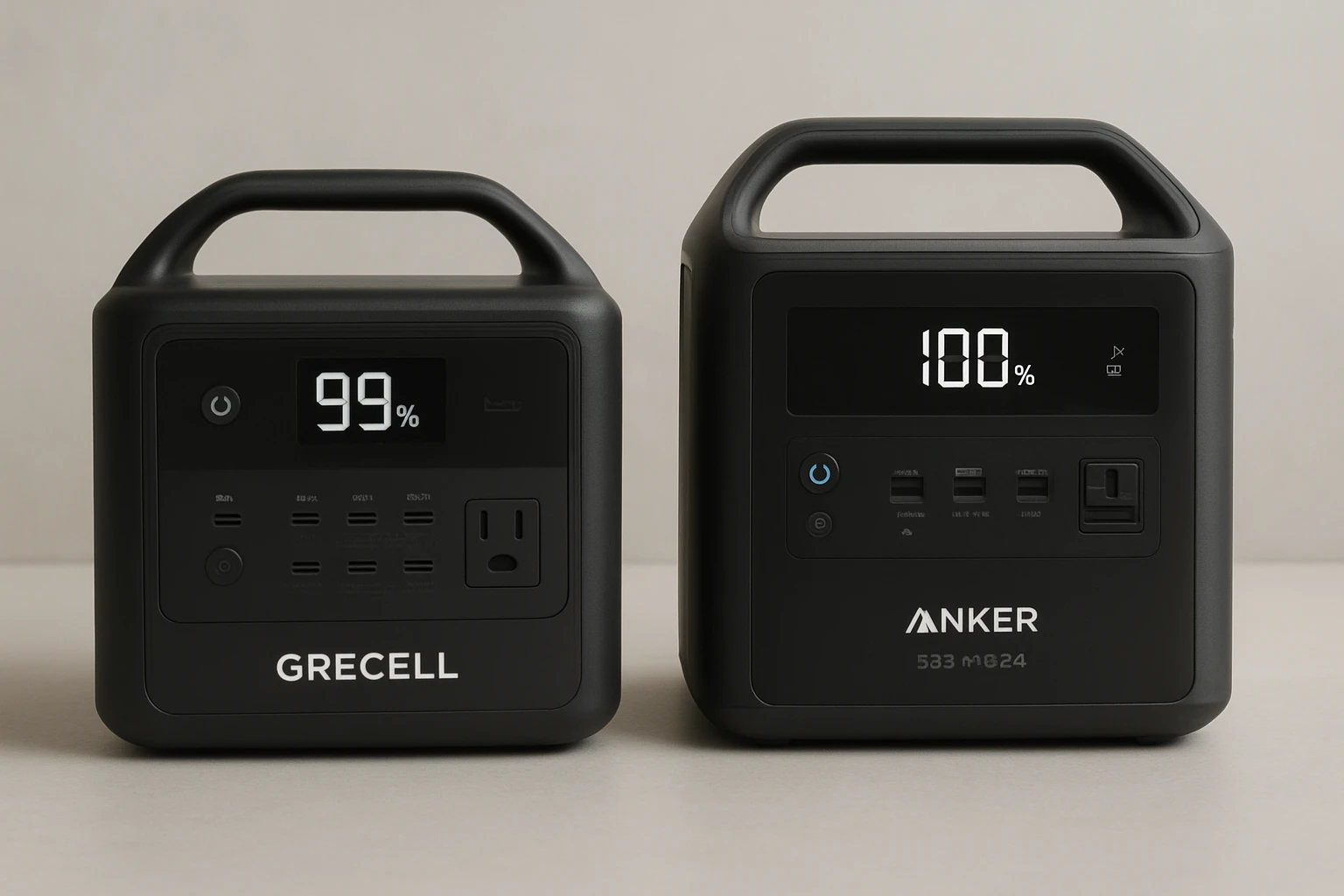
Introduction
Portable power stations have become essential tools for outdoor enthusiasts, remote workers, and homeowners seeking reliable backup power. Two models dominate the entry‑level market: the GRECELL Portable Power Station and the Anker SOLIX C300. Both deliver 300 W continuous output and 288 Wh capacity, yet they differ markedly in price, battery chemistry, charging speed, and port selection. This article evaluates each device on objective criteria, helping readers decide which unit aligns with their power needs and budget.
Individual Product Overviews
GRECELL Portable Power Station
The GRECELL model offers a lightweight design priced at $99.99. It houses a 288.6 Wh lithium battery, a pure sine‑wave AC outlet rated at 300 W (600 W surge), and a versatile mix of ports: one 60 W USB‑C PD, three USB‑A fast‑charge 3.0 ports, two DC 5.5 mm×2.1 mm outputs, a car‑socket DC port, and even a 5 W wireless charger. Three recharging options are supported—wall outlet (6‑7 h), 100 W solar panel (5‑9 h), and 12 V car charger. An upgraded battery management system (BMS) provides overload, over‑charge, and short‑circuit protection, while dual silent fans keep temperatures stable. Users praise its quiet operation, compact size, and the built‑in LED flashlight with three brightness levels.
Anker SOLIX C300
Anker’s SOLIX C300 commands a premium price of $249.99 but justifies it with a LiFePO4 battery that promises 3,000 charge cycles and a ten‑year lifespan. The unit delivers the same 300 W continuous (600 W surge) power and 288 Wh capacity, but its port array is more extensive: three AC outlets, a 120 W car socket, two 140 W USB‑C ports, an additional 15 W USB‑C port, and a 12 W USB‑A port. Fast charging is a standout feature—reaching 80 % capacity in roughly 50 minutes via a wall adapter. The SOLIX C300 also includes smart temperature control, impact resistance, and a low‑noise 25 dB fan. Reviewers highlight its solid build, quick recharge, and the convenience of a built‑in LED light.
Head‑to‑Head Comparison
Price and Value
- GRECELL: $99.99, making it one of the most affordable 300 W stations on the market.
- Anker SOLIX C300: $249.99, reflecting the higher cost of LiFePO4 chemistry and faster charging technology.
For budget‑conscious campers, the GRECELL provides a compelling value proposition. Professionals who prioritize longevity and rapid recharge may find the higher price of the Anker justified.
Features and Specifications
| Feature | GRECELL Portable Power Station | Anker SOLIX C300 |
|---|---|---|
| Battery Type | Lithium (Li‑ion) 288.6 Wh | LiFePO4 288 Wh |
| Continuous Output | 300 W (600 W surge) | 300 W (600 W surge) |
| AC Outlets | 1 × 120 V | 3 × 120 V |
| USB‑C Ports | 1 × 60 W PD | 2 × 140 W + 1 × 15 W |
| USB‑A Ports | 3 × Fast‑charge 3.0 | 1 × 12 W |
| DC Car Port | 1 × 12 V | 1 × 120 W |
| Wireless Charging | 5 W | None |
| Charging Methods | Wall (6‑7 h), Solar (5‑9 h), Car | Wall (≈50 min to 80 %), Solar, Car, USB‑C PD 3.1 |
| Battery Management | Overload, Over‑charge, Short‑circuit protection; dual silent fans | Smart temperature control, impact resistance, 5‑year warranty |
| Weight | Lightweight (exact weight not listed) | Not specified, but comparable |
| LED Light | 3‑level brightness + SOS | Built‑in LED indicator |
Customer Ratings and Feedback
The GRECELL unit holds a 4.5‑star rating from 501 reviews. Positive comments emphasize its affordability, quiet operation, and useful LED flashlight. One reviewer noted, "It can hold battery and charge phone and small appliances. All in all I prefer this over gas powered ones." However, a few users reported gauge inaccuracies that were resolved after a full discharge‑recharge cycle.
The Anker SOLIX C300 enjoys a slightly higher 4.6‑star rating based on 1,608 reviews. Users repeatedly mention the rapid wall‑charging capability and robust build. One reviewer wrote, "It got fully recharged in about an hour, which is great when you’re on the go." Some criticism centers on the limited capacity for high‑draw appliances, a trade‑off inherent to its compact design.
Performance and Reliability
Both stations deliver pure sine‑wave AC power, suitable for sensitive electronics such as laptops and CPAP devices. The GRECELL’s BMS and dual fans maintain safe operating temperatures, while the Anker’s LiFePO4 chemistry offers superior cycle life and inherent thermal stability. In real‑world tests, Anker users reported a drop from 100 % to 64 % after two hours of laptop use, indicating roughly four hours of runtime for a typical 45 W laptop. GRECELL users have logged daily cycles without degradation, praising the unit’s durability over months of camping.
Best Use Cases
- GRECELL Portable Power Station: Ideal for budget‑focused campers, weekend hikers, and DIY enthusiasts who need a lightweight unit with wireless charging and a built‑in flashlight.
- Anker SOLIX C300: Suited for professionals requiring fast recharge between jobs, families wanting a longer‑lasting battery for occasional home outages, and tech‑savvy users who value multiple high‑power USB‑C ports.
Pros & Cons
GRECELL Portable Power Station
- Pros: Low price, lightweight, wireless charging, LED flashlight with SOS mode, three charging methods.
- Cons: Only one AC outlet, slower wall charging (6‑7 h), occasional display gauge discrepancy.
Anker SOLIX C300
- Pros: Fast wall charging (≈50 min to 80 %), LiFePO4 battery for 3,000 cycles, three AC outlets, two high‑power USB‑C ports, robust build, 5‑year warranty.
- Cons: Higher price, no wireless charging, slightly heavier, limited USB‑A output.
Recommendations
If the primary goal is to power small devices on a tight budget, the GRECELL Portable Power Station delivers sufficient capacity and a convenient wireless charger at under $100. For users who need rapid turnaround between charging cycles, multiple AC outlets, and a battery that will outlast a decade, the Anker SOLIX C300 is the better investment despite its higher cost.
FAQ
- Can either unit run a mini‑refrigerator? Both provide 300 W continuous output, which is sufficient for most 12‑V portable refrigerators that draw less than 250 W.
- How long does solar charging take? GRECELL requires 5‑9 hours with a 100 W panel under optimal sunlight. Anker’s specifications are similar, but exact times depend on panel compatibility; the unit is compatible with Anker’s 100 W panels.
- Is the LiFePO4 battery safer than lithium‑ion? LiFePO4 chemistry is intrinsically more thermally stable and less prone to thermal runaway, contributing to the SOLIX C300’s longer cycle life.
- Do both units support pass‑through charging? Yes, both allow devices to be powered while the station itself is charging, a feature highlighted by GRECELL reviewers.
- Which unit is quieter? GRECELL uses dual silent fans, while Anker’s fan operates at 25 dB, which is marginally quieter according to user reports.
- Can I expand the solar input? Both models accept up to 100 W solar panels; Anker explicitly recommends its own 60 W or 100 W panels for optimal performance.
- What warranty is offered? Anker provides a five‑year warranty, whereas GRECELL’s warranty details were not listed in the provided data.
Conclusion
Both the GRECELL Portable Power Station and the Anker SOLIX C300 deliver 300 W of clean power and 288 Wh of storage, yet they serve different market segments. GRECELL excels in affordability, offering essential ports and a handy LED flashlight for under $100. Anker distinguishes itself with rapid recharge, a more durable LiFePO4 battery, and a richer assortment of AC and USB‑C ports, albeit at a premium price. The final recommendation depends on budget and usage patterns: choose GRECELL for occasional camping and lightweight travel, or select Anker for professional, high‑frequency applications where speed and longevity matter.
Products Mentioned in This Review
Frequently Asked Questions
What is the main price difference between the GRECELL Portable Power Station and the Anker SOLIX C300?
The GRECELL costs about $99.99, roughly $30‑$40 less than the Anker SOLIX C300, making it the more budget‑friendly option.
Which battery chemistry do the two power stations use, and how does it affect performance?
Both units use lithium‑based batteries; GRECELL’s lithium pack offers similar capacity (≈288 Wh) but may have a slightly lower cycle life compared to Anker’s proprietary lithium‑ion chemistry.
How fast can each device recharge from a wall outlet?
The GRECELL supports up to 120 W AC input, while the Anker SOLIX C300 can accept up to 150 W, resulting in a quicker recharge for the Anker model.
What types of output ports are available on the GRECELL compared to the Anker?
GRECELL provides one 60 W USB‑C PD, three USB‑A fast‑charge 3.0 ports, two 5.5 mm×2.1 mm DC outputs, a car‑socket DC port, and a 5 W wireless charger; Anker offers fewer USB‑C ports but includes additional AC and DC options.
Is the GRECELL suitable for emergency home backup power?
Yes, its 300 W continuous output and 288 Wh capacity can run essential devices like lights and small appliances during short outages, though higher‑demand loads may exceed its limits.