
How to Calculate Peak Surge (Inrush) Current for Refrigerator & AC Compressor Inductive Loads — Tools, Formulas, Step-by-Step Guide
Introduction
Understanding the peak surge, also known as inrush current, of refrigerator and air‑conditioner compressors is essential for designing safe electrical systems. Inrush current can be several times higher than the normal running current, and it may cause nuisance tripping of circuit breakers or damage to wiring if not properly accounted for. This guide will teach the reader how to measure, calculate, and interpret inrush current for these inductive loads, providing practical formulas and real‑world examples. By the end of the article, the reader will be equipped with the knowledge to size protective devices accurately and avoid costly electrical failures.
What You'll Need
- Digital clamp meter capable of measuring AC current and providing data‑hold functionality.
- Multimeter for voltage verification (optional if the clamp meter includes voltage leads).
- Safety gloves, insulated screwdriver, and a clear work area.
- Manufacturer's nameplate information for the appliance (voltage, rated current, power).
For the clamp meter, the guide recommends three reliable options that are readily available on Amazon.
Step 1: Select a Suitable Clamp Meter
The first step is to choose a clamp meter that offers sufficient accuracy, safety certifications, and useful features such as data‑hold and non‑contact voltage detection. For a budget‑friendly solution, the AstroAI 2000 Count Clamp Meter provides 2000 counts of resolution, AC/DC voltage measurement, and a built‑in non‑contact voltage detector. Priced at $21.99 with a 4.6‑star rating from 8,764 reviews, it meets basic safety standards (overvoltage category III 600V) and includes two AAA batteries.
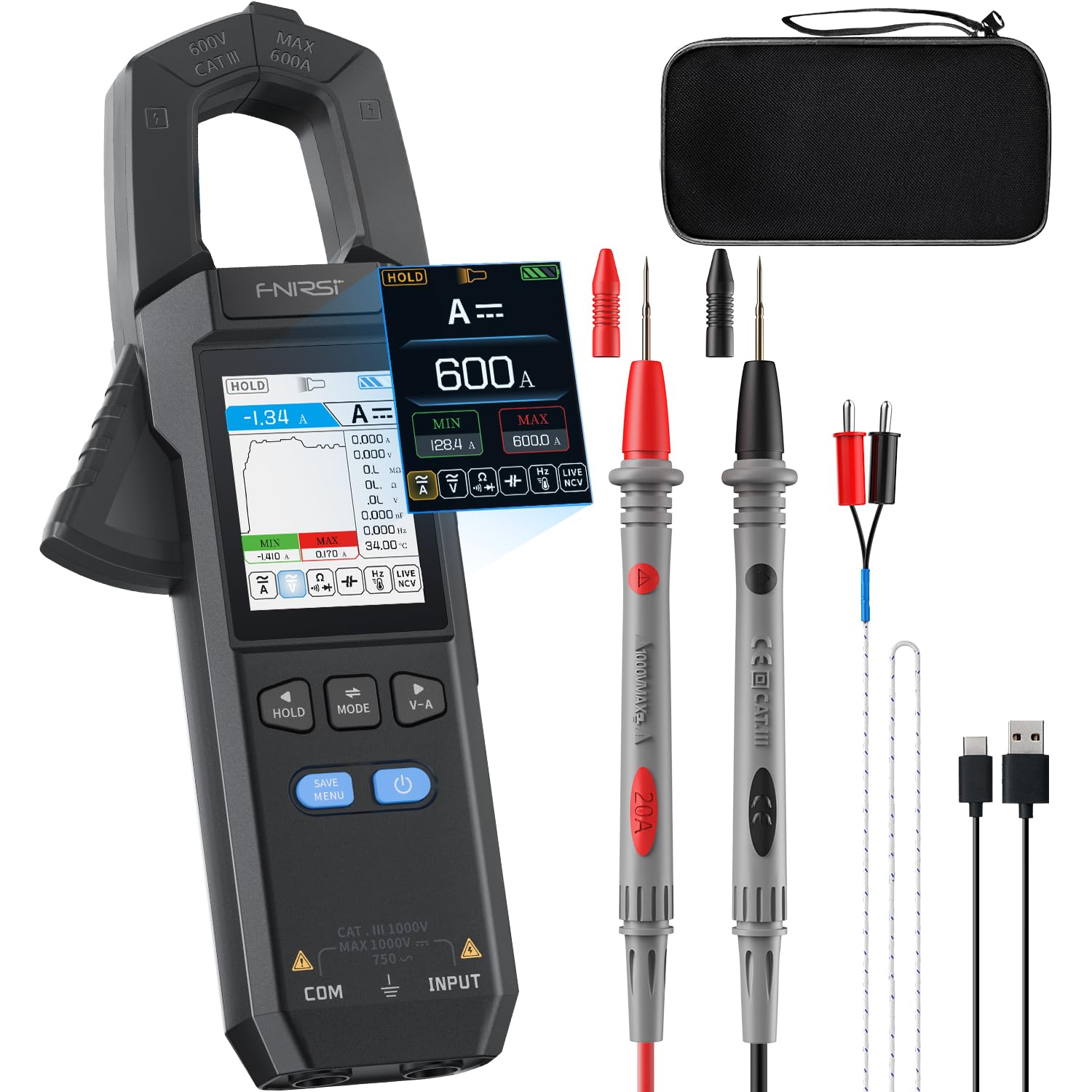
If the user requires advanced data logging and a higher resolution display, the FNIRSI DMC-100 Clamp Meter offers 9999 counts, a 2‑inch TFT color screen, and built‑in storage for up to 30 historical records. At $45.59 and a 4.6‑star rating from 615 reviews, it also features a rechargeable 1500 mAh lithium battery and a 25 mm jaw suitable for larger conductors.
For users who desire a middle ground with higher resolution than the AstroAI 2000 but without a rechargeable battery, the AstroAI 4000 Count Clamp Meter delivers 4000 counts, AC/DC voltage, frequency measurement, and a built‑in flashlight. It is priced at $35.99 and holds a 4.5‑star rating from 3,183 reviews.
Each of these meters includes data‑hold, max/min tracking, and audible/visual alarms that are crucial for capturing brief inrush events without missing data.
Step 2: Gather Appliance Nameplate Data
Locate the nameplate on the refrigerator or AC unit. The nameplate typically lists the rated voltage (e.g., 120 V or 240 V), full‑load amperage (FLA), and power consumption in watts. Record these values in a notebook because they will be used to verify the measured inrush current against the manufacturer's specifications.
For example, a typical residential refrigerator may show 120 V, 5 A FLA, and 600 W. An air‑conditioner compressor might list 240 V, 12 A FLA, and 2,800 W. These numbers provide a baseline for normal operating current, which is usually far lower than the peak surge current.
It is also advisable to note the type of compressor (scroll, reciprocating, or rotary) because different designs exhibit distinct inrush characteristics. Scroll compressors often have lower inrush peaks than reciprocating models.
Having this data on hand will simplify the calculation step and help you decide whether the measured peak is within acceptable limits.
Step 3: Ensure Safety Precautions
Before any measurement, turn off the appliance at the circuit breaker and disconnect it from the power source. Wear insulated gloves and verify that the work area is dry. Use a non‑contact voltage tester (available on all three clamp meters) to confirm that the wires are de‑energized.
Once the area is verified safe, reconnect the appliance to the power source but keep the circuit breaker in the "ON" position. This allows the compressor to start and generate the inrush current while you remain protected.
Maintain a clear line of sight to the clamp meter display and avoid touching exposed conductors. If possible, have an assistant monitor the circuit breaker for any unexpected trips.
These precautions minimize the risk of electric shock and protect both the operator and the measuring equipment.
Step 4: Measure Inrush Current with the Clamp Meter
Open the jaws of the selected clamp meter and position them around a single supply conductor (not the entire cord). The jaw should be centered on the wire to ensure accurate magnetic field detection. For a refrigerator on a 120 V circuit, clamp around the live (black) wire; for a 240 V AC unit, clamp around one of the two hot legs.
Activate the data‑hold function before the compressor starts. Most modern clamp meters, including the AstroAI 4000 Count model, allow you to press the "Hold" button to freeze the reading at the moment of peak current. The FNIRSI DMC‑100 offers a similar feature along with a graphical curve that can capture the entire inrush waveform.
Turn the appliance back on and observe the meter. The initial surge will appear as a sharp spike, often lasting only a few hundred milliseconds. Record the maximum value displayed. For example, the AstroAI 2000 Count may show 35 A for a refrigerator that normally draws 5 A.
If the meter includes a max/min function, you can review the recorded peak after the event. Some meters also provide audible alarms that signal when the current exceeds a preset threshold, which can be useful for repetitive testing.
Step 5: Apply the Inrush Current Formula
While direct measurement is the most reliable method, it is helpful to understand the theoretical basis. For an inductive load, the inrush current (I_peak) can be approximated by:
I_peak ≈ V × √2 / (R + ωL)
where V is the RMS supply voltage, R is the winding resistance, L is the inductance, and ω = 2πf (f = 60 Hz in North America). Because L is typically much larger than R, the denominator is dominated by the inductive reactance (ωL), causing a high initial current that decays as the magnetic field builds.
In practice, you can use the measured inrush value as I_peak and compare it to the calculated estimate to verify consistency. If the measured value deviates significantly (e.g., more than 20 %), re‑measure to ensure the clamp meter was correctly positioned and the jaws were not saturated.
Document both the measured and calculated values in your report, noting any assumptions made about R and L.
Step 6: Size Protective Devices Appropriately
With the peak surge current known, select a circuit breaker or fuse that can tolerate the inrush without nuisance tripping. Standard residential breakers are typically rated for 125 % of the continuous load but must also accommodate short‑duration surges. A common rule of thumb is to choose a breaker rated at least 1.5 times the measured inrush current for compressors.
For example, if a refrigerator exhibits a 35 A inrush, a 50 A breaker would provide sufficient margin, whereas a 30 A breaker might trip during start‑up. Verify local electrical codes, as some jurisdictions require specific inrush‑rated breakers for motor loads.
Document the chosen protective device, its rating, and the justification based on the measured inrush. This information is valuable for electricians, inspectors, and future maintenance personnel.
Finally, label the circuit in the breaker panel with the measured inrush value and the selected breaker size to aid troubleshooting.
Tips & Pro Tips
- Always use a clamp meter with a jaw opening that comfortably fits the conductor; a jaw that is too small may saturate and give inaccurate readings.
- If the appliance has a soft‑start feature, the inrush current will be lower; be sure to test the unit in its normal operating mode.
- Record ambient temperature because resistance varies with temperature, affecting the inrush calculation.
- For repeated testing, the FNIRSI DMC‑100’s data‑curve storage allows you to compare multiple start‑up events side‑by‑side.
- When measuring a three‑phase AC unit, clamp around a single phase and repeat for each phase to identify any imbalance.
Troubleshooting
Problem: The clamp meter shows a constant high reading instead of a spike.
Solution: Ensure the jaws are only around one live conductor; clamping around both hot and neutral wires cancels the magnetic field and can produce erroneous results.
Problem: The meter displays "OVER" or saturates during inrush.
Solution: Use a meter with a higher current rating, such as the AstroAI 4000 Count model, which can handle larger peaks without saturation.
Problem: No audible alarm is heard during high inrush.
Solution: Verify that the non‑contact voltage alarm is enabled and that the volume is not muted; some meters require a separate setting for audible alerts.
Conclusion
Calculating peak surge (inrush) current for refrigerator and AC compressor inductive loads involves careful measurement, a solid understanding of motor physics, and appropriate selection of protective devices. By following the step‑by‑step process outlined in this guide, one can obtain accurate inrush values, compare them to theoretical estimates, and size circuit breakers to prevent nuisance trips. The recommended clamp meters—AstroAI 2000 Count, FNIRSI DMC‑100, and AstroAI 4000 Count—provide the necessary features to capture brief surges reliably. Armed with this knowledge, electricians and DIY enthusiasts can ensure safe, reliable operation of household inductive appliances.
Products Mentioned in This Guide
Frequently Asked Questions
What is inrush (peak surge) current and why does it matter for refrigerators and AC compressors?
Inrush current is the brief, high‑current draw when a compressor motor starts, often several times the running current, and it can trip breakers or stress wiring if not accounted for.
How can I measure the inrush current of a refrigerator or AC compressor?
Use a digital clamp meter with AC current and data‑hold functions to clamp around the live conductor during motor start, noting the peak reading.
What formula is used to calculate expected inrush current from nameplate data?
A common estimate is I_inrush ≈ (V × √2) / (Z_start), where Z_start is the motor’s starting impedance, often approximated as 1/5 to 1/7 of the running current.
Which protective device should I select to handle the surge without nuisance tripping?
Choose a circuit breaker or fuse rated for at least 1.5‑2 × the calculated inrush current and ensure the wiring gauge matches the continuous load current.
What safety precautions are needed when testing inrush current on these appliances?
Turn off power before connecting meters, wear insulated gloves, keep the area clear, and never touch live conductors while the motor is starting.