Introduction
Anyone who spends extended time living or traveling in a recreational vehicle knows that reliable power is essential. One of the most common challenges is keeping the house batteries charged while avoiding over‑charging or deep‑discharge. This guide explains how to prioritize battery charging sources—solar, alternator, generator and shore power—so that each source is used efficiently and safely. Readers will learn practical steps, recommended tools, and best‑practice tips that protect battery life and ensure a comfortable RV experience.
What You'll Need
- Victron 12V Car Battery Charger (smart charger with adaptive management)
- Voltset 20W Solar Battery Charger (MPPT solar panel kit)
- LANDERPOW 3000W Pure Sine Wave Inverter (for AC loads and power distribution)
- Standard RV wiring accessories, fuses, and battery monitors
- Protective gloves and basic hand tools
Step 1: Assess Battery Capacity and Power Consumption
Before connecting any charger, one must understand the total amp‑hour capacity of the house battery bank and the daily load demand. Calculate the sum of all AC and DC loads, then compare this figure with the battery capacity to determine the required depth of discharge. Use a digital battery monitor to record voltage, current and state‑of‑charge in real time. This assessment informs which charging source should be engaged first and how long each source must operate.
When the battery bank is sized appropriately, the alternator can handle routine recharging during travel, while solar panels provide supplemental charge when parked. The smart charger serves as a backup to top‑off the batteries after long trips or when shore power is unavailable. Finally, the inverter converts DC to AC for sensitive electronics without compromising battery health.
Step 2: Install and Configure the Solar Charger
Solar energy is the most efficient source for maintaining a steady charge while the RV is stationary. Mount the Voltset 20W Solar Battery Charger on a roof rack or awning where it receives maximum sunlight. The panel’s high‑efficiency MPPT controller extracts up to 30 % more power than conventional charge controllers, reducing charging time for 12 V batteries. Secure the mounting brackets using the pre‑drilled holes; the installation requires no tools and can be completed in under five minutes.
After mounting, connect the solar leads to the battery bank through a fuse block rated for at least 30 A. The charger automatically stops charging when the battery reaches full voltage and resumes when the voltage drops, preventing over‑charge. Its waterproof IP67 rating ensures reliable operation in rain, snow or extreme heat, making it suitable for any climate. The LED indicators provide a quick visual check of the charging status, which is especially useful for night‑time monitoring.
Key specifications of the Voltset solar charger include:
- 20 W monocrystalline panel with MPPT technology
- Universal compatibility with AGM, Gel, LiFePO4 and lead‑acid batteries
- Built‑in multi‑layer protection against over‑charge, reverse polarity and short circuit
- Price: $39.99, Rating: 4.6/5.0 (1,464 reviews)
Step 3: Use the Alternator for On‑The‑Road Charging
When the RV is being driven, the engine’s alternator supplies a substantial amount of charge to both the starter battery and the house bank. However, direct connection can lead to uneven charging if the alternator voltage is not regulated. The Victron 12V Car Battery Charger acts as a smart DC‑DC charger that steps down the alternator output to a safe, optimized charging profile for deep‑cycle batteries.
Install the Victron charger between the alternator and the house battery using appropriate ring terminals. The charger’s microprocessor‑controlled adaptive battery management automatically selects the correct bulk‑absorption‑float algorithm for the specific battery chemistry. Its 94 % efficiency generates four times less heat than conventional chargers, reducing wear on both the charger and the battery.
Additional benefits include wireless monitoring via Bluetooth, allowing the user to view real‑time voltage and current on a smartphone app. Firmware updates add new features without replacing hardware, extending the product’s lifespan. The charger also supports lithium‑ion batteries, making it a versatile tool for modern RVs that use lightweight lithium packs.
Key specifications of the Victron charger include:
- 30 A output with adaptive battery management
- 94 % efficiency, low heat generation
- Bluetooth connectivity for remote monitoring
- Price: CAD225.97, Rating: 4.6/5.0 (533 reviews)
Step 4: Integrate Generator or Shore Power for Rapid Recharging
During extended stays or high‑load periods, the solar panel may not provide sufficient power, and the alternator is unavailable. In these situations, a portable generator or shore power connection can quickly replenish the battery bank. Connect the generator or shore power to a dedicated AC input on the LANDERPOW 3000W Pure Sine Wave Inverter. The inverter’s pure sine wave output mimics utility power, protecting sensitive electronics such as laptops, CPAP machines and LED lighting from harmonic distortion.
When shore power is present, plug the inverter into the campsite’s 120 V outlet. The inverter’s built‑in charger will convert AC to DC, delivering a fast charge to the house batteries while simultaneously providing AC power to appliances. The device includes three AC outlets, a hard‑wired terminal for high‑current tools, a 30 W USB‑C PD port and a standard USB port, allowing multiple devices to be powered from a single unit.
The inverter’s remote controller features an LED screen that displays battery voltage, load current and error codes. This real‑time feedback enables the user to adjust load distribution and avoid over‑loading the system. With a surge capacity of 6000 W, the inverter can start heavy appliances such as a coffee maker or a small air conditioner without tripping the circuit.
Key specifications of the LANDERPOW inverter include:
- 3000 W continuous, 6000 W surge pure sine wave output
- >91 % conversion efficiency
- Three AC outlets, 30 W USB‑C PD, 5 V/3.1 A USB, hard‑wired terminal
- Included 1 AWG copper battery cables for safe high‑current delivery
- Price: $149.99, Rating: 4.5/5.0 (149 reviews)
Step 5: Manage Power Distribution and Monitor Battery Health
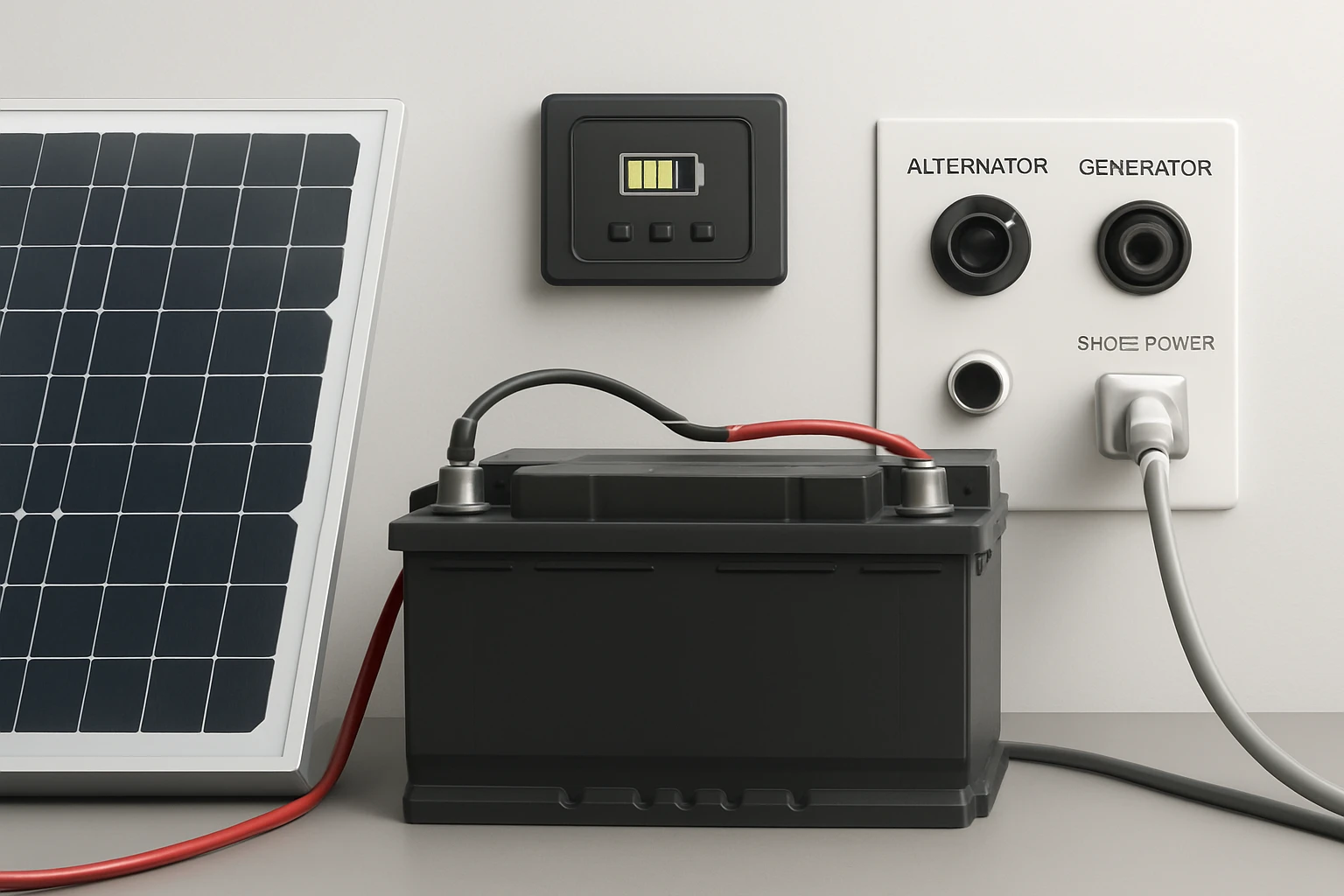
With multiple charging sources active, it is essential to prioritize them to prevent conflicts and maximize efficiency. A common hierarchy is: solar first, alternator second, inverter (generator/shore) third, and smart charger last for topping off. Use a battery management system (BMS) or a digital monitor to set charge‑acceptance thresholds for each source. For example, configure the Victron charger to engage only when the battery voltage falls below 12.2 V, while allowing the solar controller to operate down to 11.8 V.
Implement a simple flowchart on the RV’s control panel that indicates which source is active. This visual aid helps the user quickly identify the current charging mode and adjust loads accordingly. Regularly inspect all connections for corrosion, tighten any loose terminals, and verify that fuses are correctly rated. Maintaining clean, secure connections reduces voltage drop and improves overall system efficiency.
Finally, schedule a monthly deep‑cycle test by fully charging the battery bank, then discharging it to 50 % using a controlled load. Record the time required for each charging source to restore the battery to full capacity. Over time, this data reveals which source provides the fastest recovery and highlights any degradation in battery performance.
Tips & Pro Tips
- Place solar panels at a 30‑degree angle facing true south (or north in the southern hemisphere) for optimal sun exposure.
- Use high‑quality battery cables (minimum 4 mm² for 30 A circuits) to minimize resistance and heat buildup.
- Enable Bluetooth monitoring on the Victron charger to receive push notifications when the battery reaches full charge.
- When using a generator, let it run at 50 % load for the first ten minutes to warm up, then increase to the desired power level. This reduces wear on the engine.
- Store the LANDERPOW inverter in a ventilated compartment; even with high efficiency, it can generate heat during prolonged use.
- Consider adding a solar charge controller with temperature compensation if you frequently camp in extreme climates.
Troubleshooting
Problem: Battery voltage does not rise after connecting solar panel.
Solution: Verify that the panel is receiving direct sunlight and that the MPPT controller is not in night‑mode. Check the fuse rating and ensure the connections are tight. If the panel is shaded, reposition it or clean any debris covering the surface.
Problem: Inverter trips immediately when a high‑draw appliance is plugged in.
Solution: Confirm that the battery bank voltage is above 12 V and that the 1 AWG cables are securely attached. Reduce the load by disconnecting non‑essential devices, then restart the inverter. If the problem persists, inspect the hard‑wired terminal for loose connections.
Problem: Victron charger does not start charging after a long drive.
Solution: Ensure the Bluetooth app shows the correct battery state‑of‑charge. If the charger reports “float” mode, manually set it to “bulk” using the app. Check that the alternator voltage is within the charger’s input range (13.5‑14.8 V).
Conclusion
Balancing solar, alternator, generator and shore power requires careful planning, proper equipment and diligent monitoring. By assessing battery capacity, installing a high‑efficiency solar charger, using a smart DC‑DC charger for alternator input, integrating a pure sine wave inverter for rapid recharging, and managing power distribution with a clear hierarchy, RV owners can extend battery life and enjoy reliable power on every adventure. Implement the steps outlined in this guide, apply the pro tips, and troubleshoot any issues promptly to maintain a robust charging system.
Products Mentioned in This Guide
Frequently Asked Questions
How should I prioritize solar, alternator, generator, and shore power when charging my RV batteries?
Use solar first for continuous low‑current charge, then alternator while driving, followed by generator for higher demand, and reserve shore power for final top‑up or heavy loads.
What is the benefit of a smart charger like the Victron 12V Car Battery Charger?
It automatically adjusts voltage and current to prevent over‑charging and extends battery life with adaptive management.
Can I connect a solar MPPT charger and the alternator to the same battery bank safely?
Yes, provided you use a proper battery isolator or DC‑DC charger to prevent back‑feeding and ensure each source charges independently.
How do I determine the right size of solar panel for my RV’s daily power needs?
Calculate your total daily amp‑hour consumption and select a solar panel that can supply at least 10‑20% of that load under typical sunlight conditions.
What safety accessories are essential when setting up multiple charging sources?
Install appropriate fuses, a battery monitor, and use protective gloves and insulated tools to prevent shorts and monitor charge status.