Introduction
In this guide the reader will learn how to select, install, and optimise a portable solar array for overlanding adventures. The content explains each phase from assessing energy demand to wiring the system and fine‑tuning performance. By following the step‑by‑step instructions the reader can achieve reliable off‑grid power without excessive trial and error. The guide also highlights specific products that simplify the process while maintaining a focus on practical technique.
What You’ll Need
The essential items for a functional overlanding solar setup include:
- Portable solar panels (recommended models are listed below)
- Charge controller compatible with the panel voltage and battery chemistry
- Deep‑cycle battery or power station to store energy
- MC4 or compatible connectors, cables, and adapters
- Kickstand or mounting brackets for stable panel placement
- Tools such as a wrench, screwdriver, and cable ties
All of the recommended panels arrive with most of the required accessories, reducing the need for additional purchases.
Step 1: Assess Power Requirements
The first task is to calculate the daily energy consumption of the overlanding rig. List every device that will be powered, note its wattage, and estimate the number of operating hours per day. Multiply wattage by hours to obtain watt‑hours, then add a safety margin of 20 % to accommodate cloudy periods. For example, a 60 W refrigerator running eight hours consumes 480 Wh; a 30 W LED light used four hours adds 120 Wh, resulting in a total of 600 Wh plus margin, roughly 720 Wh.
Understanding the required storage capacity guides the selection of battery size and informs the total panel wattage needed to recharge the battery within daylight hours.
Step 2: Choose Appropriate Solar Panels
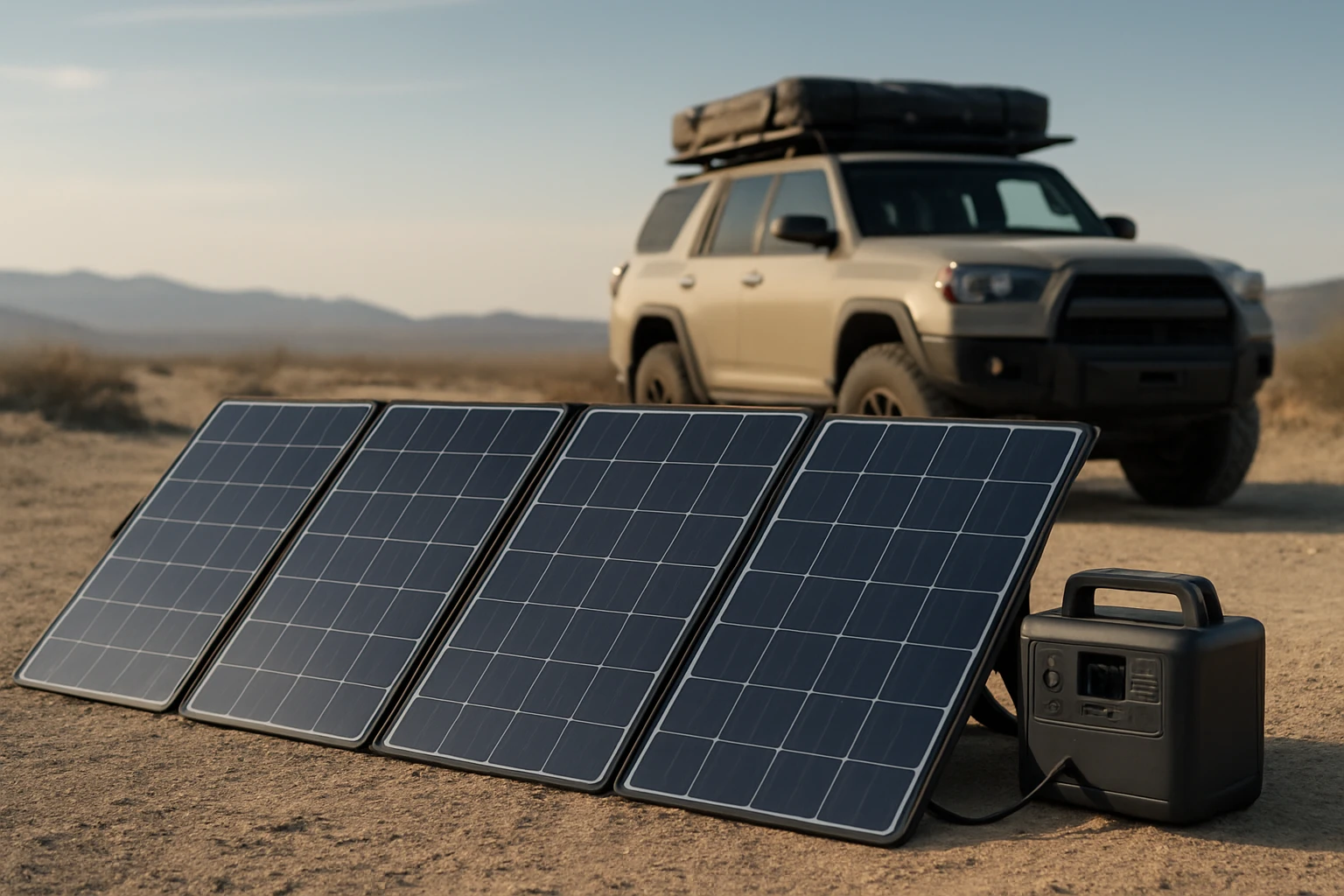
Based on the calculated energy demand, select panels that can deliver the necessary wattage while fitting within the vehicle’s storage constraints. The Renogy 400W Portable Solar Panel Suitcase provides a high‑efficiency 23 % monocrystalline array in a foldable case that weighs 30.2 lb and folds to 33.7"×27.95". Its sturdy rust‑proof kickstands enable a one‑minute setup, and the IP68 waterproof connectors ensure reliable operation in rain or snow. At a price of $508.37 and a rating of 4.3 / 5 from 258 reviews, it offers durability for demanding overland routes.
For travelers seeking a lighter and more compact option, the TWELSEAVAN 200W Foldable Solar Panel delivers 24 % conversion efficiency in a 15.7 lb package that folds to 23"×22". It includes a 9.8 ft MC4 cable, four adjustable kickstands, and dual USB‑C/ QC3.0 fast‑charging ports, making it ideal for charging small electronics directly. Priced at $179.99 with a 4.5 / 5 rating from 729 reviews, it balances power output and portability.
Both panels feature parallel wiring that mitigates the impact of partial shading, a valuable attribute for forested or mountainous routes where shadows are common.
Step 3: Select a Charge Controller and Battery
A maximum‑power‑point‑tracking (MPPT) charge controller maximises energy harvest from high‑efficiency panels. Pair the controller with a lithium‑iron‑phosphate (LiFePO4) battery or a compatible power station to store energy safely. The controller should support the panel voltage range (up to 60 V for the Renogy 400W) and provide sufficient amperage for the chosen battery capacity. Although specific models are not listed, most reputable brands such as Victron or Renogy offer MPPT controllers that integrate seamlessly with the recommended panels.
When connecting the battery, observe polarity carefully and use the provided MC4 connectors or appropriate adapters. The separate PWM controller included with the DOKIO 150W Foldable Solar Panel Kit illustrates the importance of dedicated charge regulation for safety.
Step 4: Mount and Position the Panels
Stability is critical for optimal sun exposure and panel longevity. Deploy the built‑in kickstands on the Renogy or TWELSEAVAN panels, adjusting the angle to match the sun’s elevation for the current latitude. A tilt of 30‑45° typically yields the highest output during midday. Secure the panels to a roof rack or ground frame using straps or bungee cords, ensuring that the mounting points do not interfere with the water‑proof seals.
The Renogy panel’s rust‑proof kickstands are engineered for rugged terrain, while the TWELSEAVAN panel’s four adjustable legs allow fine‑tuning on uneven ground. Both designs enable a setup time of less than two minutes, which is valuable when weather conditions change rapidly.
Step 5: Wire the System Correctly
Begin by connecting the panel’s MC4 output to the charge controller using the supplied 9.8 ft cable (TWELSEAVAN) or the appropriate MC4 connectors on the Renogy panel. Ensure that the positive and negative leads are matched correctly; an inverted connection can damage the controller. If additional length is required, use MC4‑compatible extension cables rated for outdoor use.
From the controller, run a suitably gauged cable to the battery or power station, observing the recommended amperage limits. For systems that require multiple panels in parallel, use a Y‑connector that maintains individual panel independence, preserving the shading‑mitigation benefit.
Finally, attach any USB‑C or QC3.0 ports directly to devices if immediate charging is desired, as provided on the TWELSEAVAN panel. This bypasses the battery for low‑power gadgets, conserving stored energy for larger loads.
Step 6: Test, Monitor, and Optimise
After wiring, power on the charge controller and verify that the voltage and current readings correspond to the panel specifications. A 400 W panel under full sun should deliver approximately 22 A at 18 V; the 200 W panel should show around 11 A at the same voltage. Use a multimeter or the controller’s built‑in display to confirm these values.
Monitor the battery state of charge throughout the day. If the battery does not reach the desired level, consider adding a second panel in parallel or adjusting the tilt angle to capture more sunlight. Seasonal variations may require a higher tilt during winter months.
Regularly clean the panel surface to remove dust or bird droppings, as even a thin film can reduce efficiency by several percent.
Tips & Pro Tips
- Plan the panel placement before departure; a pre‑mounted roof rack reduces setup time at the campsite.
- Use a portable solar tracker or a simple swivel mount to follow the sun’s path during extended stays.
- Employ cable ties and waterproof tape to protect connections from moisture and vibration.
- Store the panels in their carry cases when not in use to prevent scratches and UV degradation.
- When over‑paneling (using more panel wattage than the battery can accept), rely on the MPPT controller to limit input and avoid over‑charging.
Troubleshooting
Problem: Low output despite clear skies.
Solution: Verify that the panel is oriented correctly, clean the surface, and check for shading from nearby objects. Confirm that the MC4 connectors are fully seated.
Problem: Controller displays error code.
Solution: Inspect polarity, ensure the battery voltage is within the controller’s operating range, and examine cables for damage.
Problem: Intermittent charging after moving the vehicle.
Solution: Re‑tighten all cable clamps and inspect the kickstand bolts for looseness caused by vibration.
Conclusion
This guide has outlined a systematic approach to establishing a portable solar array for overlanding, from calculating energy needs to selecting high‑efficiency panels, installing secure mounting, wiring safely, and optimising performance. By applying the recommended steps and using the highlighted products, the reader can achieve dependable off‑grid power for refrigeration, lighting, communication, and entertainment while travelling through remote terrain.
Products Mentioned in This Guide
Frequently Asked Questions
How do I calculate the solar panel size needed for my overlanding trip?
Determine your daily energy consumption in watt‑hours, then divide by the average sunlight hours at your destination and add a safety margin of 20‑30%.
What type of charge controller is best for a portable overlanding solar setup?
A MPPT charge controller is preferred because it maximizes power extraction from the panels and works efficiently with varying voltages.
Can I use a standard deep‑cycle battery with a portable solar array?
Yes, but match the battery chemistry (e.g., AGM, lithium) to the charge controller settings to avoid over‑charging or damage.
How should I mount portable solar panels for stable performance while on the move?
Use a kickstand or lightweight mounting brackets that allow quick angle adjustment and secure the panels with straps or cable ties during travel.
What safety accessories are essential when wiring a portable solar system?
Include MC4 connectors, fuse or circuit breaker, proper gauge cables, and use cable ties to keep wiring tidy and protected from abrasion.