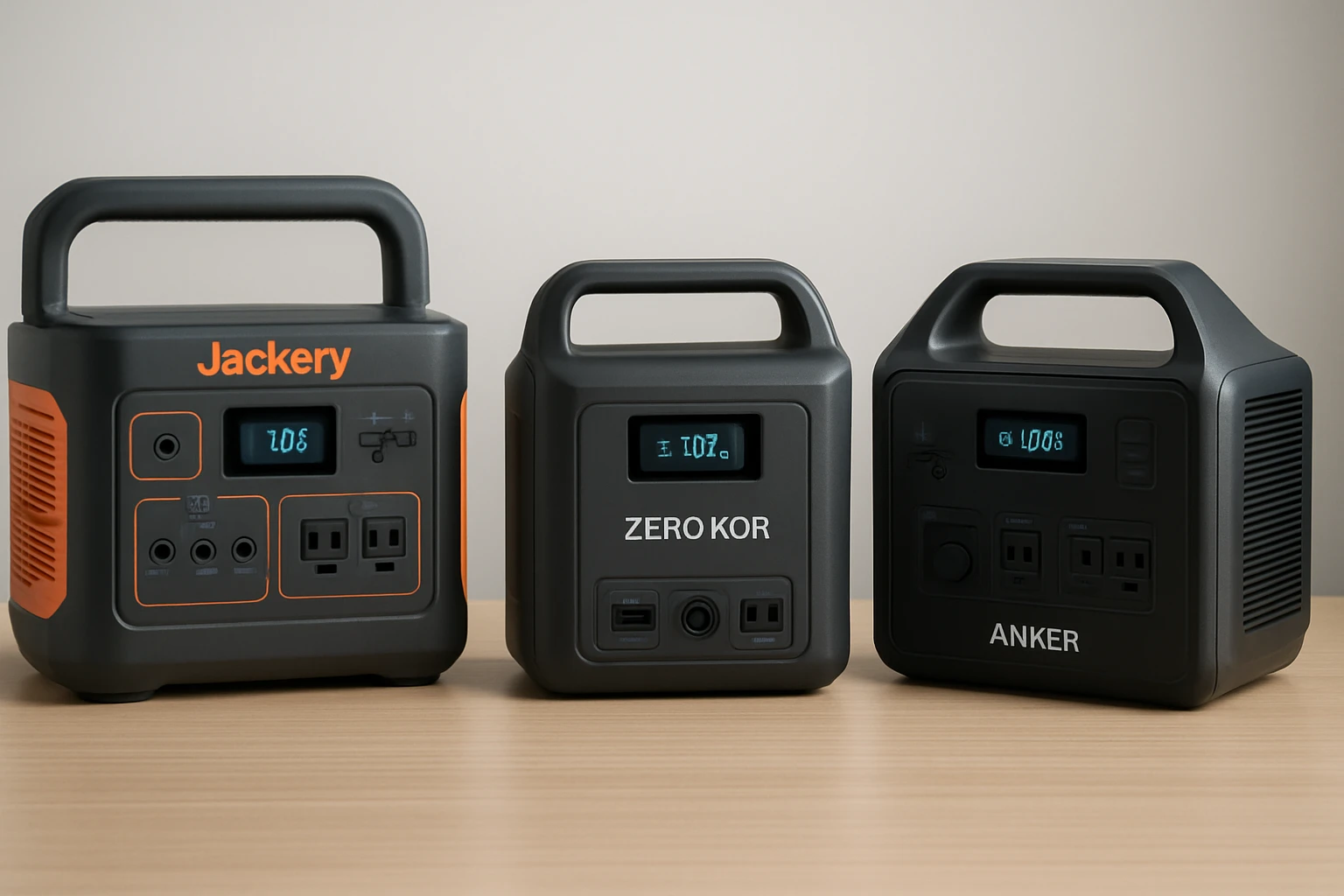
Introduction
Portable power stations have become essential for outdoor enthusiasts, remote workers, and emergency‑prepared households. This article compares four popular Amazon models – the Jackery Explorer 300, the ZeroKor 300W Solar Generator, the Anker SOLIX C300, and the Anker SOLIX C2000 Gen 2. Understanding their differences helps buyers select a unit that matches budget, power needs, and portability requirements.
Individual Product Overviews
Jackery Explorer 300
The Jackery Explorer 300 offers a 293 Wh lithium‑ion battery and 300 W continuous pure sine wave output. Weighing only 7.1 lb, it features two AC outlets, a 60 W PD USB‑C port, a fast‑charge 3.0 USB‑A port, and a DC car port. Recharge time is 2 hours for 80 % capacity using a wall outlet and the USB‑C port simultaneously. The unit ships with an AC adapter and car charger cable; a SolarSaga 100 W panel is sold separately.
Customer sentiment highlights reliability: “Great product! It is useful for all emergencies… it kept lights on and devices charged until power was restored.” (5‑star review). The device holds a 4.6/5 rating from 11,152 reviewers and is priced at $189.
ZeroKor 300W Solar Generator
ZeroKor’s offering packs a 280 Wh battery with a 300 W continuous AC output and includes a foldable 60 W monocrystalline solar panel. It supplies two AC outlets, one DC port, three USB‑A ports, a quick‑charge USB‑C port, and an SOS flashlight with reading mode. The built‑in BMS provides short‑circuit, over‑current, over‑voltage, overload, and overheating protection.
Reviews praise durability: “This power station exceeded my expectations… it ran a night‑light, iPhone, AirPods, Apple Watch, and tablet for 8 hours.” (4‑star review). The unit rates 4.3/5 from 1,551 reviewers and costs $177.88.
Anker SOLIX C300
The SOLIX C300 delivers 288 Wh of LiFePO4 capacity, 300 W continuous (600 W surge) power, and fast two‑way USB‑C charging up to 140 W. It includes three AC outlets, a 120 W car socket, two high‑power USB‑C ports, a 15 W USB‑C port, and a 12 W USB‑A port. Anker advertises 80 % recharge in 50 minutes via wall outlet, and the unit ships with a 60 W solar panel.
Users note quiet operation and smart app integration: “this little thing super convenient… the app shows temperature, watt input, and output.” (5‑star review). The model holds a 4.6/5 rating from 288 reviewers and is priced at $329.99.
Anker SOLIX C2000 Gen 2
The C2000 Gen 2 is a high‑capacity station with a 2,048 Wh LiFePO4 battery, 2,400 W continuous (4,000 W surge) output, and optional expansion to 4 kWh. It can be fully recharged in 58 minutes via AC or 800 W alternator charging from a vehicle. At 41.7 lb, it remains portable for its class and includes multiple AC, USB‑C, and car ports.
Reviewers emphasize speed and robustness: “I’ve had the Anker SOLIX C2000 for about a month, and it’s been awesome… it charges crazy fast and runs just about anything.” (5‑star review). The unit rates 4.7/5 from 188 reviewers and costs $789.
Head‑to‑Head Comparison
Price and Value
The ZeroKor 300W is the most affordable at $177.88, offering a modest 280 Wh capacity. Jackery follows at $189, providing slightly higher capacity (293 Wh) and a reputable brand name. Anker’s mid‑range C300 costs $329.99, reflecting its LiFePO4 chemistry, faster USB‑C charging, and premium app. The C2000 Gen 2 commands $789, targeting users who need home‑backup power and extended runtimes.
Features and Specifications
All four units support AC, USB, and car charging, but they differ in output power and expandability. Jackery and ZeroKor each deliver 300 W continuous output, while Anker’s C300 matches that level but adds a 600 W surge and two high‑power USB‑C ports. The C2000 Gen 2 dwarfs the others with 2,400 W continuous power and optional 4 kWh expansion. Solar compatibility is standard across the range, though only Jackery and ZeroKor explicitly mention MPPT controllers; Anker’s panels are proprietary.
Customer Ratings and Feedback
Jackery and Anker C300 share a 4.6 rating, reflecting strong satisfaction. The C2000 Gen 2 leads with 4.7, indicating that users value its speed and capacity despite a higher price. ZeroKor’s 4.3 rating suggests solid performance but occasional concerns about slower recharge speed, as noted in a review: “the recharge input speed is on the slow side.”
Performance and Reliability
Jackery’s pure sine wave inverter and 2‑hour 80 % recharge time make it reliable for short‑term outages. ZeroKor’s built‑in BMS protects devices, though its 300 W limit means high‑draw appliances (hair dryers, coffee makers) could overload the unit. Anker’s LiFePO4 cells provide longer cycle life (3,000 cycles) and operate quietly at 25 dB, a benefit for camping. The C2000 Gen 2’s ultra‑fast 58‑minute full charge and 800 W car charging set a new benchmark for rapid replenishment.
Best Use Cases
- Jackery Explorer 300: Ideal for weekend campers, RV trips, and emergency kits where weight (<8 lb) and quiet operation matter.
- ZeroKor 300W Solar Generator: Suited for budget‑conscious users who need a compact solar‑ready unit for light‑duty camping and short‑term power tools.
- Anker SOLIX C300: Great for tech‑savvy travelers who appreciate fast USB‑C charging, app monitoring, and a balance of capacity and portability.
- Anker SOLIX C2000 Gen 2: Best for homeowners seeking a backup power source capable of running appliances such as refrigerators, HVAC, or workshop tools during prolonged outages.
Comparison Table
| Product | Battery Capacity (Wh) | Continuous Power (W) | Surge Power (W) | Weight (lb) | Price (USD) | Rating |
|---|---|---|---|---|---|---|
| Jackery Explorer 300 | 293 | 300 | 300 | 7.1 | 189.00 | 4.6 (11,152) |
| ZeroKor 300W Solar Generator | 280 | 300 | 300 | Not specified | 177.88 | 4.3 (1,551) |
| Anker SOLIX C300 | 288 | 300 | 600 | Not specified | 329.99 | 4.6 (288) |
| Anker SOLIX C2000 Gen 2 | 2048 | 2400 | 4000 | 41.7 | 789.00 | 4.7 (188) |
Pros & Cons
Jackery Explorer 300
- Pros: Lightweight (7.1 lb), fast 2‑hour 80 % recharge, pure sine wave AC, strong brand reputation.
- Cons: Solar panel sold separately, no expandable battery, limited to 300 W max load.
ZeroKor 300W Solar Generator
- Pros: Includes 60 W solar panel, comprehensive protection circuit, affordable price.
- Cons: Slower recharge speed, no USB‑C input, weight not disclosed, limited to 300 W.
Anker SOLIX C300
- Pros: LiFePO4 battery longevity, 140 W two‑way USB‑C fast charging, app monitoring, quiet operation.
- Cons: Higher price, strap not included, weight not listed.
Anker SOLIX C2000 Gen 2
- Pros: Massive 2,048 Wh capacity, 2,400 W continuous output, 58‑minute full charge, expandable to 4 kWh.
- Cons: Heaviest (41.7 lb), premium cost, may be overkill for casual campers.
Recommendations
For users who need a portable, lightweight solution for short trips, the Jackery Explorer 300 provides the best balance of price, weight, and reliable pure sine wave power.
Budget‑focused campers who want an all‑in‑one solar kit should consider the ZeroKor 300W Solar Generator. Its included panel and solid protection make it a practical entry‑level choice.
Tech‑oriented travelers who value fast USB‑C charging and smart‑phone integration will benefit most from the Anker SOLIX C300. The LiFePO4 chemistry ensures long‑term durability.
Homeowners or professionals requiring high‑power backup should select the Anker SOLIX C2000 Gen 2. Its rapid recharge, massive output, and expansion capability make it suitable for running refrigerators, power tools, or multiple AC units during extended outages.
FAQ
- Can these power stations be used indoors? Yes, all four units produce pure sine wave AC power, making them safe for indoor electronics.
- How long does it take to fully charge each model? Jackery: ~2 hours for 80 %; ZeroKor: slower, typical wall charge 6–8 hours; Anker C300: 50 minutes to 80 %; C2000 Gen 2: 58 minutes to 100 % via AC.
- Are the solar panels compatible across brands? Generally not. Jackery and ZeroKor use MPPT‑enabled panels, while Anker’s panels are proprietary and only work with their respective units.
- What is the expected lifespan of the batteries? LiFePO4 cells in the Anker models are rated for 3,000 cycles, often exceeding 10 years. Jackery’s lithium‑ion cells typically last 500–800 cycles, while ZeroKor’s specifications are not disclosed.
- Do any of these units have built‑in lighting? Both the ZeroKor and Anker C300 include built‑in LEDs (SOS flashlight for ZeroKor, front light bar for Anker). Jackery does not have an integrated light.
- Can I expand the battery capacity? Only the Anker C2000 Gen 2 offers an optional expansion battery to reach 4 kWh. The other models have fixed capacities.
- Which unit is the quietest? Anker’s C300 operates at 25 dB, making it the quietest; Jackery and ZeroKor are also low‑noise, while the larger C2000 Gen 2 produces a modest fan sound under heavy load.
Conclusion
Each power station excels in a specific niche. The Jackery Explorer 300 delivers lightweight convenience for everyday emergencies. ZeroKor offers the most economical entry point with an included solar panel. Anker’s SOLIX C300 balances modern fast‑charging technology with reliable LiFePO4 performance. Finally, the SOLIX C2000 Gen 2 stands as a premium solution for high‑power home backup and professional use. By matching the device to one’s power demand, budget, and portability needs, consumers can make an informed purchase that will serve them well for years.
Products Mentioned in This Review
Frequently Asked Questions
What is the battery capacity and continuous output of the Jackery Explorer 300?
It has a 293 Wh lithium‑ion battery and delivers 300 W of continuous pure sine wave power.
How does the ZeroKor 300W Solar Generator differ in weight and ports compared to the Jackery Explorer 300?
The ZeroKor is slightly heavier and typically includes fewer AC outlets but offers similar 300 W output with dedicated solar input ports.
Which model provides the highest power output among the four reviewed?
The Anker SOLIX C2000 Gen 2 delivers the highest output, supporting up to 2 000 W peak power.
Are all four portable power stations compatible with solar panels?
Yes, each unit can be charged via compatible solar panels, though charging speed varies by model and panel wattage.
What are the key factors to consider when choosing between these portable generators?
Consider battery capacity, continuous wattage, weight, available ports, and your typical power‑needs such as camping, remote work, or emergency backup.