Series vs Parallel Wiring for Solar Panels: The Ultimate Guide to Battery Charging, Efficiency & Safety
Introduction
This guide explains the fundamental differences between series and parallel wiring configurations for solar panels. Readers will learn how each topology influences voltage, current, battery charging, overall system efficiency, and safety considerations. The article also recommends proven accessories that simplify installation and improve reliability. By the end of the guide, one will be able to select the optimal wiring strategy for a specific application and avoid common pitfalls.
Background/Context
Solar photovoltaic (PV) modules generate direct current (DC) that must be matched to the battery bank and charge controller. The two primary ways to interconnect panels are in series, which adds voltage while keeping current constant, and in parallel, which adds current while keeping voltage constant. Understanding Ohm’s law (V=IR) and the power equation (P=VI) is essential because charge controllers have maximum voltage and current limits. Most modern MPPT controllers, such as the Victron SmartSolar MPPT Controller, can handle a wide voltage range, but exceeding specifications can damage equipment or reduce efficiency.
Safety devices such as fuses, circuit breakers, and waterproof connectors protect against short circuits, over‑current, and environmental exposure. Selecting components with appropriate IP ratings (e.g., IP67 for connectors, IP68 for controllers) ensures long‑term durability in harsh outdoor conditions. The following sections break down each wiring method, illustrate practical use‑cases, and integrate product recommendations that meet the technical requirements described above.
Series Wiring
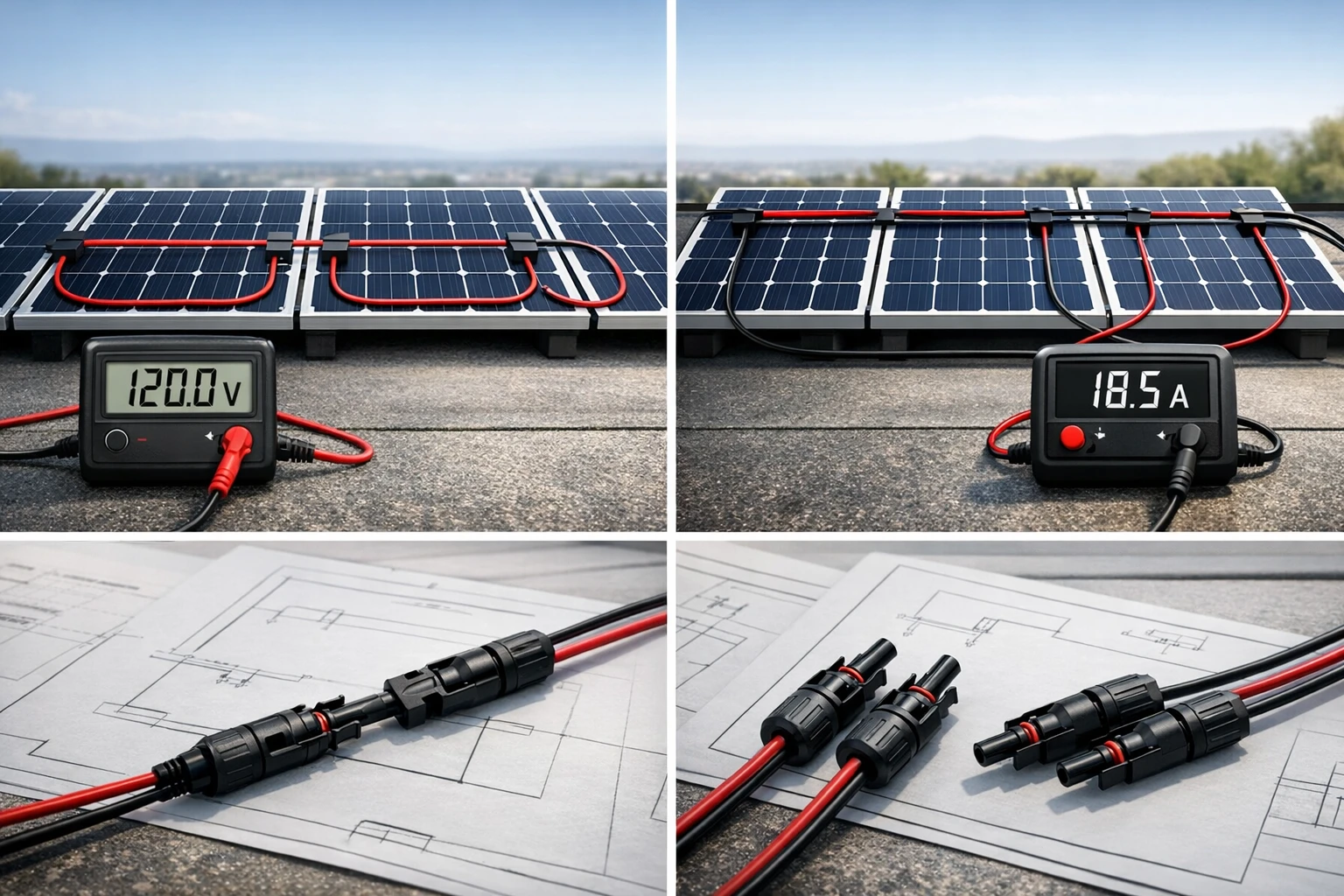
In a series arrangement, the positive terminal of one panel connects to the negative terminal of the next, creating a string that adds the voltage of each module while the current remains equal to the current of a single panel. For example, two 12 V, 6 A panels wired in series produce approximately 24 V at 6 A, which is advantageous when the charge controller’s maximum voltage rating is high but its current rating is limited.
Series wiring reduces resistive losses because the same current travels through fewer conductors, which can improve overall system efficiency, especially over long cable runs. However, the configuration is sensitive to shading: if one panel is partially shaded, the current of the entire string drops to the lowest panel’s output, potentially reducing power dramatically.
When designing a series‑only system, ensure that the total string voltage does not exceed the controller’s input limit. The Victron SmartSolar MPPT Controller supports up to 100 V, making it suitable for strings of three to four typical 12‑V panels. Use high‑quality MC4‑style connectors such as the BougeRV Y Branch Connectors if you need to branch the string for future expansion.
Parallel Wiring
Parallel wiring ties all positive terminals together and all negative terminals together, preserving the panel voltage while summing the current. Two 12 V, 6 A panels in parallel deliver 12 V at 12 A, which is ideal when the charge controller’s current rating is higher than its voltage rating, such as with many PWM controllers.
Parallel configurations are more tolerant of partial shading because each panel operates independently; a shaded panel contributes less current but does not drag down the whole array. The trade‑off is increased cable thickness to handle higher current and greater resistive losses, which can be mitigated by using appropriately sized conductors (e.g., 10 AWG for 20 A).
To keep connections secure and waterproof, the BougeRV Y Branch Connectors provide a 1‑to‑2 male‑to‑female (M/FF) and female‑to‑2‑male (F/MM) solution rated for 20 A, DC 1000 V, and IP67 protection. For larger parallel arrays, the BougeRV Y Branch Connectors (2 Pairs) offer the same specifications with a higher quantity, simplifying installation.
Hybrid Configurations
Many off‑grid and mobile applications combine series and parallel connections to achieve a target voltage and current that matches the charge controller and battery bank. A common hybrid is two strings of two panels in series, then those strings connected in parallel, yielding 24 V at 12 A.
Hybrid setups benefit from the voltage‑boost of series wiring while retaining the shading resilience of parallel wiring. However, they require careful balancing of string voltages and the use of equalizing devices such as bypass diodes or MPPT controllers that can perform maximum power point tracking for each string.
When building a hybrid system, the MUYI Solar Panel Tool Kit becomes valuable. It includes 10 pairs of male‑female connectors, additional pins, spanners, and a crimping tool, enabling precise termination of both series and parallel connections while maintaining IP67 sealing and UL94‑V0 flame‑retardant ratings.
Comparison/Selection Guide
| Criteria | Series Wiring | Parallel Wiring |
|---|---|---|
| Voltage to Controller | Higher – reduces current loss | Lower – matches low‑voltage controllers |
| Current to Controller | Constant – limited by single panel | Summed – may require larger conductors |
| Shade Sensitivity | High – one shaded panel reduces whole string | Low – each panel works independently |
| Cable Size | Smaller – lower current | Larger – higher current |
| Typical Use‑Case | Long runs, high‑voltage MPPT controllers | Short runs, PWM controllers, mobile rigs |
| Recommended Products | Victron SmartSolar MPPT Controller | BougeRV Y Branch Connectors & BougeRV Y Branch Connectors (2 Pairs) |
Choose series wiring when the controller’s voltage ceiling is the limiting factor and cable runs are long. Opt for parallel wiring when shading is likely or when using a PWM controller such as the HUINE Waterproof PWM Solar Controller, which operates best at 12‑24 V.
Best Practices & Tips
- Always size conductors according to the maximum expected current plus a safety margin of 25 %.
- Use connectors with an IP rating of at least 67 for outdoor exposure; the BougeRV Y Branch Connectors meet this requirement.
- Install a fuse or circuit breaker on the positive lead close to the battery to protect against short circuits.
- Label each string and document the wiring layout to simplify troubleshooting.
- When using parallel strings, match panel specifications (voltage, current, and type) to avoid imbalanced charging.
- Consider temperature compensation in the charge controller; Victron’s MPPT controller automatically adjusts for temperature variations.
- Periodically inspect O‑rings and seals on connectors for wear, especially in marine or RV environments.
FAQ
- 1. Can I mix series and parallel strings on the same controller?
- Yes, provided the total voltage does not exceed the controller’s maximum input and the combined current stays within its current rating.
- 2. What is the advantage of MPPT over PWM controllers?
- MPPT controllers extract the maximum power from a panel by continuously adjusting the operating voltage, resulting in up to 30 % higher efficiency, especially in series configurations.
- 3. Do I need a separate grounding rod for solar arrays?
- Grounding is required for metal frames and conductive mounting hardware. A single grounding rod per array is sufficient if installed according to local electrical codes.
- 4. How often should I replace O‑rings on waterproof connectors?
- Inspect O‑rings annually; replace them if they show cracks, flattening, or loss of elasticity. The BougeRV connectors use durable PPO material that resists UV degradation.
- 5. Can I use the HUINE PWM controller with lithium‑ion batteries?
- No. The HUINE controller is designed for lead‑acid, AGM, and gel batteries only. Using it with lithium chemistries can damage the battery and void the warranty.
- 6. What wire gauge is recommended for a 20 A PWM controller?
- For a 20 A load, 12 AWG copper wire is typical, but 10 AWG provides additional safety margin and reduces voltage drop.
Conclusion
Series and parallel wiring each have distinct advantages that align with specific system goals. Series wiring maximizes voltage, reduces current losses, and pairs well with MPPT controllers like the Victron SmartSolar MPPT Controller. Parallel wiring preserves voltage, improves shading tolerance, and works effectively with PWM controllers such as the HUINE Waterproof PWM Solar Controller. By following the best‑practice checklist, selecting appropriate connectors—e.g., the BougeRV Y Branch Connectors—and using a comprehensive tool kit like the MUYI Solar Panel Tool Kit, installers can achieve safe, efficient, and reliable solar power systems.
Products Featured in This Guide
BougeRV Y Branch Connectors
Price: $7.19 | Rating: 4.7/5 (10,266 reviews)
Featured for their IP67 waterproof rating, 20 A/1000 V capacity, and plug‑and‑play design that simplifies parallel panel connections.
MUYI Solar Panel Tool Kit
Price: $19.99 | Rating: 4.8/5 (149 reviews)
Provides 10 pairs of connectors, 12 pins, spanners, and a high‑quality crimping tool, essential for both series and parallel terminations.
BougeRV Y Branch Connectors (2 Pairs)
Price: $14.99 | Rating: 4.7/5 (2,401 reviews)
Offers double the quantity of the single‑pack Y‑branch connectors, ideal for larger parallel arrays or backup stock.
Victron SmartSolar MPPT Controller
Price: $108.12 | Rating: 4.7/5 (4,973 reviews)
Delivers maximum power point tracking, Bluetooth monitoring, and synchronized charging for multiple controllers, perfect for high‑voltage series strings.
HUINE Waterproof PWM Solar Controller
Price: $20.99 | Rating: 4.5/5 (506 reviews)
IP68‑rated 20 A PWM controller suitable for 12‑24 V lead‑acid batteries, offering an affordable solution for parallel panel setups.
Frequently Asked Questions
What is the main difference between series and parallel wiring for solar panels?
Series wiring adds voltage while keeping current constant; parallel wiring adds current while keeping voltage constant.
How does wiring configuration affect battery charging with an MPPT controller?
MPPT controllers convert higher panel voltage from series strings efficiently, while parallel strings provide higher current for faster charging.
Which wiring setup typically offers higher system efficiency?
Series wiring usually yields higher efficiency because higher voltage reduces resistive losses in the cabling.
What safety concerns arise when wiring panels in series?
Series strings raise system voltage, requiring voltage‑rated components, proper insulation, and adherence to the charge controller’s maximum voltage limit.
Can I combine series and parallel connections in a single solar array?
Yes, a series‑parallel configuration balances voltage and current, but the total must stay within the charge controller’s voltage and current specifications.