Introduction
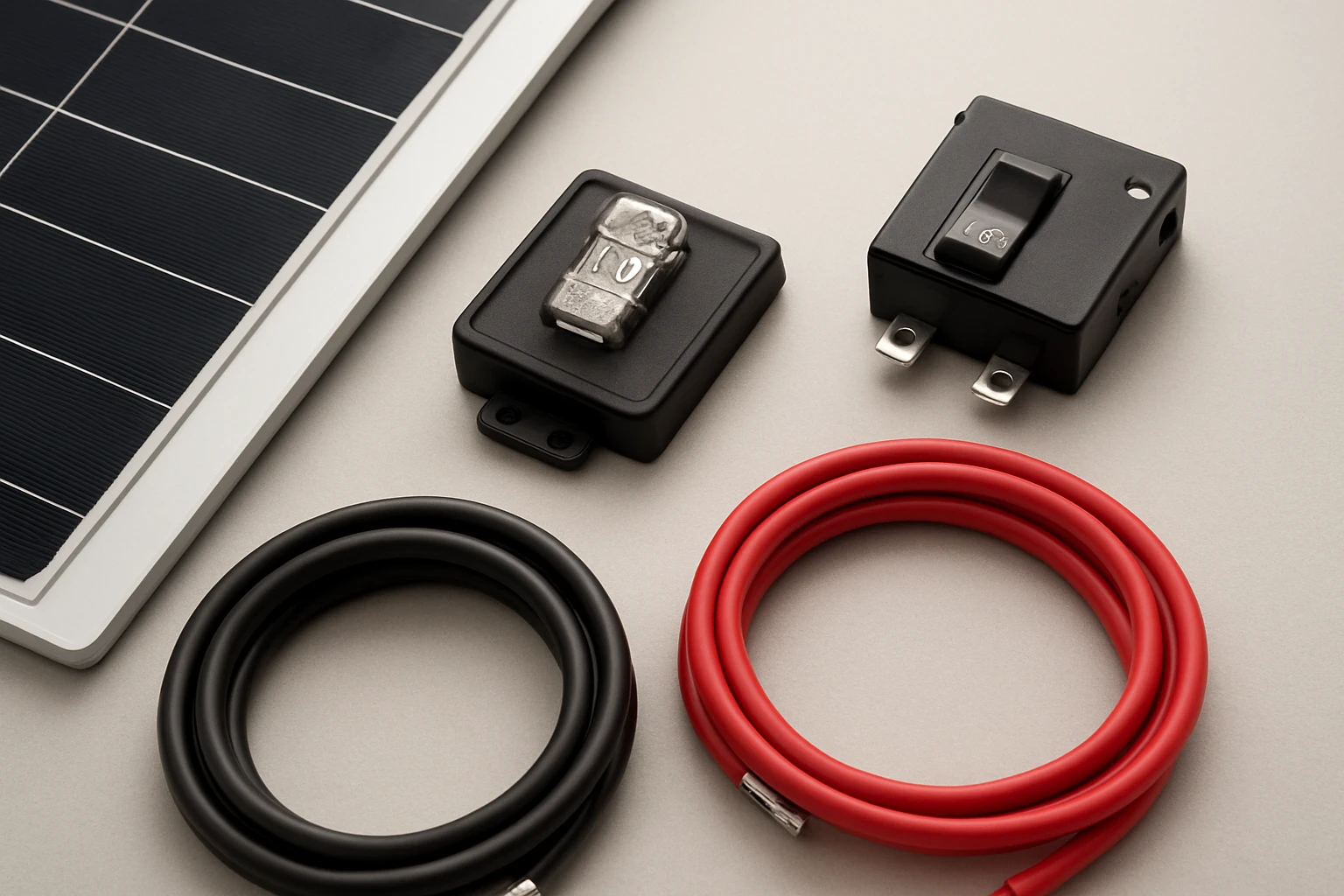
Portable solar installations provide flexible power for RVs, campers, and off‑grid projects, but they require careful electrical design to remain safe and efficient. This guide will teach the reader how to calculate the correct fuse, breaker, and cable sizes for a typical portable solar array. By following the step‑by‑step instructions, one can avoid overheating, voltage drop, and costly component failures. The information presented is valuable for hobbyists and semi‑professional installers who want reliable performance without excessive expense.
What You'll Need
- Solar panels and charge controller (specified by manufacturer)
- Battery bank appropriate for the system voltage
- Measuring tools: multimeter, clamp meter, and wire gauge ruler
- Installation accessories such as cable glands, fuse holders, and breakers
- Protective equipment: insulated gloves and safety glasses
For the accessories, the following Amazon products have proven useful and are linked at their first mention.
Step 1: Determine Power Requirements
The first task is to establish the maximum current that the solar array will deliver to the charge controller. Multiply the total wattage of the panels by the panel voltage, then divide by the system voltage to obtain the expected amperage (I = P/V). For example, a 300 W panel at 12 V yields 25 A, while the same panel at 24 V yields 12.5 A. It is essential to add a safety margin of at least 25 percent to accommodate temperature variations and potential shading.
Once the peak current is known, the designer can select a charge controller that can handle that current continuously. Most MPPT controllers list a maximum input current; the chosen controller should exceed the calculated value by the safety margin. This step ensures that the controller will not become a bottleneck or overheat during peak sunlight.
Step 2: Calculate Cable Size
Cable sizing is driven by two primary factors: allowable voltage drop and the ampacity rating of the conductor. A common design goal is to keep voltage drop below 3 percent for the longest run, which can be calculated using the formula V_drop = 2 × I × L × R, where L is the one‑way length and R is the resistance per foot of the chosen gauge.
After determining the required gauge, the installer must protect the cable entry points from moisture and mechanical stress. The Link Solar Double Cable Entry Gland is an ideal solution for sealing cables on RV roofs, boats, and portable enclosures. It accommodates 2 mm² to 6 mm² conductors, is rated PG7 for waterproof performance, and includes two rubber seals for a tight fit. Priced at $9.89 with a 4.7‑star rating from over 2,400 reviews, it offers reliable protection without the need for custom machining.
When installing the gland, apply a compatible sealant such as Sikaflex 221 or stainless‑steel self‑tapping screws to ensure a watertight seal. The gland’s ABS housing is lightweight, making it suitable for mobile applications where weight savings matter. Properly sealed cables prevent corrosion, which can otherwise increase resistance and lead to premature failure.
Step 3: Select the Appropriate Fuse
Fuses protect the wiring and downstream equipment by opening the circuit when current exceeds a safe threshold. The fuse rating should be 125‑150 percent of the calculated maximum continuous current, as recommended by most solar standards. For a system delivering 25 A, a 30 A fuse would be appropriate, while a 12 A system could use a 15 A fuse.
For portable installations, the IGEYAPA 15A Solar Fuse Holder provides a compact, IP67‑rated solution that can be easily swapped in the field. Each holder includes a 15 A, 1000 V inline fuse, tinned copper terminals with less than 0.5 mΩ resistance, and a silicone O‑ring for water resistance. Priced at $27.99 and carrying a 3.8‑star rating from four reviews, it offers a balance of safety and convenience for moderate‑size arrays.
If the system requires a higher rating, the Solar Super Sonic PV Fuse Holder 25A delivers a 25 A, 1000 V fuse with UL94‑V0 flame‑retardant certification. Its IP68 rating, tool‑free connector design, and rapid installation (under eight seconds) make it ideal for high‑current connections. At $11.99 with a 4.6‑star rating from 39 reviewers, it provides excellent value for larger portable setups.
Step 4: Choose the Correct Breaker
Breakers serve as resettable protection devices and are especially useful when the system may need frequent maintenance. Select a breaker rated at or slightly above the fuse rating to avoid nuisance trips. For a 30 A fuse, a 35 A DC breaker with a low trip curve is recommended.
When installing a breaker, mount it in a location that remains accessible yet protected from direct sunlight, as excessive heat can lower the trip threshold. Use heat‑shrink tubing or a small enclosure to shield the breaker from splashes or dust. Verify that the breaker’s voltage rating matches the system (e.g., 12 V or 24 V DC) to ensure proper coordination.
Step 5: Install and Verify the System
Begin by routing the cables from the solar panels to the charge controller, passing through the sealed cable gland installed in Step 2. Connect the fuse holder as close to the charge controller input as possible to protect the controller from over‑current events. Then, install the breaker downstream of the fuse, feeding the battery bank.
After all connections are made, double‑check polarity, torque specifications, and the integrity of seals. Power up the system and use a multimeter to verify that the voltage at the controller input matches the expected panel voltage under load. Finally, perform a short‑circuit test on the fuse holder (using a purpose‑built test load) to confirm that the fuse opens as designed.
Tips & Pro Tips
- Always use tinned copper conductors; they resist oxidation and maintain low resistance over time.
- When sealing a cable gland on a metal roof, add two small stainless‑steel screws as recommended by users to prevent the gland from lifting under heat.
- Label each fuse and breaker with its rating; clear labeling speeds up troubleshooting and future upgrades.
- Consider using a voltage‑drop calculator app to quickly verify gauge selections for different run lengths.
Troubleshooting
Problem: Fuse trips immediately after connection.
Solution: Verify that the cable gauge matches the calculated ampacity and that no short circuits exist at the panel connectors.
Problem: Voltage at the charge controller is significantly lower than panel voltage.
Solution: Measure resistance of the cable run; excessive resistance indicates undersized conductors or poor connections, requiring larger gauge or additional terminals.
Problem: Breaker trips under normal load.
Solution: Ensure the breaker rating exceeds the fuse rating and that ambient temperature does not exceed the breaker’s derating curve.
Conclusion
Correctly sizing fuses, breakers, and cables is essential for safe, efficient portable solar installations. By calculating power requirements, selecting appropriate conductors, sealing cable entries, and installing reliable protection devices, one can achieve a robust system that lasts for years. The recommended products—Link Solar Double Cable Entry Gland, IGEYAPA 15A Solar Fuse Holder, and Solar Super Sonic PV Fuse Holder 25A—provide practical, cost‑effective tools to meet these design goals. Apply the steps and tips outlined in this guide, and enjoy dependable solar power wherever the journey leads.
Products Mentioned in This Guide
Frequently Asked Questions
How do I calculate the correct fuse size for a portable solar array?
First determine the maximum current from the solar panels and then select a fuse rated at 125% of that current to allow safe overload protection.
What breaker rating should I use for a 12 V portable solar system?
Choose a breaker that matches or slightly exceeds the calculated maximum current, typically the next standard size up (e.g., 15 A for a 12 V system drawing up to 12 A).
How can I prevent voltage drop in portable solar cabling?
Use cable gauge that keeps voltage drop under 3% at the longest run, referring to AWG tables based on current and length.
What wire gauge is recommended for a 30 A solar charge controller?
For short runs (up to 5 ft) use 10 AWG; for longer runs (10‑15 ft) upgrade to 8 AWG to maintain low resistance.
Why are fuse holders and cable glands important in portable solar setups?
They provide secure, weather‑tight connections and protect the wiring from mechanical stress and accidental short circuits.