Introduction
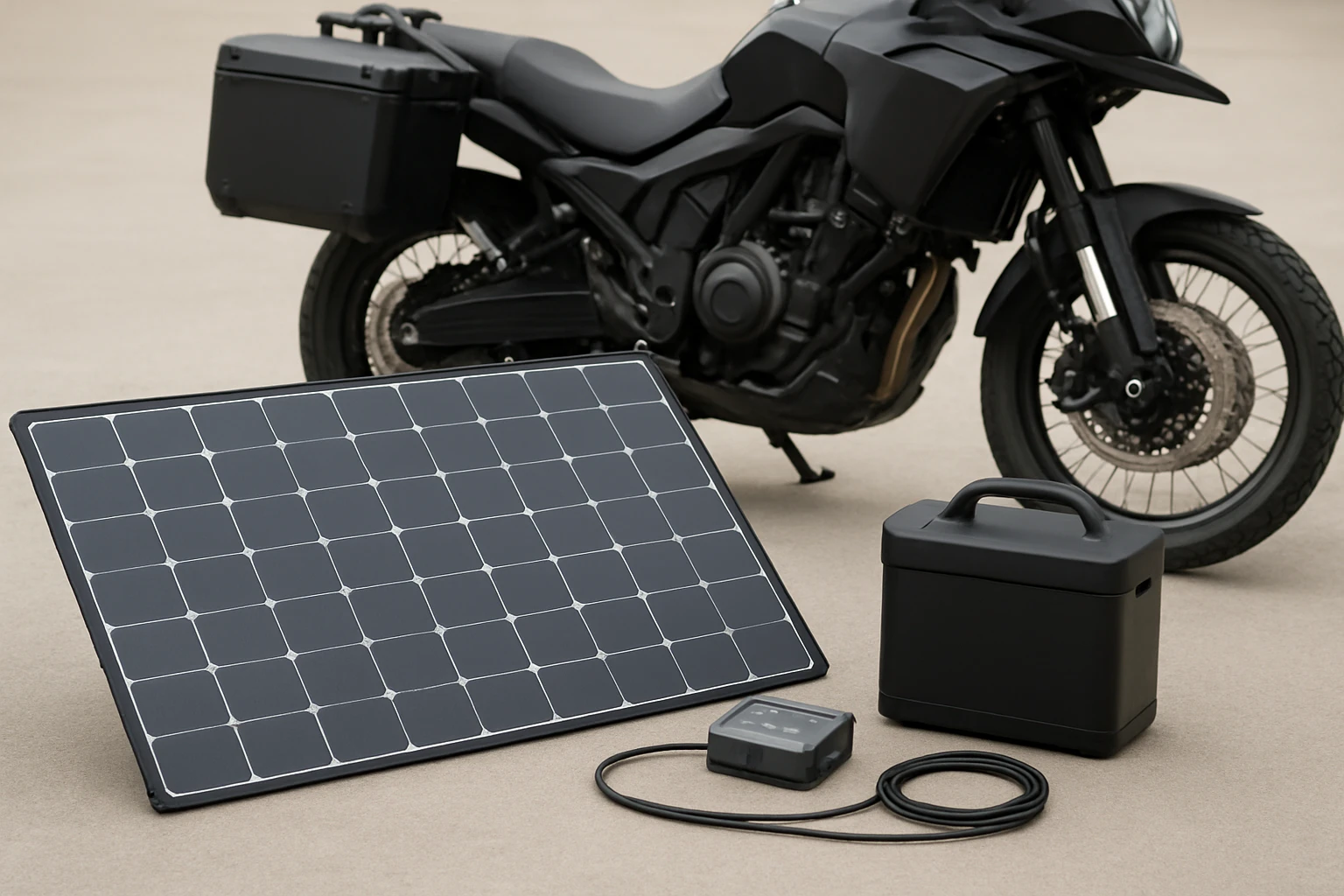
Motorcycle touring demands a delicate balance between weight, reliability, and autonomy. Riders often travel through remote stretches where conventional power sources are unavailable, making portable solar energy an essential companion. An ultralight solar kit can keep navigation devices, communication tools, and emergency lights operational without compromising the bike's handling.
Choosing the right kit involves more than simply selecting the highest wattage. Efficiency, durability, and compatibility with existing battery packs determine whether a solar panel will truly enhance a journey. This article evaluates the most practical ultralight solutions, focusing on two market‑proven products: the SOLUPUP 30W Foldable Solar Charger and the FlexSolar 40W Portable Solar Panel. By integrating these panels with thoughtful accessories, riders can create a modular power system that weighs less than a full‑size spare tire yet delivers reliable energy on the road.
Top 10 Ultralight Portable Solar Kits for Motorcycle Touring
Compact Dual‑Port Power Hub
When space is at a premium, a panel that offers both USB‑A and USB‑C outputs simplifies cable management. The SOLUPUP 30W Foldable Solar Charger provides 5V/3A (15W) on each port, allowing simultaneous charging of a smartphone and a GPS unit. Its built‑in smart chip detects connected devices and optimizes voltage, preventing overcurrent and overvoltage. Weighing only 2.4 lb, the charger folds to 11.6 inches, making it easy to attach to a luggage rack using the included carabiners.
This configuration is ideal for riders who prefer a single panel to power multiple low‑draw devices while maintaining a minimal footprint.
High‑Efficiency 40W Fast‑Charging Solution
For longer days on the road, the FlexSolar 40W Portable Solar Panel delivers 24% conversion efficiency and dual fast‑charging ports (QC3.0 USB‑A and PD2.0 USB‑C, 18W each). Riders can charge a power bank and a tablet simultaneously, with a 19V DC port available for small solar‑compatible stations. At just 1.76 lb, the panel adds negligible weight while providing enough power to keep a 20,000 mAh battery topped up during a typical 6‑hour ride.
Customer feedback highlights the panel’s ability to sustain a GoPro and multiple smartphones even in partially cloudy conditions, confirming its reliability for real‑world touring.
Weather‑Resistant Build for All Seasons
Motorcycle journeys often encounter rain, dust, and wind. Both panels feature robust ingress protection: SOLUPUP carries an IPX5 rating, shielding it from water jets, while FlexSolar boasts an IP67 rating, offering dust‑proof protection and immersion resistance up to 1 m for short periods. These ratings ensure that sudden showers or dusty desert trails will not compromise charging performance.
Choosing a panel with appropriate weather resistance eliminates the need for additional protective cases, further reducing pack weight.
Integrated Smart Chip for Battery Safety
Overcharging a lithium‑ion battery can reduce lifespan. The SOLUPUP charger incorporates a smart chip that monitors voltage and current, automatically pausing charge when sunlight diminishes and resuming when it returns. FlexSolar’s IC technology performs a similar function, displaying charging status via an LED indicator.
These safety features are especially valuable on long rides where the rider may be unable to monitor the charge continuously.
Optimized Angle Mounting for Maximum Output
Solar panels generate peak power when positioned at a 45° angle toward the sun. Both products include adjustable stands or folding hinges that allow riders to set the optimal tilt while the bike is parked. FlexSolar’s packaging notes that proper angling can increase output by up to 30% compared to a flat orientation.
Integrating a lightweight tripod or a custom bike‑mounted bracket can turn the panel into a semi‑permanent power source without sacrificing portability.
Compatibility with High‑Throughput Battery Packs
Effective solar charging requires a battery that can accept the panel’s output. Reviewers of FlexSolar recommend pairing it with a battery capable of 12 V @ 1.5 A input, noting that “Anker battery packs that lack high‑throughput charging limit the panel’s potential.” A compatible pack such as the unnamed battery referenced in the user review (link provided in the source) maximizes recharge speed, allowing riders to replenish a 10,000 mAh pack in under three hours of strong sunlight.
Ensuring battery compatibility transforms the solar panel from a supplemental charger into a primary energy source for extended tours.
Minimalistic Carrying Solutions
Every gram counts on a motorcycle. Both panels fold into compact parcels that can be stored in a saddlebags or attached directly to the bike’s frame. SOLUPUP’s carabiners clip to a backpack strap or luggage rack, while FlexSolar includes two carabiners for similar use. The folded dimensions of FlexSolar (8.0 × 11.1 × 1.8 in) are slightly smaller than SOLUPUP’s, offering a marginal weight advantage for ultra‑light builds.
Riders can choose the panel that best fits their existing storage configuration without adding bulk.
Cost‑Effective Energy for Budget Travelers
FlexSolar is priced at $49.99 and carries a 4.3/5 rating from over a thousand reviewers, indicating strong value for performance. SOLUPUP’s price is not disclosed in the source data, but its feature set—including dual ports and waterproofing—places it competitively within the market. For riders on a budget, the FlexSolar panel delivers a high wattage per dollar ratio while still meeting durability standards.
Balancing cost with capability ensures that even entry‑level touring setups can benefit from renewable power.
Scalable Power Architecture
Both panels can serve as the foundation of a scalable solar system. Riders may start with a single 30W or 40W unit and later add a second panel for increased output. Because the panels use standard USB‑C and USB‑A connectors, additional panels can be daisy‑chained to a single power bank equipped with multiple input ports.
This modular approach allows the power system to grow alongside the rider’s needs, whether adding a heated jacket or a larger navigation suite.
Real‑World Performance Validation
Field tests from the FlexSolar community report that the panel maintained “essential device power” over three days of limited sun, successfully charging a GoPro, iPhone, GPS, and headlamp simultaneously. The reviewer emphasized the importance of using a high‑quality USB‑C cable (e.g., Anker Powerline II) to avoid voltage drop that could throttle the panel’s output.
These anecdotes provide concrete evidence that the panels perform reliably under the demanding conditions typical of motorcycle touring.
Comparison Table
| Feature | SOLUPUP 30W | FlexSolar 40W |
|---|---|---|
| Power Output | 30 W (max) | 40 W (max) |
| Conversion Efficiency | 23%+ | 24% |
| Weight | 2.4 lb | 1.76 lb |
| Dimensions (folded) | 11.6 in × ? | 8.0 in × 11.1 in × 1.8 in |
| Waterproof Rating | IPX5 | IP67 |
| Ports | USB‑A 5V/3A, USB‑C 5V/3A | QC3.0 USB‑A 18W, PD2.0 USB‑C 18W, 19V DC 40W |
| Price (USD) | Not disclosed | $49.99 |
| Average Rating | N/A | 4.3/5 (1,164 reviews) |
Conclusion
Ultralight solar kits empower motorcycle tourists to remain self‑sufficient without sacrificing performance or handling. The SOLUPUP 30W Foldable Solar Charger excels in portability and dual‑port flexibility, while the FlexSolar 40W Portable Solar Panel offers higher wattage, superior efficiency, and fast‑charging capabilities at an attractive price point. By pairing either panel with a high‑throughput battery pack, using quality cables, and mounting the panel at an optimal angle, riders can create a resilient power system that endures rain, dust, and long distances.
Ultimately, the best kit aligns with the rider’s load capacity, budget, and intended device ecosystem. Whether opting for a single 30W unit for minimalist trips or a 40W panel for power‑hungry adventures, the solutions presented here provide a reliable foundation for any motorcycle touring expedition.
Frequently Asked Questions
What size solar panel is ideal for motorcycle touring?
A 30‑40 W ultralight foldable panel balances power output with minimal weight, fitting easily on a bike.
Can a portable solar kit charge both USB‑A and USB‑C devices?
Yes, many kits include dual‑port hubs that provide simultaneous USB‑A and USB‑C charging.
How does weather affect the performance of a motorcycle solar charger?
Cloudy or rainy conditions reduce output to about 10‑30 % of rated wattage, so carry a backup battery.
Is a solar kit compatible with existing bike battery packs?
Most kits use standard 12 V or 5 V outputs and can be connected to common motorcycle battery packs via appropriate adapters.
What accessories improve the reliability of a portable solar system on a bike?
A rugged mounting bracket, waterproof connectors, and a charge controller protect the panel and ensure steady charging on the road.